
Posted in BOCC, St. Johns County

Update on the May 2 St. Johns County Board of County Commissioner’s Meeting

Surprises on the Agenda!

The first and second regular agenda items for May 2 were the 2nd Reading of the Workforce Housing Ordinance modifications. In a big surprise to many in the audience, Commissioner Joseph raised a concern about the Ordinance being on the Agenda May 2 because of changes that had occurred since the 1st Reading. Specifically, she was concerned that the passage of the Live Local Act had impacts on the ordinance and those changes should be considered before the Ordinance is heard. Commissioner Dean also raised concerns about the reading of the Ordinance. He indicated a need for time periods on when workforce housing could be “flipped.” An additional point of concern for Commissioner Dean was a definition of what is “affordable.” After discussion, Commissioner Joseph made a motion that the Workforce Housing Ordinance be delayed to the first Meeting in June (June 6) to give the County time to assess the changes that may be needed in alignment with the Florida Live Local Act.


Agenda Item 3 was the reading and approval of the Pedestrian and Vehicle Safety within Public Road and Rights of Way Ordinance. This ordinance prohibits car to pedestrian interactions on designated road rights of way and is applicable in unincorporated St. Johns County. The ordinance prohibits stopping, sitting, standing, or otherwise occupying or remaining in a median on a designated roadway when that person is not trying to lawfully cross the road. The Ordinance was approved 5-0.


The County announced the results of the 18 month Brand Development activity. Many of us had participated in the survey so long ago we may have forgotten about it! This brand was created by a local company, using the input of the County and the community research that included the survey respondents. Highlighting the waterways, natural resource, county history and outdoor activities, there is also a tagline of “Florida at First Sight.” We will soon be seeing the new branding on county materials, vehicles, etc.

County Administrator Hunter Conrad shared some of the funding for county projects that was included in the state budget that has passed and is awaiting Governor DeSantis’ signature. Included in the budget is:

  • $6 Million for State Road 210 interchange improvements
  • $6 Million for the 210 Interchange and railroad modification
  • $15 Million for 4 lanes on 2209 from International Golf Parkway north
  • $25 Million for the Ponte Vedra Beach restoration
  • $5 Million for Summerhaven relief
  • $2 Million for the Pine Island intersection improvements
  • $3 Million for the West Augustine Medical Center
  • $3 Million for Home Again to address Homeless Veteran’s concerns.

The County Attorney, David Migut, raised a concern about the on-going negations with the Twin Creeks Development Association to widen County Road 210, just east of I-95, from 2 lanes to 4 lanes. This was a condition of their Development Agreement and has not been completed.  Mr. Migut requested and received approval from the Commissioners to proceed with filing suit against Twin Creeks Development Association if they are not able to successfully negotiate an agreement.


If you are finding value in these updates, please subscribe to my blog so you get notifications when I publish an update. Feel free to share with others who may find value in the content.
Posted in BOCC, Essential Worker Housing, St. Johns County

What’s Happening at the May 2 St. Johns County Board of County Commissioner’s Meeting

The May 2 Board of County Commissioners Agenda is short with only 5 items on the Agenda. As always, meetings are at the County Auditorium at 9:00 AM, 500 San Sebastian View, St. Augustine.


Agenda items 1 & 2 are the Adoption Hearing and Second reading of the Workforce Housing Comprehensive Plan Amendment and Land Development Ordinance updates that were proposed by the Northeast Florida Builder’s Association in 2022.

These changes would raise the price of affordable housing under the ordinance to $260,000 from the previous starting price of $240,000 and lower the percentage of homes required to be built from 40% to 30%.

Other modifications in the ordinance include:

  • Adding rental regulations for Workforce Housing including establishing a maximum rental rate and specifying a related time-limit for such rate
  • Increasing site development standard incentives for Workforce Housing such as decreased lot size
  • Increasing the timeline for Workforce Housing construction commencement by an additional year
  • Updating LDC Table 6.01 Schedule of Area, Height, Bulk and Placement Standards to reflect related changes
  • Amending the definition of Workforce Housing

The full ordinance can be read at this link: Agenda Items 1 & 2

What is not known at this time is how the recently signed Florida Senate Bill 102, known as the “Live Local Act,” will impact this ordinance.

Read on to understand more about the Workforce Housing Ordinance.


Two important elements to understand about the ordinance are the intended demographic and the pricing structure.

Definitions of Workforce Housing

The definitions of workforce housing included this ordinance are:

Sec. 5.11.03 Definitions

Workforce Housing is the missing Workforce housing in St. Johns County capable of being purchased or rented by a household within the upper “low” to lower “moderate” income categories (as defined by the Federal Housing Authority).

What does this mean?

What is the upper “low” to lower “moderate” income categories for St. Johns County? For the purposes of the Federal Housing Authority, St. Johns County is considered part of the Jacksonville Metropolitan Statistical Area.

Moderate Income in the Jacksonville MSA is at or below 120% of the Median Income for the MSA. The Median Income for a family of 4 in the Jacksonville MSA is $86,500. 120% of that would be $103,800. So Workforce Housing is intended for those households making $103,800 or less.

Pricing

The Initial Sales Price for Workforce Housing is $260,000. Included in the definitions section of the ordinance being presented are price adjustments. The wording is included here (highlights for emphasis):

Maximum Initial Sales Price for Workforce Housing offered for sale is $260,000. The base maximum sales price shall be adjusted by the Annual Average Construction Cost Index as published by the Engineering News-Record in June of each calendar year, not to exceed a three (3) percent increase/decrease. Beginning in 2022, any adjustments to the Maximum Initial Sales Price for Workforce Housing shall be effective on July 1 of each calendar year thereafter.

Adjustments to the Maximum Initial Sales Price will always be calculated using the base price of $260,000. The Maximum Initial Sales Price, as calculated above, will be increased by the amount of any credits, contributions or costs paid by seller on behalf of the initial buyer for qualified costs. Qualified costs include interest rate buydowns, mortgage origination charges or fees, processing fees, appraisal fees, survey charges, recording fees, Florida deed stamps, Florida intangible taxes, Florida mortgage stamps, prepayments for buyer’s escrow account items including homeowner’s insurance, mortgage insurance, and property taxes, prepaid solid waste fees, title insurance including endorsements, costs or contributions associated with down payment assistance programs, closing settlement charges, homeowners association charges or contributions, upfront mortgage insurance and discount points but not including real estate commissions. The resulting price will be the Adjusted Maximum Initial Sales Price. The Maximum Rental Rate shall be no more than 10% higher than the rent limits, not inclusive of utilities, established annually by the State of Florida SHIP program for the 80% of Average Median Income category. The Maximum Rental Rate shall be adjusted annually when the new limits are established by the State.

What does this mean?

This means the $260,000 starting price is just that, a starting price, and will be adjusted every year. And, if the seller provides any buyer assistance, that can be added to the price of the house. Translation, the mortgage is not going to be a $260,000 mortgage but potentially much higher.


Agenda Item 3 is the 2nd reading of the Ordinance for Pedestrian and Vehicle Safety within Public Roads and Rights of Way.

The full presentation can be found here: Safety Ordinance


Agenda Item 4 is the presentation of the St. Johns County Brand Development Project. Many of us participated in a survey many months ago about the rebranding project. Tera Meeks, Director of Tourism and Cultural Development will present the county logo and branding elements that were developed as a result of the project.


The last item on the agenda Tuesday is a time certain meeting at 1:00 to announce a private Attorney Client related to settlement negotiations with an on-going lawsuit.


If you are finding value in these updates, please subscribe to my blog so you get notifications when I publish an update. Feel free to share with others who may find value in the content.

Posted in Affordable Housing, BOCC, Essential Worker Housing, St. Johns County

St. Johns County April 18 Board of County Commissioner’s Meeting

What’s on the Agenda for the April 18 St. Johns County Board of County Commissioner’s Meeting?

A key theme for Tuesday’s meeting is addressing Affordable Housing in St. Johns County. That term can have a negative connotation to some of our residents. Considering the median price of a home in St. Johns County last month was $555,000, and the median income in St. Johns County is $110,000; it really means providing housing for people who can’t afford the median priced home but provide many of our daily services that contribute to our quality of life in St. Johns County.


After the usual opening activities, the Commissioners will approve the Consent Agenda.

The Consent Agenda for Tuesday includes an important item for Affordable Housing in St. Johns County. One of the impediments for building affordable housing in the County is the high Impact Fees charged to builders. A request had been made to utilize State Housing Initiative (SHIP) grant funds to assist in lowering the cost of the Impact fees non-profit developers who are building homes for the low and very-low income population. This would affect ONLY homes under $260,000.

Read more about the proposed amendment here: Consent Agenda Item 20

Moving on to the Regular Agenda, Public Comment will be heard at Time Certain of 11:30.


Regular Agenda:

Puerta Del Sol

On the Regular Agenda Tuesday is a Public Hearing for Puerta Del Sol in District 3 on State Road 206 near US 1. This could be a lengthy presentation and discussion based on the presentation at the Planning and Zoning Agency March 2. The PZA decision was a “technical denial” as it was tied, 3-3.

Anticipate this topic will take up the morning session, up to Public Comment and a lunch recess.

There are two requests for Puerta Del Sol. The first is for a Comprehensive Plan Amendment to change the Land Use change from Residential B to Residential C and the second is the creation of a Planned Unit Development (PUD). The PUD would include a single-family home, 137 townhome units, and 25,000 square feet of commercial use.

At the PZA presentation, there was much public comment from nearby residents who do not want more development in their area. Some were ok with more development if it wasn’t townhomes because they don’t want lower income homes nearby. Other residents were in favor because of the need for diverse housing options such as townhomes. Another recommendation in favor was the concern if housing does not get built in this space, commercial will one day fill the space and housing is preferable to adding commercial to 206.

Read more about the PUD here: Puerta Del Sol PUD

Live Local Act

Continuing the theme of Affordable Housing, Item 5 on the Agenda is a workshop discussion to be led by one of the County Attorneys, Christine Valliere and Assistant Administrator Joy Andrews.

Senate Bill 102, The Live Local Act, was recently passed by the Florida Legislature and quickly signed into law by Governor DeSantis. This legislation is intended to incentivize developers and builders to provide more affordable housing across the State of Florida and in many instances preempts local jurisdictions local ordinances.

Some important elements include:

  • Preempts local authorization of multi-family and mixed-use residential rental developments in any area zoned commercial, industrial, or mixed use with an affordable housing component.
  • 40% of the units must be affordable for at least 30 years; 65% of the total square footage must be residential in mixed-use projects.
  • Density and height restrictions are based on maximum limits of jurisdiction and nearby developments.
  • Local government cannot require a development authorized under this preemption to obtain a land use/zoning change, special use approval or variance for use, density, or height. No public hearing process allowed.

Read more about Tuesday’s presentation here: Live Local Act – Workshop


The full agenda for Tuesday can be found here: BOCC Agenda

I’ll provide a summary of the meeting later in the week.


If you are finding value in these updates, please subscribe to my blog so you get notifications when I publish an update. Feel free to share with others who may find value in the content.

Posted in BOCC, Essential Worker Housing, PZA, St. Johns County

Summary of the April 6 St. Johns County Planning and Zoning Agency Meeting

Two impactful items on the agenda

The April 6 Planning and Zoning Agency (PZA) meeting had 2 items of great impact to St. Johns County and a handful of smaller items.


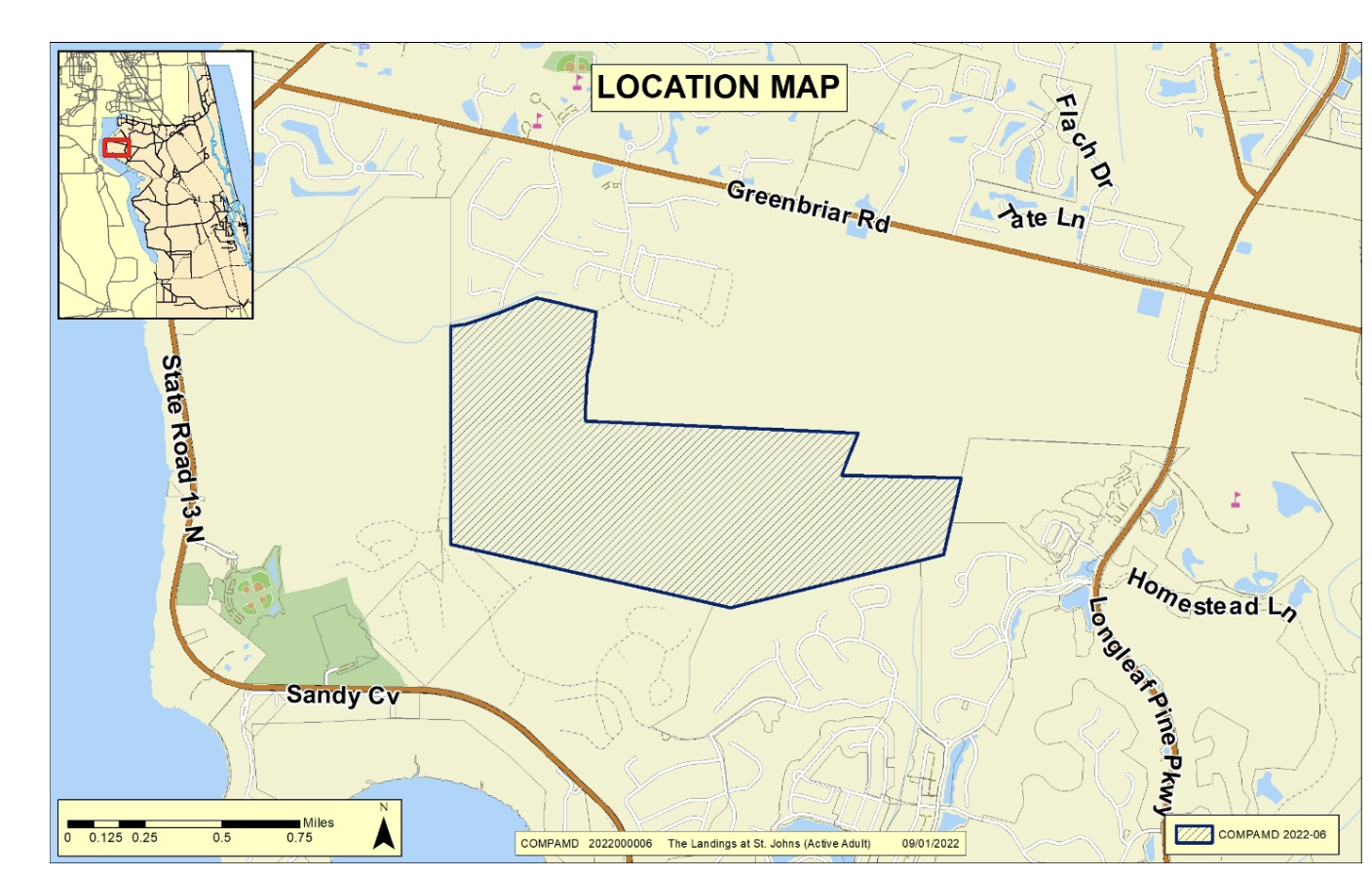
Agenda Item 1 was The Landings at St. Johns, an Active Adult community.

This item is of great interest to those in the Northwest Sector, District 1.

The applicant for this project is Pulte. At the beginning of the presentation, Chair Matovina wanted to emphasize this is a Comprehensive Plan Amendment and NOT a PUD hearing. He stated that the PUD will be heard at a later date.

The presentation was from Ellen Avery-Smith, representing the applicant. While the application on Thursday was only for one community, Ms. Avery-Smith provided an overview of the entire project for this area.

There are four applications proposed:

The Landings at Greenbriar

  • Small Scale Comprehensive Plan Amendment
    • Planned Unit Development

The Landings at St. Johns

  • Large Scale Comprehensive Plan Amendment
    • Planned Unit Development – Active Adult

Because the Landings at Greenbriar is a Small Scale Plan Amendment, it only requires 2 hearings, not the 4 required for a Large Scale Amendment. Thursday’s presentation was ONLY for the Large Scale Plan Amendment for The Landings at St. Johns.

This property is surrounded by land that is zoned Residential B and Rural/Silviculture. Ms. Avery-Smith walked through the rationale for why legally, this project would not be considered Urban Sprawl so the development boundaries can be extended. This is important for the legal aspects of approval of this project.

The project includes:

  • The Landings at St. Johns – 761 Active Adult Homes
  • The Landings at Greenbriar – 588 Single Family Homes
  • Open Space Preservation – 49% Open Space and Recreation, 302.8 Acres of Wetland Preservation, 146 Acres of Upland Preservation and 28.6 Acres of parks

What was under review for Thursday was the Active Adult Community only. This is housing for 55-years of age and older. There can be no one under the age of 19 years old occupying the home. This importantly provides for no impact on the school system while still providing ad valorem school tax revenue.

Additional benefits noted are reduced roadway traffic and amenity programming on-site that reduces need for external trips. Also noted was no impact on the local recreation programs such as sports teams.

It was pointed out in the presentation that this property was previously the Switzerland Air Field, used by the US Navy. The site plan was developed using the pathways utilized by the airplanes thus creating a compact and orderly plan.

There have been 2 community meetings conducted for this project. As is a common theme, resident concerns are around transportation and schools.

The Active/Funded transportation projects noted that impact this development are:

  • CR 210 four lane from Cimarrone to 210 West – Under construction
  • Longleaf Pine Parkway four lane – plans are complete. Greenbriar Helow has contributed up front money and construction should be completed in 2 years
  • Veterans Parkway connection to CR 210 – Should be completed end of 2023 or first quarter of 2024
  • Greenbriar Road widening to Greenbriar Estates – Greenbriar Helow project will pay for this widening
  • Shearwater Parkway to 16A – still to be built
  • First Coast Expressway – Under construction – completed by 2030; will have an entrance ramp at Longleaf Pine Pkwy

Proposed Improvements to be paid for by this project:

  • Greenbriar Road and Longleaf Pine Parkway Intersection
  • Switzerland Point Middle and Hickory Creek Elementary Turn Lanes
  • Bartram Trail High School Lanes

The lanes at the schools are intended to improve traffic flow. The School Board will need to approve these proposals.

The age-restricted development, while not generating additional load to the schools will generate $10.4 Million in proportionate share payments with .9M going to School Access improvements and $1M in Annual local Ad Valorem Tax.

During Public Comment, Christine Mullis spoke representing the Greenbriar Road Preservation Group. She referenced materials that had been submitted to the PZA about why this should not be approved. Items mentioned included lack of adequate infrastructure, the Greenbriar Road traffic analysis, and the Lot Sizes that would be inconsistent with surrounding developments. Also included were concerns about protection of wetlands.

Al Abbatiello spoke of concerns about the impact on the Bartram Trail Scenic Highway. He emphasized that the Commission continually approves these amendments and the county still does not have a Strategic Plan in place. He shared concerns about the added traffic and that projected plans are not going to solve the current issues in District 1. He would like to see the PZA reject the transmittal of the proposal.

Concerns were raised by some residents about the impact on schools. The applicant during rebuttal commented that this application is for the Active Adult community that has no impact on school populations.

After much more discussion with the applicant and the Agency, the motion passed 4:1.

This will now go to the County Commissioners for approval.


There were several smaller applications that did not generate as much discussion before the final item on the Agenda, the Adoption of a Workforce Housing Ordinance update that has been proposed by the Northeast Florida Builder’s Association.

Workforce Housing Ordinance

The two most impactful elements of the ordinance are to raise the initial sales price of Workforce Housing from $240,000 to $260,000 and reduce the % of required Workforce Housing from 40% to 30%.

This ordinance is another Amendment to the Comprehensive Plan for the County. The Adoption Hearing with the Commissioners is scheduled for May 2.

A representative from NEFBA shared a short presentation with the rationale for the changes. He compared the proposal to Sarasota and Martin counties, that are comparable to St. Johns in size and wealth. He also confirmed that if the builder pays qualified closing costs on behalf of buyers, it would add to the initial sales prices of the house.

Also shared was a chart showing a comparison to other counties and their Workforce Housing pricing. Putnam County was the lowest at $243,000 and Collier and Sarasota counties were the highest at $420,000.

The Ordinance was approved for adoption by the PZA 5:0.


If you are finding value in these updates, please subscribe to my blog so you get notifications when I publish an update. Feel free to share with others who may find value in the content.

Posted in BOCC, Growth & Development, St. Johns County

Highlights from the April 4 Board of County Commissioners Meeting

Great discussion and good information shared!

Opening Session:

The morning started with a moving tribute to John Patton, a resident of Orangedale, celebrating his 100th birthday! Mr. Patton served his country during World War II, earning 6 bronze stars.

Public Safety Update

During the Public Safety Update, Sheriff Hardwick shared that the increase in commercial businesses in the county has been accompanied by a 71% increase in thefts, largely in these commercial businesses. Sadly, the county has seen a 21% increase in overdoses with 156 non fatal and 30 fatal events events in the past year. The Sheriff urges people to take advantage of programs to help kick addiction. The SJSO publishes resources for people to find the help they need.

Interim Fire Rescue Chief Bullard shared information about how they are better tracking their non-emergency calls. Last month they ran 3238 total calls, 1505 of which were transports to the hospital.

Regular Agenda Items

An item of interest on the agenda was the First Reading of an Ordinance Relating to Pedestrian and Vehicle Safety within Public Road and Rights-of-Way. For background, in January, Commissioner Whitehurst raised a question about public safety in the County Rights of Ways. He referenced an ordinance that had recently been passed in Clay County and wondered if St. Johns County could do the same. The Board directed staff to prepare an ordinance for consideration in St. Johns County.

During the presentation it was noted that Florida has been rated as the second highest in the nation in terms of pedestrian deaths. Statistics for St. Johns County show 60 vehicle/pedestrian crashes in 2020 with 4 fatalities, 88 crashes in 2021 with 9 fatalities and in 2022, 86 crashes with 7 fatalities.

The focus of this ordinance is to address safety hazards with interaction between pedestrians and vehicles in medians and near travel lanes and in vehicle-to-vehicle interactions while in travel lanes.

This ordinance would apply to unincorporated St. Johns County. “Designated Roadways” are interstate/intrastate, arterials, collectors, and the first 440 feet of a local road intersecting with those road types. Includes the media and 4 feet outside the shoulder or curb.

The focus is conduct, not speech or people holding signs.

Specific prohibitions include:

“engaging in any physical interaction between a pedestrian and an occupant of a motor vehicle, including the transfer of any product, material or monies, while the motor vehicle is located on the traveled portion of the designated roadway and is not legally parked”

“Stopping, sitting, standing, or otherwise occupying or remaining in a median on a designated roadway by a person when that person is not in the process of lawfully crossing the road in accordance with applicable traffic and safety laws, regulations and ordinances.”

They county performed comparison with neighboring Jacksonville City and Clay County ordinances and did not include some of the items in those ordinances that could have potential challenges in enforcement.

Questions were asked and satisfactorily answered about the impact on campaigning on the median or roadways. Again, the focus is on public safety, not prohibiting free speech.

The detailed presentation can be found here: Agenda Item 4

Public Comment:

During public comment there were again a large number of residents from Marsh Landing raising concerns about the Storm Water Management System in their community and the on-going litigation. It is a difficult situation as the County is trying to assist residents but ultimately have little control over the Storm Water Management System as it is under the purview of the St. Johns River Water Management District.

Commissioners Reports

During Commissioners reports, Commissioner Whitehurst as for assistance from Jesse Dunn, Director for the Office of Management and Budget to address some mis-information that has been shared in the county recently. There have been statements made in public forums that the County has $130 Million in impact fees that could be spent on roads, and the county is not spending the money appropriately.

Commissioner Whitehurst asked Mr. Dunn to share information about how Impact Fees are collected and how budget reserves are managed.

Mr. Dunn explained that yes, there is about $135 Million in collective impact fees that have been collected. There are 11 categories for Impact Fees. Currently, there are about $40 Million that remain in reserves. $95 Million has been allocated to projects. Mr. Dunn described the procurement process that could take 25 months to spend the money on the projects as the county goes through the process of awarding the contracts and initiating construction.

Just as in corporate budgets, the county must place that money in reserves for those projects until such time as the contracts are awarded and the money is paid out over the life of the contract and construction.

The concern from the Commissioners is that the accrual of money in reserves is being misrepresented and that residents may be hearing information that is misleading.

For those who enjoy digging into the numbers for themselves, the County budget can be found at this link:

2023 County Budget

This is a lengthy document – the Impact Fees Summary begins on Page 285.

If you enjoy these updates on the County Meetings, please subscribe to my blog and you’ll get the updates as soon as they are published. Feel free to share with other St. Johns County Residents who are interested.