
Posted in Ag Enclaves, BOCC, St. Johns County

Summary of Ag Enclave Certification Meeting

What really happened at the Ag Enclave Certification Meeting on Wednesday, August 19.

Spoiler: Thousands of homes were NOT approved


At its August 19 meeting, the St. Johns County Board of County Commissioners considered three applications for agricultural-enclave certification: Heritage Development East, Heritage Development West and N. Palm Valley Road.

The nearly four-hour hearing revealed substantial confusion about what certification does—and does not—approve.


What is most important was the clarification from Deputy County Attorney Kealey West about the Board’s task on Wednesday. It was a very narrow, quasi-judicial lane. Did each application meet the criteria established in SB 686 for an agricultural enclave? It was not a policy vote on whether the Commissioners liked the potential development. The commissioners had to base their decisions on the statutory criteria and the competent, substantial evidence in the record—including the application materials, staff’s review and evidence presented during the hearing.

Watch Ms. West’s explanation here: Commissioner Requirements for Today’s Agenda


At a high level, here was the meeting outcome:

ApplicationAcreageApplicant’s density positionResult
Heritage Development EastApproximately 615 acresStatutory maximum discussed as 13 units per acre; no development plan presentedCertified 3–2
Heritage Development WestApproximately 551 acresStatutory maximum discussed as 13 units per acre; no development plan presentedCertified 3–2
N. Palm Valley RoadApproximately 4,462 acresApplicant requested 1 unit per acreContinued to September 1

The two Heritage certifications passed 3-2, with Commissioners Joseph and Taylor voting no.

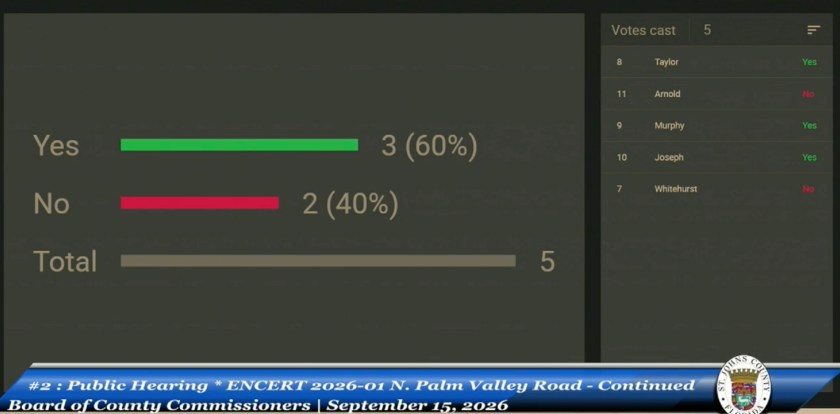
A motion to deny N. Palm Valley failed 2–3 with Commissioners Whitehurst, Murphy, and Arnold voting against denial.

Before a motion to approve was made, Chairman Murphy requested a continuance to allow staff to reexamine the boundary calculations, particularly the northern boundary. The continuance passed, 4–1 with Arnold being the no vote.


1. Heritage Development East

Applicant presentation

Background Materials

The applicant argued that the two parcels met every statutory criterion:

  • Approximately 615 acres, within unincorporated St. Johns County.
  • Owned or controlled by one entity.
  • Undeveloped as of January 1, 2025.
  • Used for timber production and classified as agricultural for at least ten years.
  • Surrounded by qualifying future land-use designations along more than the required percentage of the perimeter.
  • Within the County’s development area boundary.
  • Under the statutory acreage cap.
  • Located in a county with fewer than 1.75 million residents.
  • The applicant agreed to enter into a binding agreement to provide or pay for required public services.

The applicant said the certification could permit densities up to 13 units per acre based on surrounding land uses. However, counsel acknowledged that 13 single-family homes per acre was probably not a realistic product and said the actual density and development layout would not be known until a development plan was submitted.

Note the important statement there – until a development plan was submitted. A development plan must still be submitted even though the property was certified as an agricultural enclave.

Staff concluded that the application satisfied the agricultural-enclave definition.

Questions from commissioners

Commissioner Whitehurst focused on the distinction between the statutory maximum and actual development. He asked whether a single-family product could realistically achieve 13 units per acre. The applicant said he was unaware of such a product and that setbacks, wetlands and other land-development regulations would affect the final yield.

Commissioner Joseph questioned whether the property had previously been denied, what activity had occurred on the timber property during the previous five years, and whether people, trucks and logging operations were regularly present. The applicant could identify it as a timber operation but could not provide the date of the last harvest or replanting from the podium.

The statute requires the property to have been in continuous bona fide agricultural use for at least five years before the application. The applicant submitted historical aerial imagery showing continued timber use, and County staff independently verified that the property had received an agricultural classification and assessment from 2015 through 2025. Staff concluded that the application demonstrated compliance with the agricultural-use requirement.

Public comment

I normally do not include public comment in my reports. I’m sharing here the highlights because it is important to understand where there is confusion about the certification hearing and what comes next in the process.

Public comment focused primarily on infrastructure, maximum potential density, wetlands and the argument that the County Comprehensive Plan remained controlling. A second line of argument questioned whether agricultural classification and tax-parcel boundaries were sufficient evidence under the statute.

Applicant rebuttal and legal clarification

County Attorney West directly rejected the central Comprehensive Plan argument. She explained that the new law begins with “notwithstanding any other law” and creates a limited statutory preemption. For certification, the Board had to apply the agricultural-enclave criteria rather than the County Comprehensive Plan.

Watch her explanation here

The applicant also responded that:

  • Certification was only the first step.
  • Wetlands, environmental permitting, setbacks and other development regulations would still apply.
  • A future development plan would still be reviewed by County staff.
  • Public-services agreements were specifically allowed by the statute.
  • No public speaker had produced competent evidence contradicting the application’s acreage, ownership, perimeter calculations or agricultural classification.

Board discussion and vote

Commissioner Taylor moved to deny, citing unanswered questions about bona fide agricultural use. Commissioner Joseph seconded.

Commissioner Whitehurst asked what competent evidence had been presented showing that the property was not a bona fide timber operation. He noted that timber production does not require daily activity and questioned whether the proposed denial could be legally defended.

Commissioners Taylor and Joseph voted to deny despite staff findings of compliance and did not identify contrary evidence sufficient to persuade the majority.

The denial failed 2–3. A subsequent motion to certify passed 3–2.


2. Heritage Development West

Applicant Presentation

Background Materials

The second Heritage presentation was largely parallel to the first because it involved the same owner and statutory framework.

The applicant represented that:

  • The application covered three parcels totaling approximately 551 acres.
  • The parcels were undeveloped and under single ownership or control.
  • The land had been used for timber production and classified as agricultural.
  • More than 75% of the perimeter qualified under the applicable surrounding-development test.
  • The applicant offered to enter into agreements for required public services.
  • The property met the acreage and county-population limits.
  • County staff found that the application met the statutory definition.

As with Heritage East, the presentation discussed a maximum potential density of 13 units per acre calculated from surrounding land uses under the statute, but no development plan or actual unit count was presented.

Public comment

Public comment expanded during the West hearing.

Similar arguments were repeated during the Heritage West hearing, despite County counsel’s earlier explanation that SB 686 creates a limited preemption for the certification decision. Other comments addressed schools, agricultural documentation, parcel boundaries, traffic, wetlands and wildlife.

The agricultural-use evidence was substantially the same as for Heritage East: historical aerial imagery, a reported timber operation dating to 1956, and agricultural classification and assessment from 2015 through 2025. County staff independently reviewed the records and found that the application satisfied the statutory requirement.

Applicant rebuttal and staff response

The applicant emphasized that the property appraiser classifies agricultural and nonagricultural land annually under Section 193.461. Therefore, the classification was not a one-time designation from many years earlier.

Counsel also explained that:

  • The statutory definition of “parcel of land” does not prohibit using a property-appraiser parcel.
  • Agricultural classification was supported by the property appraiser’s annual review.
  • The offer to provide or pay for required services was the alternative expressly authorized by the statute.

County staff confirmed that it had consulted with Property Appraiser Eddie Creamer and his staff, reviewed their agricultural-classification methodology, and was comfortable with the determinations.

Board discussion and vote

Chairman Murphy gave one of the clearest summaries of the Board’s dilemma. He said St. Johns County was suffering from growth fatigue and that he disliked the state preemption, but his personal view of growth was not the legal standard. He said he could not identify a legally supportable reason to deny an application that staff concluded met the law.

Commissioners Taylor and Joseph again voted to deny despite staff findings of compliance and did not identify contrary evidence sufficient to persuade the majority.

Heritage West was certified 3–2.


3. N. Palm Valley Road

This hearing was substantially longer and produced more focused statutory challenges than the Heritage hearings.

Applicant Presentation

Background Materials

The applicant emphasized that the application contained more than 500 pages of supporting material, including:

  • A signed and sealed legal description and survey.
  • Deeds and ownership records.
  • Property-appraiser records.
  • A timber-management plan.
  • Timber-sales information.
  • Sworn affidavits.
  • Perimeter and surrounding-development calculations.
  • Letters concerning utilities, schools and other public services.

The applicant repeatedly corrected the claim that it was seeking six units per acre:

The request was one single-family residential unit per acre—approximately 4,462 units—not 26,772 units.

County staff had calculated that the statute could support a maximum of six units per acre based on surrounding land uses, but that was not what the applicant requested. Later in the hearing, County staff said the one-unit-per-acre commitment would be incorporated into a future development agreement, and applicant’s counsel stated on the record that there would be no more than 4,462 units.

The applicant argued that the property met the applicable 75%/50% perimeter test:

  • Approximately 84% of its perimeter was adjacent to qualifying residential, commercial or industrial designations.
  • Approximately 50.88% qualified as existing development.
  • The calculations were based on a signed and sealed survey.
  • Land across the Intracoastal Waterway, in Nocatee and in Duval County was used in the analysis.
  • The statute expressly requires looking across rights-of-way, bodies of water and canals.
  • Nothing in the statute prohibits considering land in an adjacent jurisdiction.

The applicant also explained that certification did not eliminate:

  • Wetlands and environmental permitting.
  • Transportation analysis.
  • School concurrency.
  • Proportionate-share requirements.
  • Utility permitting.
  • Construction-plan review.
  • County land-development regulations.

Commissioner questions before public comment

Commissioner Joseph questioned:

  • The Davis family’s ownership of adjoining land in Duval County.
  • Why the owner did not proceed through the ordinary public development process.
  • Whether the one-unit-per-acre commitment could later be increased.
  • Where traffic would go.
  • Whether an independent forester should inspect the property.
  • When timber had last been planted or harvested.

The applicant responded that the property had a timber-management plan, timber-sales information, a full-time property manager and agricultural records. Counsel declined to agree that an additional inspection was necessary.

Commissioner Taylor asked how the one-unit-per-acre representation could be guaranteed. Staff responded that the statute establishes potential density from surrounding land, but the applicant’s one-unit commitment would be written into the future development agreement.

Chairman Murphy asked whether the owner could later use this certification to qualify adjoining land to the north. Counsel cited language prohibiting an applicant from using the perimeter of one certified enclave to qualify another.

Public comment: the stronger statutory challenges

Some of the N. Palm Valley comments were much more closely connected to the actual certification criteria than comments made during the Heritage hearings.

  • Whether the 50% test should measure the percentage of the surrounding parcels that is developed rather than the percentage of the enclave perimeter touching development.
  • Whether the qualifying acreage existed as a legally defined configuration as of January 1, 2025.
  • Whether the application relied on a boundary drawn in 2026 rather than the parcels existing in 2025.
  • Whether the approximately 50.88% result depended on an impermissible calculation.
  • Whether the one-unit-per-acre representation was legally binding.
  • Whether staff independently verified continuous commercial agricultural use.
  • Use of Duval County land in the calculation.
  • The meaning of “the local government” in the statute.
  • Whether the 50% test was being applied to perimeter length rather than the area or condition of the surrounding parcels.
  • Whether the Board should continue the hearing to obtain a written legal analysis.
  • Whether land in another county could be considered at all. This was an interesting statutory question, although the applicant argued that the law requires examination of surrounding lands and contains no same-county restriction.

Those were the portions of public comment most directly relevant to the Board’s certification decision.

Public comment: development-impact arguments

A large portion of the remaining public comment concerned:

  • Traffic on Palm Valley Road, Roscoe Boulevard, A1A and Nocatee Parkway.
  • School construction and taxpayer debt.
  • Water pressure and potable-water supply.
  • Wetlands, wildlife, tree removal and climate impacts.
  • The lack of a transportation plan.
  • Residents’ loss of public input over the eventual development plan.
  • General opposition to rapid growth.
  • Requests that the Board “fight” the statute in court.

These are legitimate development concerns. However, they generally did not rebut the applicant’s evidence on the statutory certification criteria. The development plan for the property is not part of the certification process.

Several speakers explicitly acknowledged that they did not understand the legal process or were not attempting to make a statutory argument. Their comments were largely appeals to deny or delay development based on its anticipated impacts.

Applicant rebuttal

The applicant responded point by point:

  • The application boundary was supported by a signed and sealed legal description and survey.
  • The alternative map displayed by a public speaker was not the map in the application.
  • The statutory definition permits an owner or developer to designate a describable parcel of land.
  • The long parcel along the Intracoastal was included in the timber-management plan and sworn agricultural-use testimony.
  • The 50.88% calculation came from surveyed boundary dimensions.
  • “Development” under Chapter 380 can include subdivision of land, shoreline alteration and other improvements; a parcel need not contain a completed house to constitute existing development.
  • The statute does not prohibit considering adjoining land in Duval County.
  • JEA had provided a letter stating that it could serve the property.
  • The project would still undergo concurrency and development-plan review.
  • The applicant committed on the record to no more than 4,462 units.

The applicant submitted a Property Appraiser letter, property records, aerial imagery, a timber-management plan, timber-sales information and sworn testimony concerning the property’s agricultural use. Staff reviewed the documentation and independently concluded that the property had been in continuous bona fide agricultural use for the required five-year period.

Board discussion and continuance

Commissioner Taylor moved to deny based on insufficient proof of agricultural use and inadequate infrastructure under the Community Planning Act. Commissioner Joseph seconded. The motion failed 2–3 with Commissioners Whitehurst, Murphy and Arnold voting against denial.

Before an approval motion was made, Chairman Murphy asked for a continuance. He said public comment had raised questions about the boundary calculations that he wanted staff to examine more fully.

The Board voted 4-1 to continue the hearing until September 1 and directed staff to recheck the boundary, particularly in the northern portion, using GIS. Commissioner Joseph also requested an independent forestry review and renewed Community Planning Act analysis, but the Board did not reach consensus on those requests.

Commissioner Whitehurst cautioned against imposing a more demanding evidentiary standard on N. Palm Valley than the Board had applied to the two Heritage applications.


What the hearing clarified—and what it did not approve

The most persistent confusion throughout the hearing was the belief that certification approved thousands of homes for immediate development.

It did not.

No development plan was before the Board for any of the three applications. Certification determines whether property meets the definition of an agricultural enclave established by state law. It does not eliminate the later requirements for environmental permitting, concurrency, transportation analysis, utility review, construction plans or compliance with applicable land-development regulations.

Maximum density is not a development plan

The Heritage properties were discussed using a statutory maximum of 13 units per acre. Those maximums were repeatedly converted into claims that approximately 8,000 homes had been approved on Heritage East and 7,000 on Heritage West.

No such development plans were presented or approved.

The applicant acknowledged that it was not aware of a single-family housing product that could realistically achieve 13 units per acre. Wetlands, setbacks, infrastructure requirements and other development regulations will affect the ultimate number and location of homes.

The same confusion surrounded N. Palm Valley. The statute could support a maximum of six units per acre based on surrounding land uses, but the applicant requested one unit per acre from the beginning—approximately 4,462 units, not 26,772. During the hearing, the applicant committed on the record to that limit, and County staff stated that it would be incorporated into the development agreement.

Infrastructure concerns did not automatically defeat certification

Many comments focused on roads, schools, utilities and other infrastructure. Those concerns will matter as development plans are prepared and reviewed, but existing infrastructure deficiencies were not an automatic basis for denying certification.

SB 686 expressly allows an applicant either to demonstrate that required public services exist or to agree to provide, fund, construct or dedicate land for those services.

The argument that the County Comprehensive Plan nevertheless allowed commissioners to deny certification was also addressed directly by County Attorney Kealey West. She explained that SB 686 creates a limited preemption for the certification process. The Board was required to apply the agricultural-enclave criteria established by state law—not the County’s ordinary discretionary standards for a Comprehensive Plan amendment.

Questions are not evidence of noncompliance

Commissioners Taylor and Joseph questioned whether the properties had been in bona fide agricultural use and supported motions to deny. However, County staff had reviewed the applications, consulted with the Property Appraiser’s Office and found that the agricultural-use requirements were satisfied.

Commissioner Whitehurst repeatedly asked what competent, substantial evidence had been introduced to contradict those findings. Questions about when timber was last harvested, whether workers were present every day or whether additional inspections might provide greater comfort did not, by themselves, establish that the statutory requirement had not been met.

The majority ultimately concluded that the Heritage applicants had demonstrated compliance and that the record did not support denial.

Why N. Palm Valley was continued

N. Palm Valley produced a different result because some questions were tied more directly to the statutory certification test.

Those questions concerned the application boundary and the calculations used to determine whether the property met the required surrounding-development percentages. Chairman Murphy requested additional time for staff to recheck the boundary, particularly along the northern portion of the property.

The hearing was continued to September 1. The application was neither approved nor denied.

The real divide at the hearing

The commissioners were not deciding whether additional growth was good for St. Johns County. They were deciding whether each property met a definition created by the Florida Legislature.

That distinction was uncomfortable but controlling.

Commissioners could dislike the law, oppose state preemption and share residents’ concerns about infrastructure. What they could not responsibly do in a quasi-judicial hearing was deny an application solely because they opposed the development that might eventually follow.

Heritage East and Heritage West were certified because the majority concluded that the applications met the statutory requirements. N. Palm Valley was continued because the majority wanted one certification issue—the boundary calculation—examined more closely.

Thousands of homes were not approved on August 19. Two properties were certified as agricultural enclaves, and one certification hearing remains open.


If you are finding value in these updates, please subscribe to my blog so you get notifications when I publish an update. Feel free to share with others who may find value in the content.
Posted in Ag Enclaves, BOCC, Comprehensive Plan

Heritage East — Assessment Based on Currently Available Record

Executive Summary

Heritage East is a proposed agricultural enclave of approximately 615.41 acres near State Road 207 and Interstate 95 in St. Johns County. County staff has completed its certification review, determined that the application passes the statutory certification test, and forwarded the matter for review by the Board of County Commissioners at the August 19, 2026 public hearing.

Based on the application materials currently available, Heritage East appears to satisfy the threshold requirements for certification, including acreage, county population, common ownership, agricultural-use history, and the qualifying Future Land Use Map perimeter test. Staff’s conclusion that the application passes the certification test has also been confirmed in press reporting.

Several matters should nevertheless be clarified or documented in the certification record:

  • Public services: The application asserts that water, wastewater, transportation, schools, and recreation facilities are available or scheduled, but provides little supporting capacity documentation. Its statement that the applicant will negotiate “to the extent necessary” is less definite than an express offer to enter the binding proportionate-share agreement described in the statute.
  • Urban-service perimeter: The applicant calculates that 78% of the perimeter meets the urban-service requirement by using the County Development Area Boundary. The County should expressly confirm that this boundary qualifies as an urban service district, area, or line and independently verify the calculation.
  • Density and proposed uses: The requested density of 13 units per acre appears supportable if the identified adjacent Mixed Use property legally permits the same density. The application also references commercial and industrial uses, but the authority for those uses appears tied to a different statutory pathway than the under-700-acre route claimed for certification.
  • Conservation easements and environmental review: Recorded conservation-easement areas should be mapped and reconciled with the certification boundary and perimeter calculations. The County site previously showed two Environmental Review comments and one Recreation Review comment; staff’s completed review indicates those comments did not prevent a favorable certification determination.

Overall assessment: Heritage East passes the staff-level certification review and is ready for consideration by the commissioners. The remaining points identified in this assessment are matters to understand in the final record or in later development review, not a basis for predicting that certification will fail.


This is an independent review of the application materials and County information publicly available as of August 13, 2026. It is not a County staff report or a legal determination. Where this assessment says a requirement has not been demonstrated, that means I did not find sufficient support in the publicly available materials reviewed; it does not necessarily mean the evidence does not exist or cannot be provided as the County’s review continues. I welcome corrections supported by publicly available documentation.


About this review: I am not an attorney, and this is not a legal opinion. I am a former Chief Audit Executive with decades of experience evaluating evidence against federal, state, local and international requirements. This assessment applies that evidentiary lens to the publicly available application materials; it is not a recommendation that the County approve or deny the application.

Disclaimer: I am not an attorney, and this is not legal advice. This assessment is my independent review of the application materials and County information publicly available as of August 10, 2026. The Heritage East application remains under active County review, and additional information may be submitted before the scheduled public hearing.


Location map from application

This executive summary is based on a more detailed review of the publicly available application materials against the requirements of SB 686. Because the County’s review remains underway and the public record may continue to change, I am not publishing the full working analysis at this stage. I will update this assessment as additional County findings and application materials become available. The supporting analysis is available upon request for those seeking to understand the methodology or documentation supporting a particular observation.

Detailed SB 686 Checklist Assessment

This assessment is based on the application materials reviewed and the County status reported as of August 12, 2026. It distinguishes between requirements that appear satisfied and matters that may still warrant clarification in the public record or later development review.

County review status as of August 12, 2026

Public hearing: Scheduled for August 19, 2026.

Applicant’s requested density: 13 units per acre.

Statutory maximum density: 13 units per acre.

County review comments: The County site previously showed two Environmental Review comments and one Recreation Review comment. Staff has nevertheless completed the certification review and concluded that the application passes the statutory test.

Application status: County staff has completed its review, determined that Heritage East passes the certification test, and placed it before the commissioners for the August 19 hearing. The August 12 site entry stating “Do not send comments out” appears to be an internal workflow instruction; without further explanation, it should not be treated as a substantive certification finding.

Project description: Certification of Two Parcels as an Agricultural Enclave Per Sections 163.3162(4) and 163.3164(4), Florida Statutes. This certification request is identified as ENCERT 2026-05 Agricultural Enclave Certification (Heritage Development East) and includes approximately 615 acres. The subject property is located East of Interstate 95 and south of State Road 207.


Note: I am using AI generate templates and maintain consistency across the reports I’ve prepared.


If you are finding value in these updates, please subscribe to my blog so you get notifications when I publish an update. Feel free to share with others who may find value in the content.
Posted in Ag Enclaves, BOCC, St. Johns County

Three Agricultural Enclave Applications Withdrawn Ahead of August 19 Hearing

Three agricultural enclave certification applications scheduled for the August 19 St. Johns County Commission meeting have now been withdrawn by their applicants.

  • Star IV Investments, involving approximately 176 acres, was withdrawn on August 7, 2026.
  • Adler Creek, involving approximately 594 to 610 acres, was withdrawn on August 10, 2026.
  • Osceola Lakes, involving approximately 1,133 acres, was also withdrawn on August 10, 2026.

The withdrawal of three applications within four days is a significant change to the agricultural enclave matters expected to come before the County Commission on August 19.

Aerial view of suburban housing construction with adjacent farmland and waterways
AI generated view of Ag Lands

I previously published separate assessments of all three applications based on the application materials and County information publicly available at the time. Those assessments will remain available as records of the applications as submitted and the questions identified during the County review process.

Withdrawal means these applications will not proceed to the County Commission for certification on August 19. It is not the same as a denial. From what I can ascertain, County Staff had not completed their certification review, although some review questions were noted in the record. The Commission will not be voting on whether any of the three properties satisfied the statutory requirements for certification under Florida’s new agricultural enclave law.

The withdrawals also do not establish a formal County interpretation of the law or create a precedent for the applications that remain under review.


I have not yet seen a publicly documented explanation for the withdrawals. Unless the applicants provide additional information, it would be inappropriate to assume that all three were withdrawn for the same reason—or to speculate about whether they may be revised and resubmitted later.

What is clear is that the August 19 agenda has changed substantially. Three large and closely watched applications will no longer be considered, while the broader questions surrounding the new agricultural enclave law—and the remaining applications—are not yet resolved.

I will continue following the County’s review process and reporting material developments as they occur.

Assessments of the remaining 2 Ag Enclave certification requests scheduled for August 19 will be published this week. They are the Heritage Development East and West. Two more applications have been filed and are scheduled to be heard by the Commissioners in September.


If you are finding value in these updates, please subscribe to my blog so you get notifications when I publish an update. Feel free to share with others who may find value in the content.
Posted in Politics, St Johns County Schools, St. Johns County

Don’t Outsource Your Vote

Early voting begins August 8 in St. Johns County.

We are down to the final days of what has been a contentious year of campaigning. Several of our key local elected officials will be decided in the August primary—not in the November general election:

  • County Commission Districts 2 and 4
  • School Board District 1
  • City of St. Augustine Commission Seat 5

The City Commission race will appear only on the ballots of voters who live within the City of St. Augustine.

This is not the primary to sit out.


Know Which Races You Can Vote In

This year, our County Commission races are Universal Primary Contests. Because all the candidates in these races are members of the same political party, every registered voter in St. Johns County may vote in them, regardless of party affiliation.

Many voters are confused about districts and which candidates will appear on their ballots.

For School Board, you may vote only for the candidate representing the district in which you live.

County Commission works differently. Commissioners must live in the districts they represent, but they are elected countywide. That means every registered voter in St. Johns County may vote in the District 2 and District 4 County Commission races—not only voters who live in those districts.

There has also been considerable discussion about where County Commission candidates are required to live.

A candidate does not have to live in the district throughout the campaign. The residency requirement must be met before taking office.

That distinction matters in the District 2 race. One candidate lived in District 5 during most of the campaign and recently shared that he moved into District 2 on August 1. Some voters have questioned whether he lives in District 2; he has responded that he does.

Voters can decide for themselves whether the timing of that move matters to them. But the legal question of residency and a voter’s judgment about a candidate’s connection to the district are two different questions.


Don’t Let Someone Else Choose for You

Every election cycle, a LOT of organizations produce voter guides recommending their preferred candidates.

In 2022, I was at a polling location where representatives were distributing three different guides: a Trump Club voter guide, a Republican Executive Committee voter guide and a Republican Liberty Caucus voter guide.

One young man stood there holding all three, trying to decide which one he should follow. Meanwhile, the people distributing them were arguing and shouting at him:

“Use this one!”

“No, use this one!”

If you wait until you arrive at the polls to pick up a voter guide, you have missed your opportunity to cast a genuinely informed vote. You are leaving your choice to another group whose priorities you may or may not share.

Voter guides can provide useful information. But they should be part of your research—not a substitute for doing it.


Look Beyond the Campaign Message

Read the candidates’ answers to questionnaires. Watch the recorded forums. Compare what candidates say to different audiences.

Forums are especially helpful because they reveal more than prepared campaign positions. They can give you a glimpse of how a candidate thinks, communicates and responds when challenged.

Before casting your ballot, consider:

  • Does this person represent the values I want on the board?
  • Do they demonstrate the character and judgment the office requires?
  • Do they understand the responsibilities—and the legal limits—of the position they are seeking?
  • What do they stand for, beyond what they oppose?
  • What specifically do they want to accomplish to move our county forward?
  • Have they explained how their proposals would be implemented and funded?
  • Do they have the temperament to work with colleagues, staff and community stakeholders?
  • How do they respond when challenged or asked a question they did not anticipate?
  • Are their claims supported by facts?
  • Are they offering workable solutions, or primarily identifying people and institutions to blame?
  • Do they demonstrate a meaningful connection to the district they seek to represent, even though the entire county votes in County Commission races?
  • Who is supporting and funding their campaign, and what might those supporters expect from them?

No candidate will agree with you on everything. The question is whether that person has the values, competence, judgment and temperament to govern responsibly.

I have been sent some endorsements for candidates and been asked to share them. I am intentionally not including endorsements, just the forums and tools for you to do your own research.

I have included links below to recorded candidate forums and official election information. Take the time to watch and read them before you cast your ballot.

Then show up—during early voting or on Election Day—and make your own decision.

League of Women Voter’s Interview with Bev Slough, Candidate for School Board District 1
League of Women Voter’s Interview with Tammie McClafferty.Candidate for School Board District 4

There was an April Candidate Forum sponsored by the St. Johns County Republican Assembly. I was unable to find a link to the video of that event. If I locate it, I will add to the post.

St. Johns County Supervisor of Elections


If you are finding value in these updates, please subscribe to my blog so you get notifications when I publish an update. Feel free to share with others who may find value in the content.

Posted in Ag Enclaves, BOCC, Comprehensive Plan

N. Palm Valley Road — Assessment Based on Currently Available Record

NOTE: This appears to be one of the most controversial of the Ag Enclave applications. There have been some interesting allegations about how many homes would be built with this enclave. Based upon the submitted materials, the applicant is currently requesting a density of one dwelling unit per acre, potentially allowing approximately 4,462 units across the gross acreage. The County identifies six units per acre as the statutory maximum, but the applicant has not requested six units per acre, and no development plan approving either 18,740 units (as has been published on social media) or any other specific unit count has been submitted.

Executive Summary

N. Palm Valley Road is a proposed agricultural enclave of approximately 4,462 acres in St. Johns County. The application remains under active County review and is scheduled for a public hearing on August 19, 2026. As of August 3, the County website lists one outstanding Environmental Division comment.

The County website does not list other outstanding comments. The public record does not establish whether all other reviewing divisions completed their reviews without comment or whether some reviews had not yet been posted. The absence of listed comments should not be treated as affirmative approval by every reviewing division.

Based on the application materials currently available, N. Palm Valley appears to satisfy several threshold requirements, including the county-population limit, the maximum acreage limit by a narrow margin, five years of agricultural classification, and likely single ownership or control. The application is unusually comprehensive and professionally assembled. Even so, several material statutory questions remain unresolved:

  • Existing-development calculation: The applicant calculates that 51% of the enclave perimeter adjoins areas identified as developed. The statute appears to require proof that at least 50% of the qualifying surrounding parcel or parcels is existing development. Measuring the enclave perimeter is not necessarily the same test.
  • Eastern boundary across the Intracoastal Waterway: SB 686 permits the County to look across a body of water, but the applicant still must establish that the actual parcels across the ICW satisfy each applicable future-land-use, zoning, development, and buildout-density requirement.
  • Large-development density averages: The applicant uses the average authorized density of the entire Nocatee and Estuary PUDs and the maximum Residential-A density along the east. The County should determine whether those are the legally appropriate comparators for every claimed boundary segment.
  • Acreage and title: The proposed 4,462.09-acre enclave is only 17.91 acres below the 4,480-acre ceiling and appears carved from larger tax parcels totaling approximately 4,568.95 acres. The exact enclave legal description, survey closure, ownership, and encumbrances require independent verification.
  • Proposed density: The applicant requests 1 dwelling unit per gross acre. Certification should not allow that representation to be used to satisfy the adjacent-density test and then be discarded in a later development application.

Overall assessment: N. Palm Valley is the strongest and most strategically constructed application reviewed to date, but the record does not yet conclusively demonstrate every element required for certification. I would classify it as not yet demonstrated—formal clarification, parcel-specific evidence, and County legal interpretation are required before an unconditional certification finding.

This is an independent review of the application materials and County information publicly available as of August 2, 2026. It is not a County staff report or a legal determination. Where this assessment says a requirement has not been demonstrated, that means I did not find sufficient support in the publicly available materials reviewed; it does not necessarily mean the evidence does not exist or cannot be provided as the County’s review continues. I welcome corrections supported by publicly available documentation.


About this review: I am not an attorney, and this is not a legal opinion. I am a former Chief Audit Executive with decades of experience evaluating evidence against federal, state, local and international requirements. This assessment applies that evidentiary lens to the publicly available application materials; it is not a recommendation that the County approve or deny the application.

Disclaimer: I am not an attorney, and this is not legal advice. This assessment is my independent review of the application materials and County information publicly available as of July 24, 2026. The N. Palm Valley application remains under active County review, and additional information may be submitted before the scheduled public hearing.


Location Map from Application Materials

This executive summary is based on a more detailed review of the publicly available application materials against the requirements of SB 686. Because the County’s review remains underway and the public record may continue to change, I am not publishing the full working analysis at this stage. I will update this assessment as additional County findings and application materials become available. The supporting analysis is available upon request for those seeking to understand the methodology or documentation supporting a particular observation.


This assessment is based on the application materials reviewed and the County status reported as of August 3, 2026. It distinguishes between requirements that appear satisfied, requirements that remain unsupported, and issues that may turn on legal interpretation or additional County verification.

County review status as of August 3, 2026

Public hearing: Scheduled for August 19, 2026.

Applicant’s requested density: 1 unit per acre.

Statutory maximum density: 6 units per acre.

Outstanding County review comments: One Environmental Division comment is listed as outstanding. No other comments are shown, but the website does not establish whether all other divisions completed review without comment or whether additional reviews had not yet been posted.

Project description: Application for Agricultural Enclave Certification pursuant to Sections 163.3162 and 163.3164, Chapter 2026-34, Laws of Florida. The request is identified as ENCERT 2026-01 Agricultural Enclave Certification (N Palm Valley Rd), includes approximately 4,462 acres, and is located north of Nocatee Parkway, west of the Intracoastal Waterway, and east of the Duval County line.


If you are finding value in these updates, please subscribe to my blog so you get notifications when I publish an update. Feel free to share with others who may find value in the content.