

Understanding how SB 686 changed the County Commission’s role.
If you’ve been following the recent discussion about Ag Enclave applications in St. Johns County, you’ve probably heard one question repeated over and over:
Why can’t the County Commission simply vote “no”?
There has been a lot of discussion in Northeast Florida over the past week about SB 686, the Ag Enclave bill. With our first applications filed, I thought it would be helpful to give some background on this bill and how we got here. Then we can talk about what the county can, or cannot, do.
Residents want to know why the County Commission can’t simply deny these six Ag Enclave applications the same way it could deny a Comprehensive Plan Amendment.
The answer is that these applications are not processed like Comprehensive Plan Amendments or rezonings. SB 686 created an entirely different process under state law, and understanding that process explains why the Commission’s role is very different than many people realize.
This may feel like another rezoning request.
It isn’t.
SB 686 created an entirely different legal process.
This article isn’t about whether SB 686 is good or bad policy. It’s about understanding what the law requires and how we arrived here.
Two Different Questions Are Being Asked
There are really two separate questions being debated.
The first is whether SB 686 was good public policy. Reasonable people can disagree on that.
The second is what authority the County Commission has now that SB 686 is law. That is the question this article addresses.
Before writing this article, I reviewed SB 686, the House and Senate bill analyses, legislative history, Florida Association of Counties updates, and four Ag Enclave certification applications filed in St. Johns County.
Before SB 686, counties had broad discretion in zoning changes. Comprehensive Plan Amendments and rezonings were legislative decisions. County Commissioners could make decisions, within the law, on local impacts of a Comprehensive Plan Amendment or zoning waiver
After SB 686, the Legislature created the Ag Enclave Certification process. Certification is essentially the county determining whether an application meets the criteria established in state law. It is not the same thing as deciding whether the county likes the project. Once certified, local decisions still occur but under a much narrower legal framework established by the legislature.
Certification is not the same as approval. There are specific steps that are very different from the usual Comprehensive Plan Amendment.
The process essentially is:
1. Developer submits certification application.
2. County reviews statutory eligibility. (Staff performs the analysis and presents to Commissioners.)
3. County issues certification if criteria are met.
4. Development application follows.
5. County still reviews engineering, infrastructure, concurrency, stormwater, utilities, etc.
6. But the County’s discretion is very different than under a traditional Comprehensive Plan Amendment.
SB 686 enacted
↓
Certification Application
↓
County determines statutory eligibility
↓
Certification issued (if requirements met)
↓
Development Review
↓
Construction approvals
Why can’t commissioners simply vote no?
Their discretion in the certification process is governed by state law rather than local judgment.
If the application meets the certification criteria, they must vote “yes” to certify. If the Commission denies certification even though the statutory requirements are met, the applicant may seek review in circuit court through a writ of certiorari. In other words, the court reviews whether the county followed the law, not whether the judges agree with the project.
So how did St. Johns County end up operating under this entirely new process?
The answer doesn’t begin with the six applications filed this month. It begins in Tallahassee, where SB 686 moved through the normal legislative process over several months before becoming law on July 1, 2026.
The Legislative Record
On December 1, 2025, Senator Stan McLain of District 9 (Central Florida District) filed the Ag Enclave bill, SB 686.
“Agricultural Enclaves; Authorizing certain persons to apply to the governing body of the local government for certification of certain parcels as agricultural enclaves; requiring the local government to hold a public hearing within a specified timeframe to approve or deny such certification; authorizing certain persons to submit certain development plans; authorizing the development of certain parcels for commercial, industrial, or single-family residential purposes under certain circumstances, etc.”
It then moved through committee hearings over the next several months before passing both chambers and being signed by the Governor on April 20, 2026, with an effective date of July 1.
The Florida Association of Counties exists in part to keep county governments informed about legislation that affects local government.
In the Florida Association of Counties FAC Legislative Bulletin: Week 2, dated January 23, 2026, they included a summary:
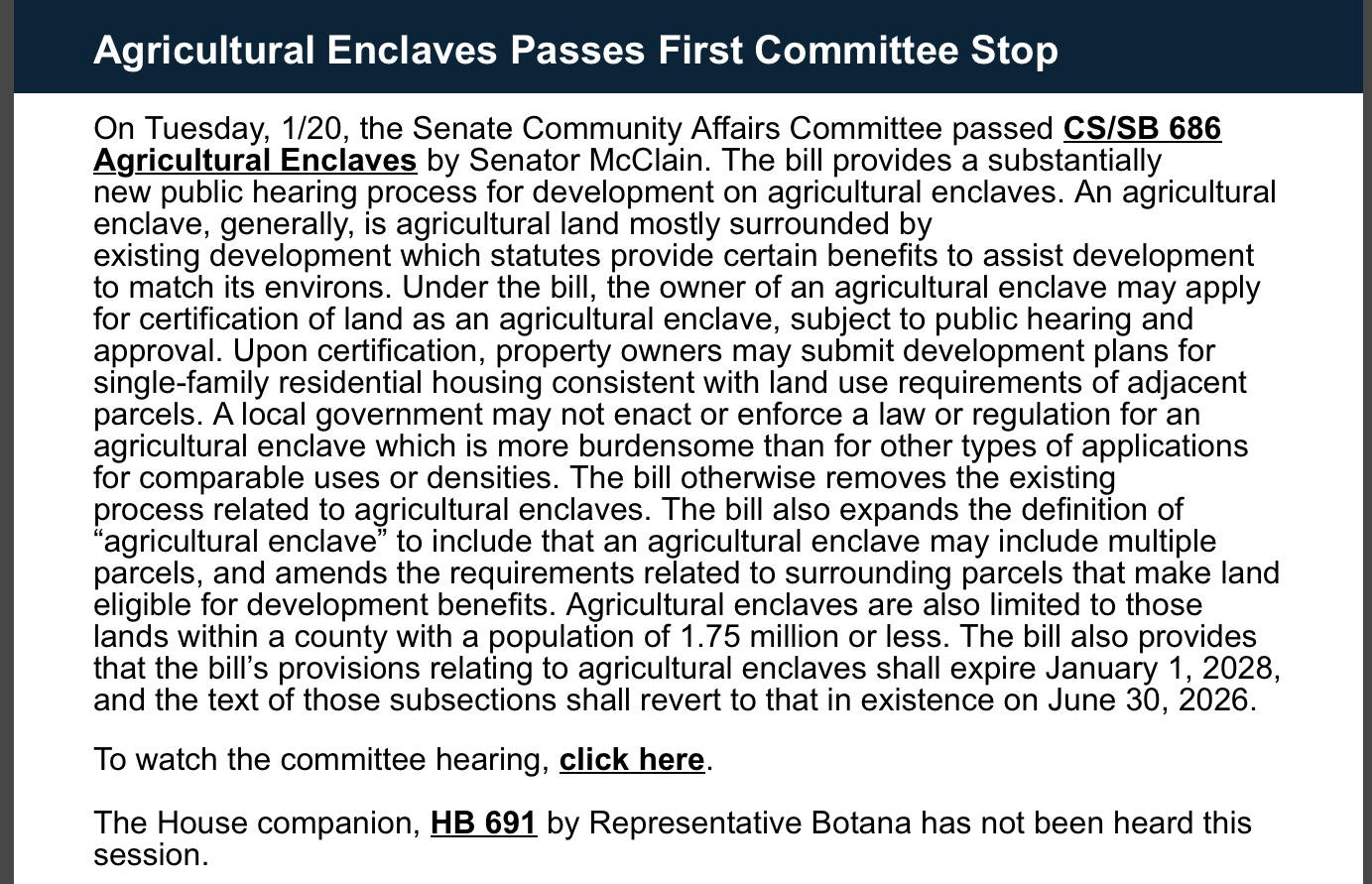
FAC legislative bulletins are distributed to county officials throughout Florida as part of the association’s legislative tracking.
The 1000 Friends of Florida shared an update about the bill in their February 11 webinar and strongly opposed the bill
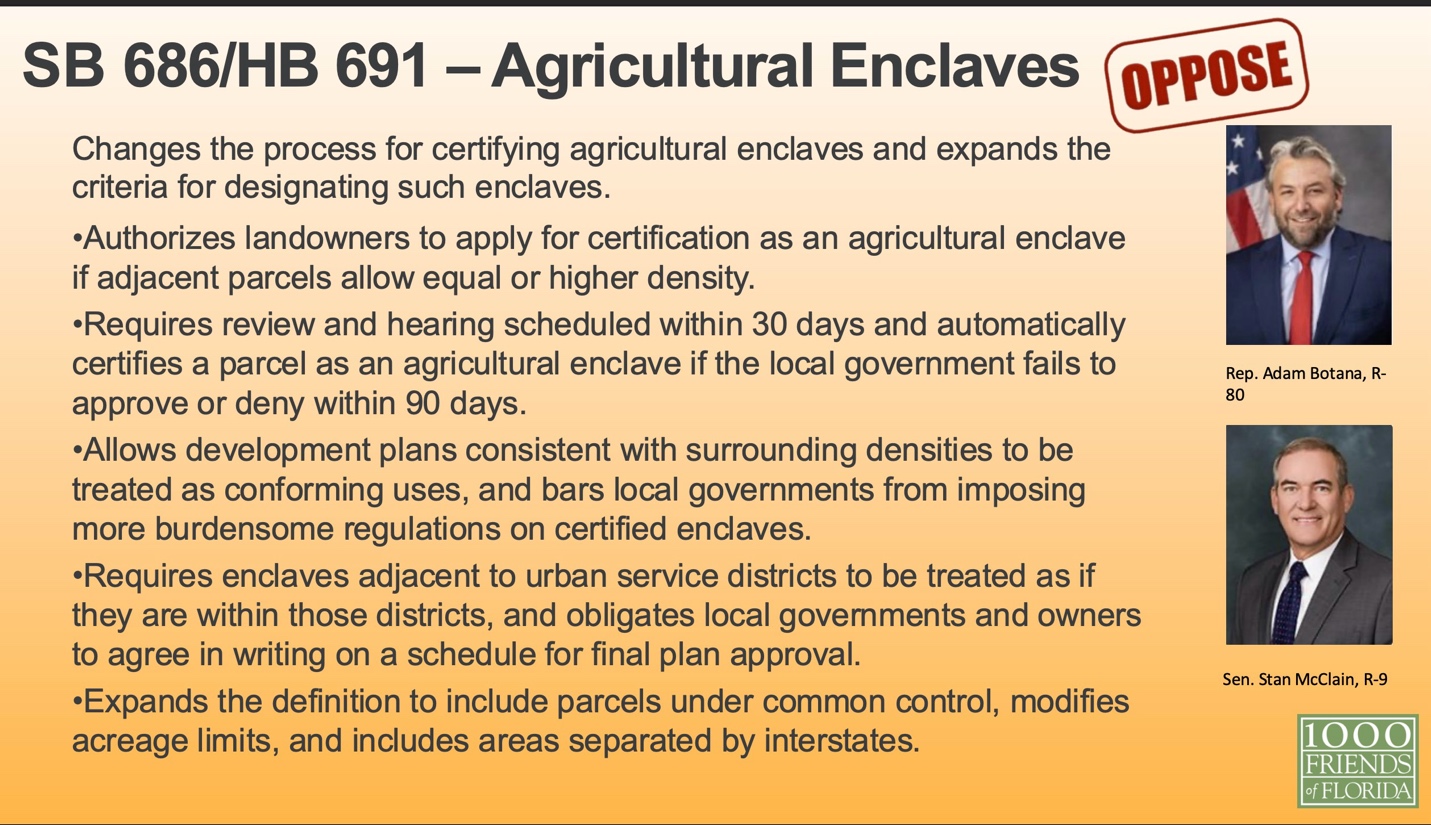
Here is a link to the full history of the bill on the Senate website: SB 686 Senate Bill History
The related House Bill was HB 691 and filed on December 8, 2025 by Representative Adam Botana of District 80 (Bonita Springs, Leon and Collier Counties)
Link to the House Bill is here: Companion Bill HB 691
The bill was presented to the Governor on April 9 and signed April 20, becoming effective July 1, 2026.
SB 686 did not appear overnight. Whether someone agrees with SB 686 or opposes it, one thing is clear from the legislative record: this bill followed the normal legislative process over several months. It moved through Florida’s normal legislative process over several months, with committee hearings, legislative analyses, advocacy from supporters and opponents, and regular legislative updates distributed to county governments through the Florida Association of Counties.
The legislation also received support from members of the St. Johns County legislative delegation. Senator Leek voted Yes on February 26, and the bill was sent to the House where all 3 of our County Representatives voted Yes on March 11, 2026.
County commissioners are now responsible for administering a law that many local officials and planning advocates opposed.
Where are we now?
On July 1, the day the law became effective, 4 Ag Enclave certification requests were filed in St.Johns County. They were followed by 2 more on July 7.
Recent public comments have focused on whether county officials had advance warning that SB 686 was moving through the Legislature and whether the volume of applications could have been anticipated.
These are actually two very different issues.
One concerns the legislation itself.
The other concerns how quickly developers responded once the law became effective.
Those questions deserve to be evaluated separately.
Was the legislation itself foreseeable?
Could the volume of applications have been anticipated?
Regardless of where you stand on SB 686, one thing should now be clear.
By the time these six Ag Enclave applications reached the St. Johns County Commission, the fundamental policy decision had already been made in Tallahassee.
The discussion before the Commission is no longer Should Florida have adopted SB 686?
It is How should the County administer the law the Legislature has already enacted?
Those are two very different questions, and understanding that distinction is essential to understanding the months ahead.
Why this matters
The real lesson is broader.
SB 686 illustrates how profoundly state legislation can reshape local government authority.
Whether one supports or opposes the policy, understanding where decisions are made, and when citizens have the greatest opportunity to influence them, is essential.
By the time an Ag Enclave certification reaches the County Commission, many of the key policy decisions have already been made in Tallahassee.
Whether you support SB 686 or oppose it, understanding the legal framework helps all of us have a more informed discussion.
Over the past several days, I’ve reviewed four of the Ag Enclave certification applications filed in St. Johns County using a checklist developed directly from SB 686 and the supporting statutory requirements. In the coming days, I’ll be sharing those reviews separately. The purpose of those articles will be different from this one: not to explain the law itself, but to examine how the submitted applications compare to the requirements established by the Legislature.
If you are finding value in these updates, please subscribe to my blog so you get notifications when I publish an update. Feel free to share with others who may find value in the content.


What worries me is how the certification process is performed. There is a tight timeline for producing (or denying) the certification but no guidance as to how to determine whether due diligence in the evaluation is performed. How is that shown so that we know that the certification is not just a rubber stamp?
Dianne Battle
That’s an excellent question, and it’s one I intend to explore in my next articles. While SB 686 establishes a relatively short timeline for certification, it doesn’t eliminate the county’s responsibility to verify that an application actually satisfies the statutory criteria. The certification process should not be a rubber stamp; it should be a careful review of whether each requirement in state law has been met. That’s why I’ve been reviewing the submitted applications against the statutory checklist, and I’ll be sharing that analysis in the coming days.