
Posted in Ag Enclaves, BOCC, Florida Legislature

How We Will Evaluate Agricultural Enclave Applications Under SB 686

Before we jump into how each of the Ag Enclave applications stacks up against the statute, I thought it would be helpful to lay out the requirements.


But first, let’s talk about the suggestions that the County should seek an injunction to stop the certification process from moving forward. Asking for an injunction is not as simple as disagreeing with the law—or believing it will produce bad results.

The County would first need a viable legal claim. That might involve an argument that the statute violates the Florida Constitution, exceeds the Legislature’s constitutional authority, violates due process or conflicts with another constitutional provision.

The County could also ask the court for a temporary injunction while the larger case was being decided. To obtain that relief, it would generally need to demonstrate a substantial likelihood of success on the merits, irreparable harm, the absence of an adequate legal remedy and that an injunction would serve—or at least not harm—the public interest.

Would merely filing the lawsuit stop the applications already pending? No. The law would remain in effect unless and until a judge entered an order temporarily preventing its enforcement. Whether that order would apply to applications already filed would depend upon the precise relief requested and granted.

Litigation could also take months or years. Meanwhile, SB 686 gives the County only 90 days to approve or deny certification before a property is certified by default. That is why, unless a court says otherwise, the County must continue evaluating the applications under the law currently in effect.


So let’s jump into what we will be looking for as we analyze the applications already submitted.

When Florida’s new agricultural enclave law took effect on July 1, 2026, it created a highly structured and unusually compressed process for reviewing qualifying properties.

Under SB 686, the St. Johns County Board of County Commissioners cannot simply decide that a proposed development is too large, too controversial or inconsistent with the county’s existing growth plans. If an application satisfies the requirements established by the Legislature, the county must certify the property as an agricultural enclave.

But that does not mean every application labeled an “agricultural enclave” automatically qualifies.

The law contains numerous factual, geographic and legal requirements. Our review will focus on whether each applicant has produced sufficient evidence to establish every required element, not merely whether the application contains the right words or conclusions.


Start With the Property as It Existed on January 1, 2025

Several of the law’s threshold requirements depend upon conditions that existed on January 1, 2025.

The property must have been:

  • Located in unincorporated county territory;
  • Undeveloped;
  • One parcel or a legally identifiable group of parcels; and
  • Owned or controlled by a single person or entity.

That makes the property’s history important.

The County should carefully review deeds, property-appraiser records, corporate records, contracts, options and other documents to determine who owned or controlled the property on the statutory date. Parcels acquired or assembled after January 1, 2025, will require particularly careful scrutiny. These documents are included in the applications but including them is not the same as demonstrating the requirement has been met.

The meaning of “undeveloped” may also become a significant issue. Agricultural property is not necessarily unimproved property. A site may contain homes, barns, roads, utilities, mining activity or other structures. Those conditions should be identified rather than simply described by the applicant as agricultural land.


Verify the Agricultural History

The property must have been in continuous bona fide agricultural use for at least five years before the application.

An agricultural classification from the property appraiser is important evidence, but it is not necessarily sufficient on its own. There should be supporting records establishing both the classification and the actual agricultural activity on every parcel during the required period.

Those records might include:

  • Agricultural leases;
  • Farm, crop or livestock records;
  • Receipts and tax schedules;
  • Historical aerial photographs; and
  • Site inspections or other documentation of the property’s use.

Any part of the property that was not used for agriculture should be mapped and evaluated separately. The evidence should demonstrate a genuine, continuous agricultural operation—not an activity established primarily to create eligibility for future development.


Check Every Foot of the Perimeter

The perimeter calculations are likely to be among the most complicated and contested parts of these applications.

A survey should identify the property’s complete perimeter in linear feet. Every boundary segment should then be classified, measured and supported by evidence. The applicant’s calculations should be independently checked.

The law provides more than one way for a property to satisfy the surrounding-development requirements.

One alternative generally requires at least 75 percent of the perimeter to be surrounded by a qualifying combination of existing development, land designated and substantially developed for residential, commercial or industrial uses, or certain interstate and urban-service-area conditions.

A second alternative applies to properties of 700 acres or less. It requires that at least 50 percent of the perimeter is surrounded by appropriately designated property and at least 50 percent is surrounded by property within an established urban service district, area or line.

A third alternative involves property located within a rural study area adopted into the local comprehensive plan and intended for residential development.

For each application, we will look to see which alternative the applicant is claiming and whether the evidence proves it.

Roads, canals and bodies of water require special attention. The qualifying land use is generally determined by examining the parcel directly across the feature—not by counting the roadway, canal or water itself as surrounding development. Corner touches and point contacts are not to be treated as portions of the perimeter.

The law also prohibits one locally certified agricultural enclave from being used to establish the qualifying perimeter of another.


Confirm the Acreage Limits

The general acreage limit is 1,280 acres.

Larger properties may qualify only under additional requirements involving their perimeter, surrounding residential development and projected population at buildout. No qualifying property may exceed 4,480 acres.

Those calculations should be documented rather than accepted at face value. Any reliance on “authorized” future development should be supported by valid development approvals, and projected buildout population should include the methodology and assumptions used.


Examine Public Services and Infrastructure

Certification does not make infrastructure limitations disappear.

Applications should address water, wastewater, transportation, schools and recreation. The review should identify the responsible service providers, available capacity, required extensions or improvements, projected timing and costs.

If those services are not presently available or scheduled through the county’s capital improvements program, the applicant may offer to pay for or construct its proportionate share of improvements or contribute necessary land. Any such offer should be sufficiently specific and enforceable to form a binding agreement.


Identify Protected Property and Environmental Constraints

Certain lands are excluded or subject to additional protections, including property within specified protected areas, military installations or ranges, and land encumbered by qualifying conservation easements.

Certification also does not erase environmental requirements.

The review should consider wetlands, floodplains, stormwater, listed species and established wildlife corridors. Where habitat connectivity may be affected, measures such as clustering, retained open space and wildlife crossings should be evaluated.

The county may be constrained in how it applies its land-use regulations, but existing environmental and conservation protections must still be identified and preserved.


Test the Adjacent Density Comparison

To obtain certification, an applicant must identify genuinely adjacent property that legally permits the same or a higher residential density.

The important question is not necessarily how many homes have already been constructed nearby. It is what density the adjacent property is legally entitled to develop under its future land use designation, zoning, development order, PUD or other valid approval.


Track the Deadlines Carefully

SB 686 imposes strict deadlines:

  • A written compliance report is due within 30 calendar days after the application is received.
  • A public hearing must be held within 30 calendar days after the report.
  • The county must approve or deny certification within 90 calendar days after receiving the application.
  • If the county fails to act within 90 days, the property must be certified.
  • After development plans are submitted, the county and applicant must establish a written review process within 30 business days.
  • The development-plan review process may not exceed 180 days.

These deadlines run from receipt of the application—not necessarily from the date the county considers it complete. That creates a risk if an application is missing information but the statutory clock continues to run.


Certification Is Only the First Stage

This is an important element. Certification establishes that a property qualifies for treatment under the new law. It is not the same thing as approving a final development plan.

After certification, the applicant must submit plans showing the proposed uses, density or intensity, infrastructure and site design. The law limits the county’s ability to reject a qualifying plan solely because it conflicts with existing comprehensive-plan or zoning designations. It also restricts the county from imposing requirements more burdensome than those applied to comparable developments.

Nevertheless, the applicant must still demonstrate that the proposed development is an eligible use and does not exceed what the law permits based upon the relevant adjacent property.


The Bottom Line

Our assessment of each agricultural enclave application will ask a straightforward question:

Has the applicant proven every element required by the statute with verifiable evidence?

Each application must be evaluated parcel by parcel, boundary segment by boundary segment and requirement by requirement. Where information is missing, we will identify it. Where calculations are questionable, we will test them. Where the law leaves room for interpretation, we will distinguish the legal question from the underlying facts.

SB 686 significantly limits local discretion—but it does not eliminate the obligation to conduct a careful, consistent and evidence-based review.


One caveat: I am not an attorney, and this is not a legal opinion. I am a former Chief Audit Executive who spent decades evaluating evidence against federal, state, local and international requirements. That is the lens I am bringing to this review.


If you are finding value in these updates, please subscribe to my blog so you get notifications when I publish an update. Feel free to share with others who may find value in the content.

Posted in BOCC, Comprehensive Plan, Florida Legislature

Why Can’t St. Johns County Simply Vote “No” on Ag Enclave Applications?

Understanding how SB 686 changed the County Commission’s role.

If you’ve been following the recent discussion about Ag Enclave applications in St. Johns County, you’ve probably heard one question repeated over and over:

Why can’t the County Commission simply vote “no”?

There has been a lot of discussion in Northeast Florida over the past week about SB 686, the Ag Enclave bill. With our first applications filed, I thought it would be helpful to give some background on this bill and how we got here. Then we can talk about what the county can, or cannot, do.

Residents want to know why the County Commission can’t simply deny these six Ag Enclave applications the same way it could deny a Comprehensive Plan Amendment.

The answer is that these applications are not processed like Comprehensive Plan Amendments or rezonings. SB 686 created an entirely different process under state law, and understanding that process explains why the Commission’s role is very different than many people realize.

This may feel like another rezoning request.

It isn’t.

SB 686 created an entirely different legal process.

This article isn’t about whether SB 686 is good or bad policy. It’s about understanding what the law requires and how we arrived here.


Two Different Questions Are Being Asked

There are really two separate questions being debated.

The first is whether SB 686 was good public policy. Reasonable people can disagree on that.

The second is what authority the County Commission has now that SB 686 is law. That is the question this article addresses.

Before writing this article, I reviewed SB 686, the House and Senate bill analyses, legislative history, Florida Association of Counties updates, and four Ag Enclave certification applications filed in St. Johns County.

Before SB 686, counties had broad discretion in zoning changes. Comprehensive Plan Amendments and rezonings were legislative decisions. County Commissioners could make decisions, within the law, on local impacts of a Comprehensive Plan Amendment or zoning waiver

After SB 686, the Legislature created the Ag Enclave Certification process. Certification is essentially the county determining whether an application meets the criteria established in state law. It is not the same thing as deciding whether the county likes the project. Once certified, local decisions still occur but under a much narrower legal framework established by the legislature.

Certification is not the same as approval. There are specific steps that are very different from the usual Comprehensive Plan Amendment.

The process essentially is:

1. Developer submits certification application.

2. County reviews statutory eligibility. (Staff performs the analysis and presents to Commissioners.)

3. County issues certification if criteria are met.

4. Development application follows.

5. County still reviews engineering, infrastructure, concurrency, stormwater, utilities, etc.

6. But the County’s discretion is very different than under a traditional Comprehensive Plan Amendment.

SB 686 enacted

        ↓

Certification Application

        ↓

County determines statutory eligibility

        ↓

Certification issued (if requirements met)

        ↓

Development Review

        ↓

Construction approvals

Why can’t commissioners simply vote no?

Their discretion in the certification process is governed by state law rather than local judgment.

If the application meets the certification criteria, they must vote “yes” to certify. If the Commission denies certification even though the statutory requirements are met, the applicant may seek review in circuit court through a writ of certiorari. In other words, the court reviews whether the county followed the law, not whether the judges agree with the project.


So how did St. Johns County end up operating under this entirely new process?

The answer doesn’t begin with the six applications filed this month. It begins in Tallahassee, where SB 686 moved through the normal legislative process over several months before becoming law on July 1, 2026.

The Legislative Record

On December 1, 2025, Senator Stan McLain of District 9 (Central Florida District) filed the Ag Enclave bill, SB 686.

Agricultural Enclaves; Authorizing certain persons to apply to the governing body of the local government for certification of certain parcels as agricultural enclaves; requiring the local government to hold a public hearing within a specified timeframe to approve or deny such certification; authorizing certain persons to submit certain development plans; authorizing the development of certain parcels for commercial, industrial, or single-family residential purposes under certain circumstances, etc.”

It then moved through committee hearings over the next several months before passing both chambers and being signed by the Governor on April 20, 2026, with an effective date of July 1.

The Florida Association of Counties exists in part to keep county governments informed about legislation that affects local government.

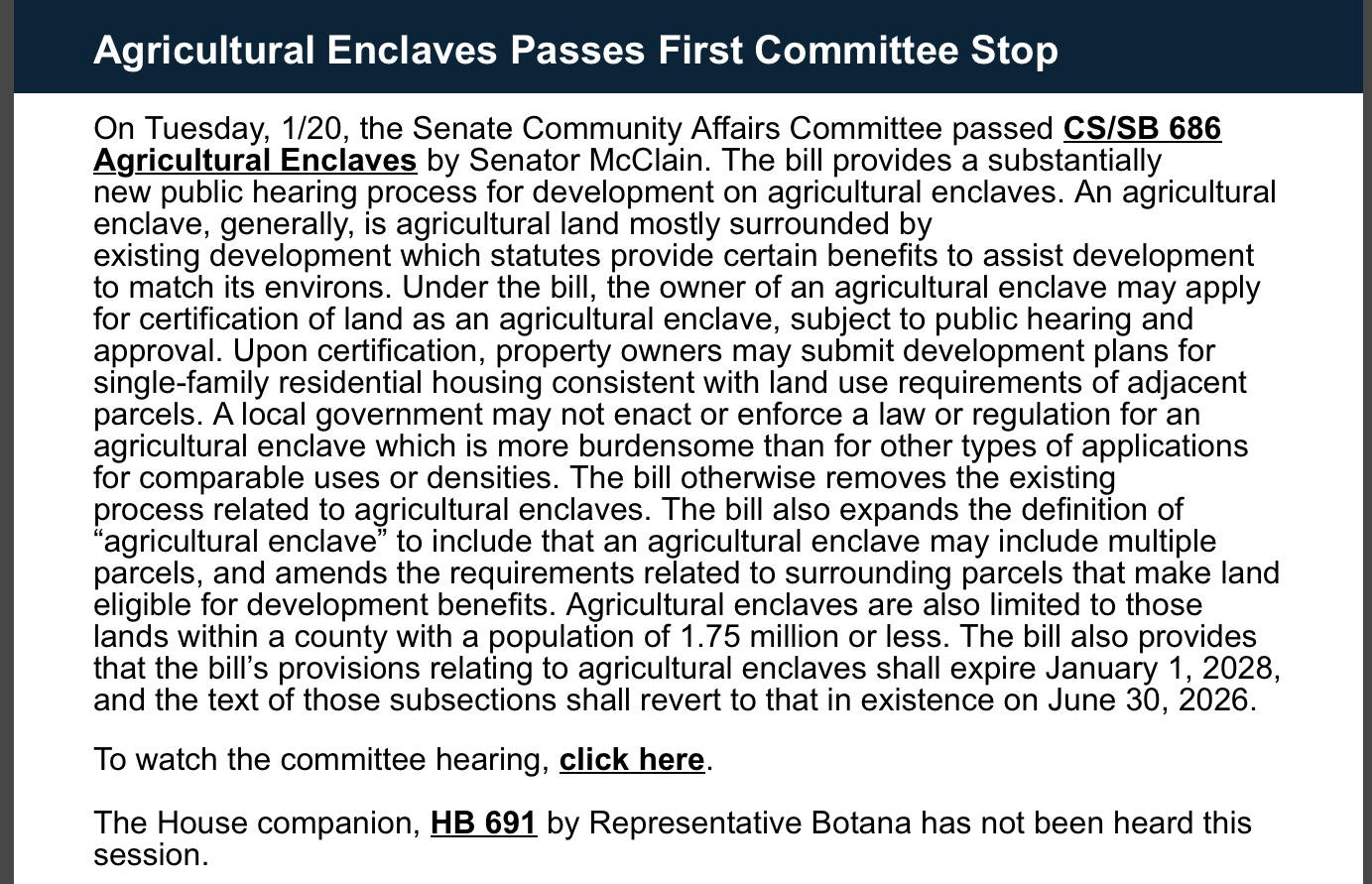
In the Florida Association of Counties FAC Legislative Bulletin: Week 2, dated January 23, 2026, they included a summary:

FAC Email Bulletin January 23, 2026

FAC legislative bulletins are distributed to county officials throughout Florida as part of the association’s legislative tracking.

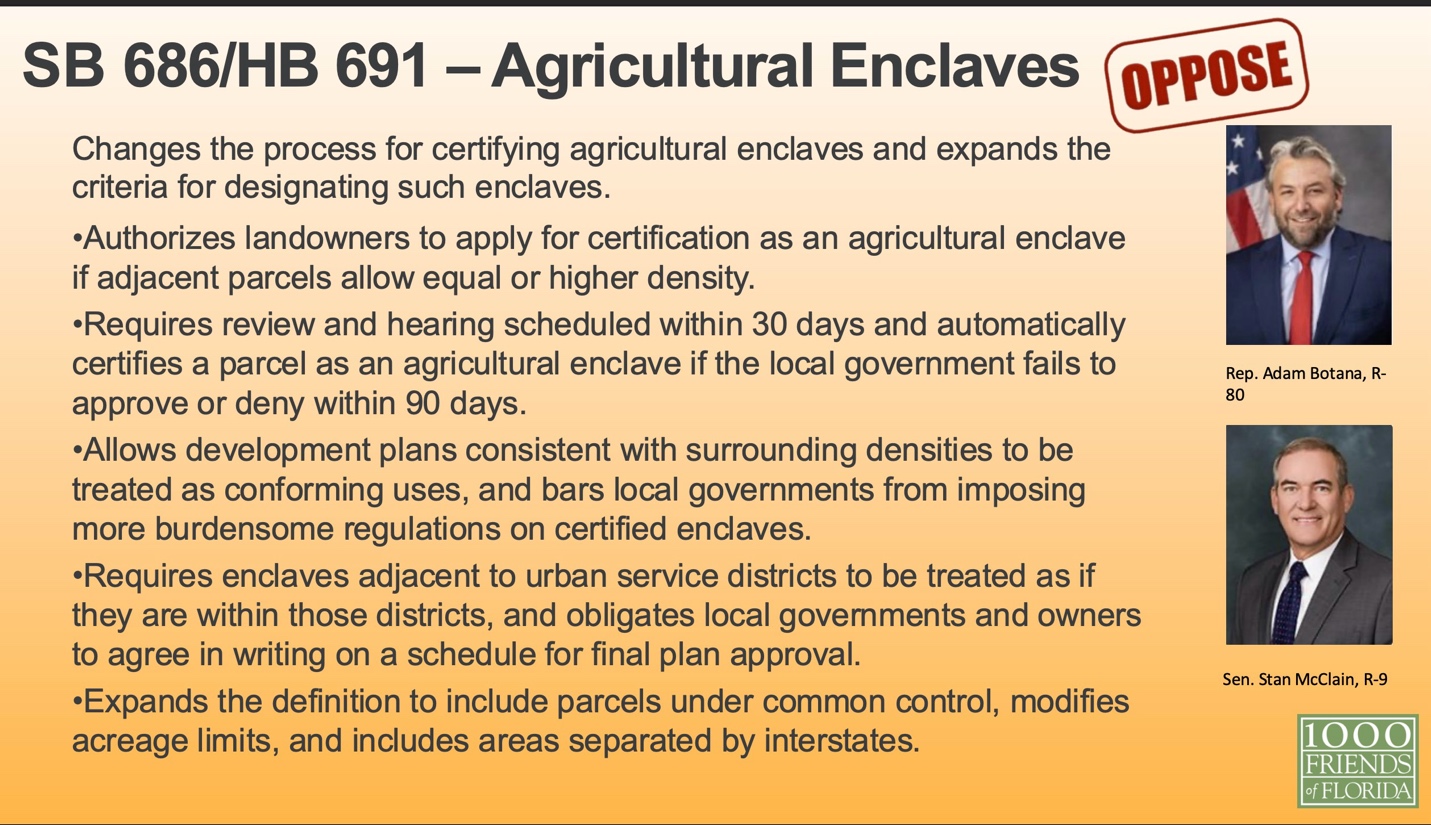
The 1000 Friends of Florida shared an update about the bill in their February 11 webinar and strongly opposed the bill

1000 Friends of Florida Webinar, February 11, 2026

Here is a link to the full history of the bill on the Senate website: SB 686 Senate Bill History

The related House Bill was HB 691 and filed on December 8, 2025 by Representative Adam Botana of District 80 (Bonita Springs, Leon and Collier Counties)

Link to the House Bill is here: Companion Bill HB 691

The bill was presented to the Governor on April 9 and signed April 20, becoming effective July 1, 2026.


SB 686 did not appear overnight. Whether someone agrees with SB 686 or opposes it, one thing is clear from the legislative record: this bill followed the normal legislative process over several months. It moved through Florida’s normal legislative process over several months, with committee hearings, legislative analyses, advocacy from supporters and opponents, and regular legislative updates distributed to county governments through the Florida Association of Counties.

The legislation also received support from members of the St. Johns County legislative delegation. Senator Leek voted Yes on February 26, and the bill was sent to the House where all 3 of our County Representatives voted Yes on March 11, 2026.

County commissioners are now responsible for administering a law that many local officials and planning advocates opposed.


Where are we now?

On July 1, the day the law became effective, 4 Ag Enclave certification requests were filed in St.Johns County. They were followed by 2 more on July 7.

Recent public comments have focused on whether county officials had advance warning that SB 686 was moving through the Legislature and whether the volume of applications could have been anticipated.

These are actually two very different issues.

One concerns the legislation itself.

The other concerns how quickly developers responded once the law became effective.

Those questions deserve to be evaluated separately.

Was the legislation itself foreseeable?

Could the volume of applications have been anticipated?

Regardless of where you stand on SB 686, one thing should now be clear.

By the time these six Ag Enclave applications reached the St. Johns County Commission, the fundamental policy decision had already been made in Tallahassee.

The discussion before the Commission is no longer Should Florida have adopted SB 686?

It is How should the County administer the law the Legislature has already enacted?

Those are two very different questions, and understanding that distinction is essential to understanding the months ahead.


Why this matters

The real lesson is broader.

SB 686 illustrates how profoundly state legislation can reshape local government authority.

Whether one supports or opposes the policy, understanding where decisions are made, and when citizens have the greatest opportunity to influence them, is essential.

By the time an Ag Enclave certification reaches the County Commission, many of the key policy decisions have already been made in Tallahassee.

Whether you support SB 686 or oppose it, understanding the legal framework helps all of us have a more informed discussion.


Over the past several days, I’ve reviewed four of the Ag Enclave certification applications filed in St. Johns County using a checklist developed directly from SB 686 and the supporting statutory requirements. In the coming days, I’ll be sharing those reviews separately. The purpose of those articles will be different from this one: not to explain the law itself, but to examine how the submitted applications compare to the requirements established by the Legislature.


If you are finding value in these updates, please subscribe to my blog so you get notifications when I publish an update. Feel free to share with others who may find value in the content.
Posted in Florida Legislature, St. Johns County, Transportation

St. Johns County State Senate Appropriations Requests

As the 2nd week of the 2025 Florida Legislative Session ends, let’s take a look at the Appropriations Requests that have been submitted by Senator Thomas (Tom) Leek.

This list follows my March 9 blog post identifying the Appropriations submitted by our State Representatives.

This is a manual review so forgive me if I miss anything!


The Senate process is a bit different from the House of Representatives Process. From the Florida Senate website:

“The appropriations bill is one of the most important bills considered by the Legislature. This bill is the state’s budget and it specifies the amount of money available to various state agencies during the next year.  The appropriations bill follows the same course as other general bills, but because it is difficult to get both houses to agree on all items in the bill, a conference committee is usually appointed to resolve the differences.”

On the Senate side, there is a 7 page form to be completed. You can view the blank form here: Funding Initiative Request Form


Let’s walk through an example with a 30 Million dollar request for St. Johns County State Road 16, Phase II.

This Request reads as follows:

“FDOT is scheduled to spend $30 million to resurface State Road 16 from International Golf Parkway to I-95 over the next year. This newly resurfaced road will then undergo milling and paving a second time during the construction phase of the SR 16 Capacity Improvements project. St. Johns County sees an opportunity to enhance government efficiency, eliminate duplicative costs, and to better utilize state resources by re-appropriating this $30 million toward the SR 16 Capacity Improvements project. This appropriations request will widen SR 16 to 4 lanes from International Golf Parkway to I-95.”

This looks like a St. Johns County version of DOGE – currently there is $30 million slated to resurface State Road 16 from IGP to I-95 in the coming year. Much needed work! However, the State Road 16 Capacity Improvements will require the road to be milled and paved again! (duplicative work!)

This request from Senator Leek is to re-appropriate the $30 million to the Capacity Improvements project that will widen SR 16 to 4 lanes from International Golf Parkway to I-95.

The type of funding for this project is “Fixed Capital Outlay.”

The Total Project cost for Fiscal Year 2025-2026 (including matching funds) is 51,708,000. Matching funds come from Federal, State, Local and “Other.”

The project has previously received state funding of $7,500,000 in 2024-2025 (Appropriation 2069A)

Future funding will likely be requested in the amount of 10,000,000 per year!

It is noted that St. Johns County has identified additional developer contributions and a federal competitive grant as future matching funds to state funding beyond FY 26 – this could reduce future financial contributions by the state.

This project is currently in the Construction Phase, is noted as “shove ready” and construction slated to starte 7/1/2025 with completion by 1/30/2027.

The purpose of the 30,000,000 is notes as “Design, permitting, right of qay acquisition, construction, post-design services and CEI for the four-lane widening of State Road 16 from International Golf Parkway to I-95, with option to include bike lanes, sidewalks, or multi-use paths where appropriate.”

The form requires answers to questions such as purpose and goal of the project, activities and services provided to met the intended purpose, what services provided to citizens, who is the target population, and the expected beneift or outcome of the project

You can read through the full request here: St. Johns County State Road 16 Phase II

This request will be reviewed by the Appropriations Committee on Transportation, Tourism, and Economic Development.  You can check their calendar and find the contact information for the committee members here: Transportation, Tourism, Economic Development Committee

You can share your thoughts on any of the Appropriations requests with Senator Leek and members of the Appropriations Committee.

Senator Leek’s contact information can be found here: Senator Leek State Senate Page

There is a link on the page to send him an email directly from there.


Here is a list of the Appropriations Requests from Senator Leek that appear to be directly impactful to St. Johns County. There is a much longer list of requests he has made (link below) but remember his district covers more than just St. Johns County.

If I could locate a corresponding request from one of our Representatives, I’ve noted that as well. If the column for Corresponding House Request is blank, I did not see a corresponding request.

NumberRequestAmountCorresponding House Request
2524Equine-Assisted Regional Rehabilitation Center for Children and Veterans1,700,000Sapp2223
2530St. Augustine Teen Center Boys & Girls Club400,000Greco2092  
2531Historic St. Johns County Police Athletic League Diamond of Dreams1,000,000Sapp2184  
2533The Florida Museum of Black History Phase 1 – St. Johns County2,000,000  
2535District 23 Medical Examiner’s Office6,000,000Sapp2172
2539I-95 Interchange Improvements at International Golf Parkway3,500,000Kendall1499
2542St. Johns County Career and Job Readiness Program245,000  
2543St. Augustine Airport Student Maintenance Training Program250,000Kendall1722
2544BRAVE (Be Resilient and Voice Emotions) Program3,000,000  
2546St. Augustine Land Purchase, Continued Design and Construction of Resilient Structure Anastasia Blvd.2,500,000Greco2110  
2547St. Augustine Volusia Woods Extension – West Augustine Septic-to-Sewer Project1,000,000Greco2886
2549St. Augustine Beach Stormwater System Resiliency1,910,000Greco2095
2550The Arc of the St. Johns, Inc. Transportation Facility Project750,000Greco2125  
2551First Coast Technical College – Firefighter & EMT Program Enhancement/Expansion760,285Kendall2285
2553Hastings Museum and Community Civic Center400,000  
2554St. Johns County State Road 16 Phase II30,000,000  
2555The Institute for Classical Education at Flagler College1,500,000Greco2890  
2556St. Johns County Historic Markland House Restoration2,000,000Greco2094
2557St. Johns County Road 2209 Central Segment – Phase 38,000,000  
2840St. Johns County EPIC Sober Living Transitional Housing Expansion Project2,500,000Greco2083
2841St. Johns County EPIC Recovery Center Women’s Substance Abuse Residential Treatment Beds750,000Greco2098
2870St. Johns County Council on Aging Shelter & Shade Project572,000Greco2080
3013St. Augustine Youth Services Intensive In-Home Therapeutic Programs450,000Greco2100
3177Home Again St. Johns, Inc. Homeless Veterans Support & Housing250,000  
3184Anastasia Island Pedestrian and Bicycle Safety Improvements500,000  
 TOTAL72,587,285  

All Appropriations Requests for the 2025 session can be found at this link: 2025 Session Appropriations Requests

You can filter by Leek to pull up just ones Senator Leek has submitted. You can click the request name and link through to the full request.


If you are finding value in these updates, please subscribe to my blog so you get notifications when I publish an update. Feel free to share with others who may find value in the content.
Posted in Florida Legislature, St. Johns County

St. Johns County State Legislative Appropriations Requests

EDITED: I HAD INADVERTENTLY PICKED UP THE WRONG LINE ITEM FOR KENALL REQUESTS 2285 AND 2136. THE NUMBERS HAVE BEEN ADJUSTED BELOW.

The 2025  Florida Legislative Session opened on Tuesday, March 4. In my last update I outlined the process that is generally used as County’s request Legislative Funding. I used the very important request for funding to address the traffic issues at I-95 and International Golf Parkway as an example of the process.


This week I’ll provide an update on that specific request and some of the questions asked, as well as sharing a list of all Appropriations requests I could locate for St. Johns County from our Florida Representatives.

A later post this week will include Appropriations Requests from Senator Tom Leek.


Update on the I-95 Interchange Improvements at International Golf Parkway

The Improvements for the I-95 Interchange at International Golf Parkway are certainly much needed. In my last post I had noted some differences between what the County had submitted and what was in the Appropriations request. I have found a few answers that I will share here.

  • Representative Kendall had continued to work with FDOT representatives after the initial reviews and a lower cost estimate for the county was submitted, thus explaining the reduction from 6,000,000 to 3,500,000 and an increase for the Federal Funding from 32,000,000 to 34,000,000.
  • It appears there may have been a gap in communication of the numbers back to the county and that has now been addressed.
  • In the Attestation Form submitted by the County on March 5, some caveats were added that addresses some differences.
    • The Lobbyist name was changed to Joe Mobley
    • A statement was added, “If state and federal funds are appropriated, the County is prepared to provide $2 million as a local match.”
    • Study was changed from Yes to No – FDOT has directed $500,000 to PD&E, which will start this spring or early summer.

As of Friday, March 7, there was no indication that Congressman Rutherford had submitted a request for the needed Federal funds. Important to note that as a federally funded Interstate, that is a key element in getting this project approved. A question to be asked is, how does this fit into the I-95 widening project? (planned for 2026 – 2027.) And another question, will the state approve funding for this project if there are no federal funds available? We will continue to follow along!


 Here is a list of the Appropriations requests I was able to identify as being specific to St. Johns County. Representatives Sapp and Greco have districts that cover multiple counties. I tried to identify as closely as possible which of their requests would impact only St. Johns County.

From Representative Kim Kendall

NumberRequestAmountAttestation Received
2285First Coast Technical College – Firefighter & EMT Program Enhancement Expansion760,285Yes  
2136St. Johns County Sheriff’s Office Re-Entry/Co-Responder Program300,000Yes
1857Switzerland Vocational & Community Center70,000Yes  
1847First Coast Technical College – Industrial Agriculture Program Enhancements650,000Yes
1722St. Augustine Airport Student Maintenance Training Program250,000Yes
1499I-95 Interchange Improvements at International Golf Parkway3,500,000Yes, with caveats
Total 5,530,285 

From Representative Sam Greco

2890The Institue for Classical Education at Flagler College1,500,000Yes
2889World War II Themed Education and Exhibit Building500,000 
2886St. Augustine Volusia Woods Extension – West Augustine Septic-to-Sewer Project1,100,000Yes  
2125The Arc of the St. Johns – Transportation Facility750,000Yes
2110St. August land Purchase engineering, Design and Construction of Resilient Structure on Anastasia Blvd2,500,000Yes  
2100St. Augustine Youth Services – intensive In-Home Therapeutic Programs450,000Yes
2098EPIC Behavioral Healthcare – St. Johns EPIC Recovery Center Women’s Substance Abuse Residential750,000Yes
2095St. Augustine Beach Stormwater System Resiliency1,910,000Yes
2094Historic Markland House Restoration2,000,000Yes
2092St. Augustine Teen Center Boys & Girls Club400,000Yes
2083EPIC Community Services – Sober Living Transitional Housing Project Expansion2,500,000Yes
2082St. Johns County Intracoastal Flood Management8,000,000Yes
2081K9s for Warriors – Veterans Suicide Prevention Program1,500,000Yes
2080St. Johns County Council on Aging Shelter & Shade Project572,000Yes
Total 24,432,000 

From Representative Judson Sapp

2223HorsePlay Therapy Center – Equine – Assisted Regional Rehabilitation Center1,700,000Yes
2184St. Johns County Police Athletic League (PAL) Diamond of Dreams1,000,000Yes
2177St. Johns River State College – Renovation of Classroom Building and Workforce Training Center Addition18,773,926Yes
2172District 23 Regional Medical Examiner’s Office6,000,000Yes
Total 27,473,926 
    

To do your own research and read the details of each request, here is a link to Search Appropriations: 2025 Appropriations Requests

Learn more about each Representative, including how to contact and share your opinions on any of these requests, at the links below. At each link you will find an email form as well as phone number for the Representatives. You will also find a link to all of their Sponsored Bills. More to come on some of those bills as the Session progresses.

Representative Greco: Link for Representative Sam Greco

Representative Kendall: Link to Representative Kim Kendall

Representative Sapp: Link for Representative Judson Sapp


If you are finding value in these updates, please subscribe to my blog so you get notifications when I publish an update. Feel free to share with others who may find value in the content.

Posted in Affordable Housing, Comprehensive Plan, Florida Legislature, St. Johns County

Update on Florida Preemption Bills

Brief update on the Florida Preemption Bills I am tracking.

HB 1417/SB 1586 – Residential Tenancies

This bill preempts the regulation of residential tenancies and the landlord-tenant relationship to the state. What does that mean? Local communities cannot regulate any part of the “landlord-tenant relationship.” This includes setting caps on application fees and security deposits.

HB 1417 – Passed Civil Justice Subcommittee, Next Local Admin/Fed Affairs Judiciary

SB 1586 – On Judiciary Committee Agenda 3/29, Next Community Affairs, Rules

HB 1515/SB 170 – Local Ordinances

This bill empowers business owners to sue cities and counties for passing ordinances that case the financial losses. Businesses can sue over “arbitrary or unreasonable” ordinances for up to $50,000. While the lawsuit is proceeding, the local government must suspend enforcement of the ordinance in question. The bill also requires local government to produce and post on the local website a “business impact estimate” during the drafting phase of the ordinance.

SB 170 Passed the Senate – sent to the House

HB1515 – Ready for House Floor Vote

HB 627/SB 102 – Live Local

This bill is intended to incentivize developers and local governments to build or refurbish affordable housing units. This would waive zoning requirements that prevent affordable housing units from being built. It takes away requirements for a zoning change or comprehensive plan amendment for multi-family or mixed-use residential projects in commercial areas if the project sets aside 40% for affordable housing. Also included are incentives and tax exemptions for developers who provide affordable housing.

HB 627 – Laid on Table – Referred to SB 102

SB 102 – Passed the House and ready for the Governor’s signature

HB 359/SB 540 – Local Government Comprehensive Plans

Anyone challenging a local government for changing its comprehensive plan and then loses that challenge must pay the legal bills for the winner. This bill discourages small resident groups from challenging comprehensive plan changes

SB 540 – Passed Community Affairs, On Judiciary Committee 3/29

HB 359 – Ready for House Floor Vote

HB 1293/SB 1212 – Affordable Housing

Providing that a provision authorizing the board of county commissioners to approve certain development projects does not apply in a specified area of critical state concern; providing that a provision authorizing a municipality to approve certain development projects does not apply in a specified area of critical state concern; providing that certain provisions governing awards made pursuant to local housing assistance plans do not apply to counties and municipalities within areas of critical state concern meeting certain criteria, etc.

SB 1212 – Introduced 3/7

HB 1293 – Passed Local Administration, Federal Affairs & Special Districts Subcommittee, Next Agriculture, Conservation & Resiliency Committee

HB 235/SB 350 – Alternative Mobility Funding Systems

Revises requirements related to agreements to pay for or construct certain improvements; authorizes local governments to adopt alternative mobility planning & fee system; prohibits alternative system from imposing responsibility for funding existing transportation deficiency upon new development; revises requirements for calculation of impact fees; removes ability of local government, school district, or special district to increase impact fees in certain instances; provides requirements for mobility fees-based funding systems, mobility fees & fee increases; specifies criteria to be used in adopting mobility plan & mobility fee for transportation mitigation improvements; prohibits courts from using deferential standard for specified purpose; provides for specified mobility fee credits.

HB 235 Passed Local Administration, Federal Affairs & Special Districts Subcommittee, Next Ways & Means

SB 350 – Introduced

HB 833 – SB 714 – Vacation Rentals

Requiring advertising platforms to collect and remit specified taxes for certain vacation rental transactions; defining the term “advertising platform”; revising the regulated activities of public lodging establishments and public food service establishments preempted to the state to include licensing; requiring advertising platforms to require that persons placing advertisements for vacation rentals include certain information in the advertisements and attest to certain information; authorizing the division to revoke, refuse to issue or renew, or suspend vacation rental licenses under certain circumstances, etc.

SB 714 – Now in Appropriations Committee on Agriculture, Environment, and General Government, Fiscal Policy

HB 833 – On Agenda for Regulatory Reform, Next Ways & Means Committee

HB 439/SB 1604 – Land Use and Development Regulations

Revising the types of data that comprehensive plans and plan amendments must be based on; requiring local governments to determine if plan amendments are necessary to reflect a certain minimum planning period; requiring, rather than encouraging, a local government to comprehensively evaluate and update its comprehensive plan to reflect changes in local conditions; revising requirements for local land development regulations, etc.

HB 439 – now in Commerce Committee, Referred to State Affairs Committee

SB 1604 – Introduced

HB 41/SB 856 – Land Development Initiative and Referendum Processes

Revises restrictions on initiative and referendum processes. Another state preemption bill that prohibits local initiatives or referendums on land development regulations.

SB 856 – On Community Affairs Agenda, Next Judiciary; Rules

HB 41 – Ready for House Floor Vote

All bills can be found at the following links:

Florida House – Enter Bill number in search tool at the top of the page.

Florida Senate – Enter Bill number in search tool at the top of the page.