
What St. Johns County voters are being asked to approve on November 3
While many of us were distracted by the debate about agricultural enclave certifications, another consequential land-use decision was approved and is headed to St. Johns County voters: whether to authorize a dedicated property-tax levy and up to $100 million in borrowing for conservation.
At its August 18 meeting, the Board of County Commissioners voted 3–2 to place the proposal on the November 3 ballot. That vote did not impose a tax or borrow money. It put the decision before the voters.
Disclosure: I serve as a volunteer appointed member of the county’s Land Acquisition and Management Program Board (LAMP). I believe we need additional funding to purchase conservation land. I also believe residents deserve a clear explanation of what they are being asked to authorize, what it could cost, and what additional improvements the acquisition process needs. The views expressed here are my own, not a statement on behalf of the LAMP Board or the county.
What would a “yes” vote authorize?
The proposal would allow the county to issue general obligation bonds in one or more series, with total principal not exceeding $100 million. Each issuance would mature within 20 years. The bonds would be supported by a property-tax levy of up to 0.15 mills.
The money would support conservation lands and related capital projects that protect water quality, drinking-water resources, wildlife habitat, natural areas, working farms and forests, and coastal resources. Flood reduction and outdoor recreation are also among the stated purposes.
The county would not have to borrow the entire $100 million at once—or borrow the entire amount at all. Commissioners would make subsequent decisions about timing, individual issuances and acquisitions. At the meeting, county budget staff also described the option of collecting millage to accumulate cash for purchases, rather than relying exclusively on borrowing. In plain language, collecting millage means placing the tax on property tax bills.
The program would operate through LAMP’s willing-seller process. LAMP evaluates properties and makes recommendations; the BOCC retains final decision-making authority. This is not a proposal to require unwilling owners to sell their land.
The wording of the Ballot below, comes from the Agenda item on August 18. Agenda Item 3 – Land Conservation General Obligation Bonds – Ballot Question
SECTION 3. BALLOT TITLE AND SUMMARY. The ballot title and summary
appearing on the ballot to be used in the election shall be in substantially the following form:
ST. JOHNS COUNTY GENERAL OBLIGATION BONDS FOR LAND
CONSERVATION TO PROTECT WATER QUALITY
To acquire and manage lands that protect water quality; conserve wildlife habitat,
natural areas, farms and forests; provide outdoor recreation, and reduce flooding,
shall St. Johns County issue general obligation bonds in one or more series in an
aggregate principal amount not exceeding $100 million, maturing within 20 years
of each issuance, bearing interest not exceeding legal maximum rates, payable from
ad valorem property taxes levied up to 0.15 mills, providing for full public
disclosure?
_____ Yes
_____ No
What would it cost a taxpayer?
One mill is $1 for every $1,000 of taxable property value. At the full proposed rate, 0.15 mills equals $15 a year for every $100,000 of taxable value.
| Taxable property value | Maximum annual tax | Monthly equivalent |
| $100,000 | $15.00 | $1.25 |
| $200,000 | $30.00 | $2.50 |
| $300,000 | $45.00 | $3.75 |
| $500,000 | $75.00 | $6.25 |
| $750,000 | $112.50 | $9.38 |
| $1,000,000 | $150.00 | $12.50 |
Illustrations assume the full 0.15-mill levy. Monthly figures are annual costs divided by 12, not a separate monthly tax.
The important word is taxable. This is not necessarily the market value of your home or the amount you paid for it. Assessment limitations and applicable exemptions can make those figures very different. Use the taxable value applicable to county taxes on your property-tax notice, not the school-tax value, and multiply it by 0.00015.
The levy would apply to all taxable property, not just owner-occupied homes. The amount collected from an individual property could change over time as its taxable value or the rate actually levied changes. Voter approval would permit the maximum rate; it would not require commissioners to levy that maximum immediately.
The $100 million cap is not a cap on all collections
This distinction deserves more attention than it has received. The $100 million limit applies to aggregate bond principal. It does not mean taxpayers could pay no more than $100 million over the life of the program. Interest and issuance costs are additional, and the authorized levy can generate money beyond annual debt-service needs.
Florida Statute 200.181(3) allows a county to levy the voter-approved maximum even when it produces more than is needed for debt service. The surplus may be used only for lawful purposes related to the approved capital project, including operations and maintenance. The surplus portion also counts toward the county’s general 10-mill limitation. This is not unrestricted revenue for unrelated county spending.
Consequently, it is inaccurate to say the county could collect only enough to pay the debt already issued. It is also misleading to present a decades-long revenue projection as a guaranteed tax bill. Such a projection depends on the rate levied each year, changes in taxable value, future exemptions and the legally permitted duration of the levy.
Another tax question on the same ballot
The same ballot will include statewide Amendment 3, which would expand the homestead exemption for non-school property taxes and reduce the assessment-growth cap for non-homestead property. Because the proposed conservation levy would apply to taxable value, Amendment 3 could reduce both an eligible homeowner’s conservation tax and the total revenue the levy would generate.
The two proposals are not automatically contradictory, but the County should explain and model their combined effect. Voters deserve to understand both what their own property may be taxed and how changes to the tax base could affect the conservation program’s purchasing capacity.
We’ll talk more about Amendment 3 in future posts.
What would conservation funding accomplish?
A dedicated source of funding could give the county a more credible opportunity to work with willing sellers when environmentally important land becomes available. The public benefit may come from acquiring land outright or from a conservation easement that protects specified resources and limits development while the land remains privately owned. Public access depends on the particular acquisition or easement; not every conservation investment creates a public park.
Money is only part of the problem
If you’ve paid attention to the LAMP program, you know there is currently not enough funding to cover prioritized purchases. This levy is intended to address that funding need.
However, there is also a process issue that additional funding alone will not resolve. The board normally meets four times a year. Properties are evaluated during the year, and the full inventory of recommended properties is then prioritized at year-end before going to the BOCC for approval to begin purchase negotiations.
A property submitted to LAMP must move through several stages before the county can begin pursuing its acquisition. After staff determines that an application is complete, staff prepares an initial assessment package and provides it to LAMP Board members at least two weeks before the property is considered. The board then conducts an initial evaluation to decide whether the property advances. If it does, it is scheduled for a future meeting for final evaluation and ranking.
At the final meeting, each property is scored against the program’s acquisition criteria. A property must receive at least 50% of the possible points to be placed on the Final Property Ranking List, and selection as a top acquisition candidate requires a supermajority vote—six of the nine LAMP Board members. The ranked list and conceptual management plans are then submitted to the Board of County Commissioners, which may approve, reject or modify the recommendations. The county’s written process says the BOCC will receive the top candidates “at least annually,” but establishes no timetable for moving an individual property from application through final ranking and BOCC consideration. That lack of a defined timeline can be a serious obstacle when a willing seller is also considering offers from private buyers.
That timetable can leave a willing seller waiting months—not for a closing, or even an agreed price, but for the county to reach the point of authorizing negotiations. A seller with other options may not be willing to wait.
Under the current schedule, a property entering the process in early 2026 might not reach the year-end prioritization vote or the County Commission until early 2027. During that time, the County may not yet have authority to begin purchase negotiations. A private buyer does not have to wait for that process.
If you are a landowner, and you are waiting to see if the County MIGHT want to purchase your property, but a willing buyer comes to you with cash in hand to make that purchase before it gets prioritized, what would you do?
In transparency, I raised that concern at our June 9 meeting. The ordinance does not require LAMP to operate at the pace of its current annual cycle. It directs the Board to meet at least quarterly and to submit a ranked list of five acquisition candidates at least once each year. Those are minimum requirements, not maximums. That does give the LAMP Board more flexibility than the current schedule suggests.
Conservation real estate does not operate on a government calendar. A willing seller may be prepared to negotiate today but unwilling to wait most of a year merely for the County Commission to authorize negotiations. Funding LAMP will give the County greater purchasing capacity, but funding alone will not preserve land if the approval process moves too slowly to keep willing sellers at the table.
The Matanzas Estuary property: what happened
Let’s talk about one of the most visible losses that has been referenced as an example of why more funding is needed for LAMP acquisitions, the Matanzas Estuary property.
- Late 2023: The 195-acre Shores Boulevard property, adjacent to the Moses Creek Conservation Area, was first reviewed by the LAMP Conservation Board.
- February 13, 2024: After completing the evaluation process, LAMP scored the property at an average of 82.1 points and ranked it as the County’s highest-priority conservation property.
- March 5, 2024: The property was presented to the Board of County Commissioners as LAMP’s top recommendation. The Commission approved the list, allowing County staff to pursue acquisition.
- April 2024: LAMP developed a conceptual management plan. The property was discussed as a possible addition to the Moses Creek Conservation Area, potentially managed in partnership with the St. Johns River Water Management District.
- March 2025: A full year after BOCC approval, County staff reported that they were still working with the North Florida Land Trust and attempting to assemble funding from multiple sources.
- By the next annual recommendation cycle: The property was no longer available for conservation acquisition.
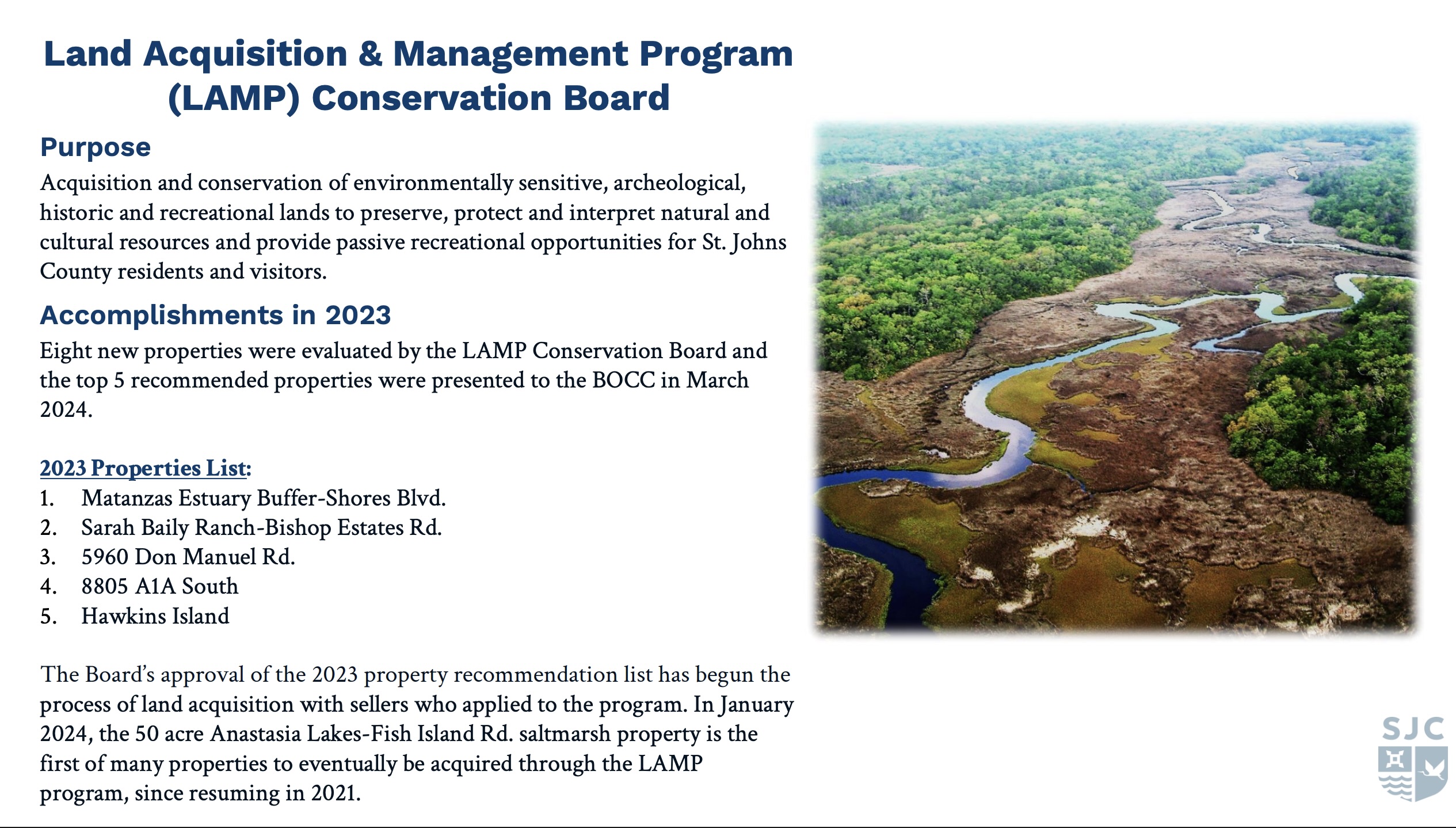
The loss of this property cannot be attributed solely to inadequate funding, although funding was unquestionably a major obstacle. The timeline also demonstrates how long a conservation acquisition can remain unresolved after the property has been identified as a priority. The property entered LAMP review in late 2023, was ranked first in February 2024 and received BOCC authorization in March. One year later, the County was still attempting to assemble a workable acquisition package. During that time, the owner remained free to consider other opportunities for the property.
Conservation purchases require careful evaluation and responsible use of public money. But willing sellers—particularly owners of valuable, developable property—cannot be expected to wait indefinitely while the County completes annual ranking cycles, secures approvals and searches for funding. In this case, the County identified an exceptional property and ranked it first, but it still could not complete an acquisition before the property became unavailable. Additional funding is necessary, but unless LAMP and the County can evaluate, authorize and negotiate acquisitions more responsively, more important properties may be lost even after voters provide the money.
If voters approve additional financing, the county should also establish a defined route for urgent opportunities: when a special LAMP meeting is warranted, how quickly a recommendation reaches the BOCC, and what preliminary work staff can undertake while preserving public oversight. Faster consideration need not mean less scrutiny.
The program also needs transparent reporting on acquisitions, debt, unspent balances, outside funding and management costs. Buying land creates an ongoing stewardship responsibility. Conservation easements can shift some responsibilities to private owners, but still require attention to monitoring and enforcement.
Learn more about the LAMP Program here: LAMP Storyboards
What voters deserve to know
Residents should not have to choose between an oversimplified promise that this is “only a $100 million bond” and an alarming projection presented as an inevitable outcome. They deserve a clear account of the borrowing limit, the tax rate, permitted uses, duration and oversight.
I believe additional conservation funding is needed. Supporting that need does not require overlooking weaknesses in the acquisition process or minimizing the financial commitment. The ballot decision belongs to the voters. Our responsibility is to make sure they understand it.
If you are finding value in these updates, please subscribe to my blog so you get notifications when I publish an update. Feel free to share with others who may find value in the content.


Very straight-ford and honest. Thank you, Beth. We all have a lot to consider come November.
Let’s see if voters are willing to put their money where their mouth is, as the expression goes. They want to preserve land and slow development, but will they complain that their taxes increase – even minimally – as a result? I have a neighbor who is angry that her proposed property taxes went up $30 for 2027. That’s $2
.50 a month but she’s still complaining. Good grief!