
Yesterday was a rare occurrence, a joint meeting of the 2 Board that have the future of our County in their hands.
The live audience was sparse, with more School District and County employees on hand than general public. This may be because of short notice and little publicity about the meeting.
The meeting opened with a surprise guest invited by Commissioner Chair, Christian Whitehurst.
Commissioner Whitehurst had met with Senator Travis Hutson last week and discussed some of the items on the agenda for the joint meeting. He invited Senator Hutson to speak to the group. As he introduced Senator Hutson, he pointed out that the school concerns are a “three-legged stool” with the School District, the County, and the delegation in Tallahassee providing solutions.
Senator Hutson shared that he had already begun some work on deregulation around education. He noted that St. Johns County has always been a high growth county, since he was elected to the House, working with Senator Thrasher at the time, they brought millions of dollars back to the county for education. He shared that the money that can be brought back to the county is based on a mathematical formula based on the needs and performance of the county.
Last year the total funds that could be used were about $40 million in total and 3 or 4 other counties made that list, with St. Johns County falling to be bottom of that list. Out of that dollar amount, St. Johns County only got about $1 million based on needs, compared to the other counties on the list.
He noted this is a statewide issue. There are policies on the books that have “hamstrung” the school districts with the bureaucracy. Example is that you have to build schools to hurricane standards now. This is requiring schools to be built to higher standards than necessary and that increases the cost. Not all schools need to be built that way – changing this formula could allow funds to be used for additional schools, not hardening schools.
There are also limits on how specific dollars can be spent for specific uses. That means dollars are tied to very specific uses – they can’t be used for other uses.
In the next couple of weeks, they will be launching a series of deregulation bills (for education) and will be working directly with the school board and others to refine those bills. Senator Hutson’s bills will be specifically about construction and the physical impact. He has a draft, but it is not ready for prime time.
During comments from the dais for Senator Hutson, School Board Member Canan mentioned the frustrations about money for the teachers as well as some of the mandates that are placed on teachers by Tallahassee.
Commissioner Dean took the time to point out that many of the homes that are being built today were actually approved long before the existing School Board and County Commissioners were on the boards.; 80% of the homes constructed since 2016 were approved during the process between 2000 and 2008. Roughly 40,000 homes remain to be built that were approved prior to 2008.
You can watch Senator Hutson’s comments and the following discussion at this link: Senator Travis Hutson Remarks
Overview of the School Construction Funding Process
Next up was School Superintendent Tim Forson and a presentation on how new schools are funded.
Mr. Forson talked about the complexity of funding sources for building new schools.
There are 2 silos of budget funds, Operating Funds and Capital Funding. The two funds cannot be intermingled or used for other purposes. Operating Funds are more Human Resources focused, daily operations of the schools. Capital Funding is for buildings.
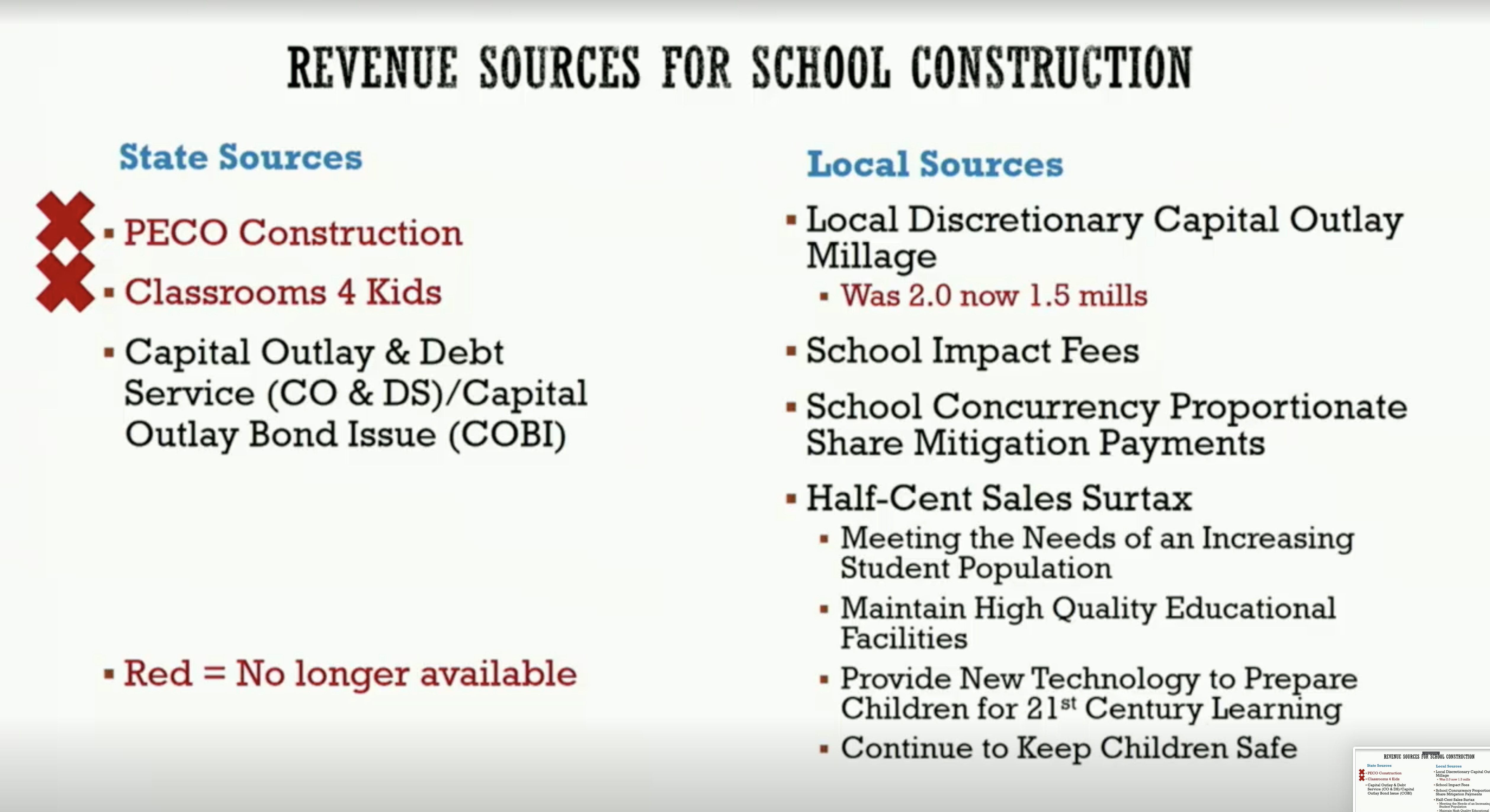
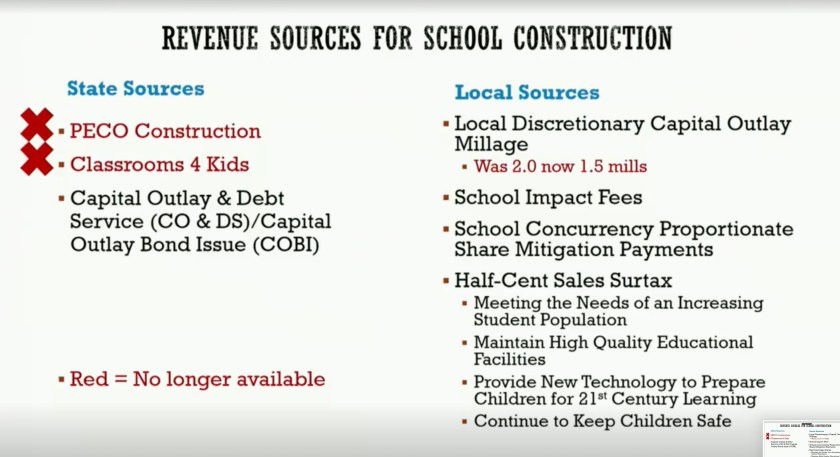
He shared that when the county was building schools in 2006, 2007, and 2008, there were significant state dollars that were used with local dollars to build the schools. That state funding is now gone.
Today, new construction of schools falls on the local communities. State sources and PECO (Public Education Capital Outlay) funding no longer exists. That is not because the state is not allocating the funds; it is because the funding sources have dried up.
NOTE: PECO funding comes from the state gross receipts tax from the sale of electricity, gas, and communications services (cable, cell phones, and land lines). As these tax receipts have decreased, so has funding for PECO.
There is no state source that will help build schools in today’s environment.
Commissioner Dean asked about the money from the Florida Lottery that is supposed to fund education. The lottery money is largely for Bright Futures, not K-12 education.
Looking at Local Sources, there are 4 primary sources:
- Local Discretionary Capital Outlay Millage (was 2.0, is now 1.5 mills)
- School Impact Fees
- School Concurrency Proportionate Share Mitigation Payments
- Half-Cent Sales Surtax
Capital Outlay millage can ONLY be spent on capital projects.
Impact fees are tiered based on the value of the home – timing is an issue.
School Proportionate Share Mitigation are based on a formula that is applied to a new construction project.
The Half-Cent surtax can only be spent on the four designated categories:
- Meeting the Needs of an Increasing Student Population
- Maintain High Quality Educational Facilities
- Provide New Technology to Prepare Children for 21st Century Learning
- Continue to Keep Children Safe
Timing of the sources:
The Millage is property tax – the school district doesn’t see that until the first time a property owner pays their property taxes. They money has to accumulate over time to fund new construction. Timeline is about 18 months before the district sees that money.
School Impact fees – paid by the homeowner when the new home is closed on.
School Concurrency fees – Mitigation fees. When a large project is phased, the proportionate share is paid when they are ready to move forward on a project. This is money that the school district gets in advance.
Sales Tax – purely economically driven
Why don’t more of these funding sources come earlier? It is taxpayer dollars and you can’t get too far ahead of the funding sources.
Not every county has Impact Fees and not every county does the work on the Proportionate Share funds. This is because not every county has capacity issues.
Not every county has the additional sales tax revenue for funding.
Observation was made that Florida’s funding of schools is not the same as other states and that can be confusing for parents coming from other states. The tax structures are so different as well as how schools are funded.
Commissioner Dean raised a question about the common belief that new schools cannot be built until the schools are at least 50% over capacity.
Answer? Statutes have changed over the years, since Mr. Forson has been involved since 2006, they have never been held from building a school because of a capacity number issue. They create a 5 year work plan, develop that workplan, and it’s approved. What stands in the way is the flow of dollars, not the state saying yes, you can build or no you can’t build.
You do need to build new schools at a size to operate in the black – there must be enough funding based on numbers of students to operate in the black.
The bonding capacity IS regulated by the state so the reduction in Millage from 2 to 1.5 did have an impact. They must complete a project before they can issue more bonds.
NOTE! School Board members have been perpetuating this urban legend – refer them back to this presentation the next time you hear it!
Commissioner Joseph asked if the School Board wanted more input into the approval of new homes.
Mr. Forson pointed out there are some legal considerations into how that happens. There are statutory and local requirements and mandates that drive the process. He did point out, they are at the table. The School Board does see the project and approves the mitigation portion before it goes to the Board of Commissioners.
School Board Member Mr. Canan wanted to refer the audience to the sales tax portion of the funding and underscore its importance. This was voted on and put in place at a time when school funds were drying up and there was no money for new schools. He asked Mr. Forson what the sales tax had funded.
Response:
- 2 new schools
- 2 partial schools that would probably have been only 1 school
- 1 school expansion
- 5,655 student stations have been built as a result of sales tax
The district would probably have about 4000 fewer seats in the system.
Mr. Forson indicated that In 10 years, the district has grown by 13,467 students to 52,000 students. Doing some fact checking, numbers in 2012 were 32,187 and numbers today are at ~52,000.
During that time, they have built 9 new schools, 3 expansions, and 3 are under construction now.
40% of that construction was based on sales tax funding.
There was further discussion about communication between the School Board and the County Commissioner’s regarding approval of new developments. Both School Board representatives and County representatives emphasized there is communication, and the School Board is engaged and aware of all new developments. They determine the proportionate fair share the developers pay and that is approved by the School Board before the Commissioners make their determination.
You can watch Mr. Forson’s presentation here: Superintendent Forson’s Presentation
Presentation of school-related infrastructure projects
Colin Groff Interim Deputy County Administrator presented on the Infrastructure projects.
He began the discussion with an explanation about the concurrency and proportionate share process.
When a developer brings forward a project, before anyone on the Board of Commissioners sees it for approval, that project has gone through the School Board and they have looked at the concurrency and said, “yes we have the capacity.” If they do not sign off on the project, it stops right there and does not move forward until the capacity deficit is addressed.
If the capacity is not there, the developer may choose to pause, or to pay the proportionate share agreement that is approved by the School Board for the developer to fund their portion of future schools.
Important to note that the process stops and the project does not move forward to the County Commissioners for review unless there is capacity or an agreement to fund future capacity. The School Board does play a role in that process.
Capital Project Updates
Dr. Asplen presented on the current school projects. He answered a question about a new High School with a projected date of around 2027 – 2028.
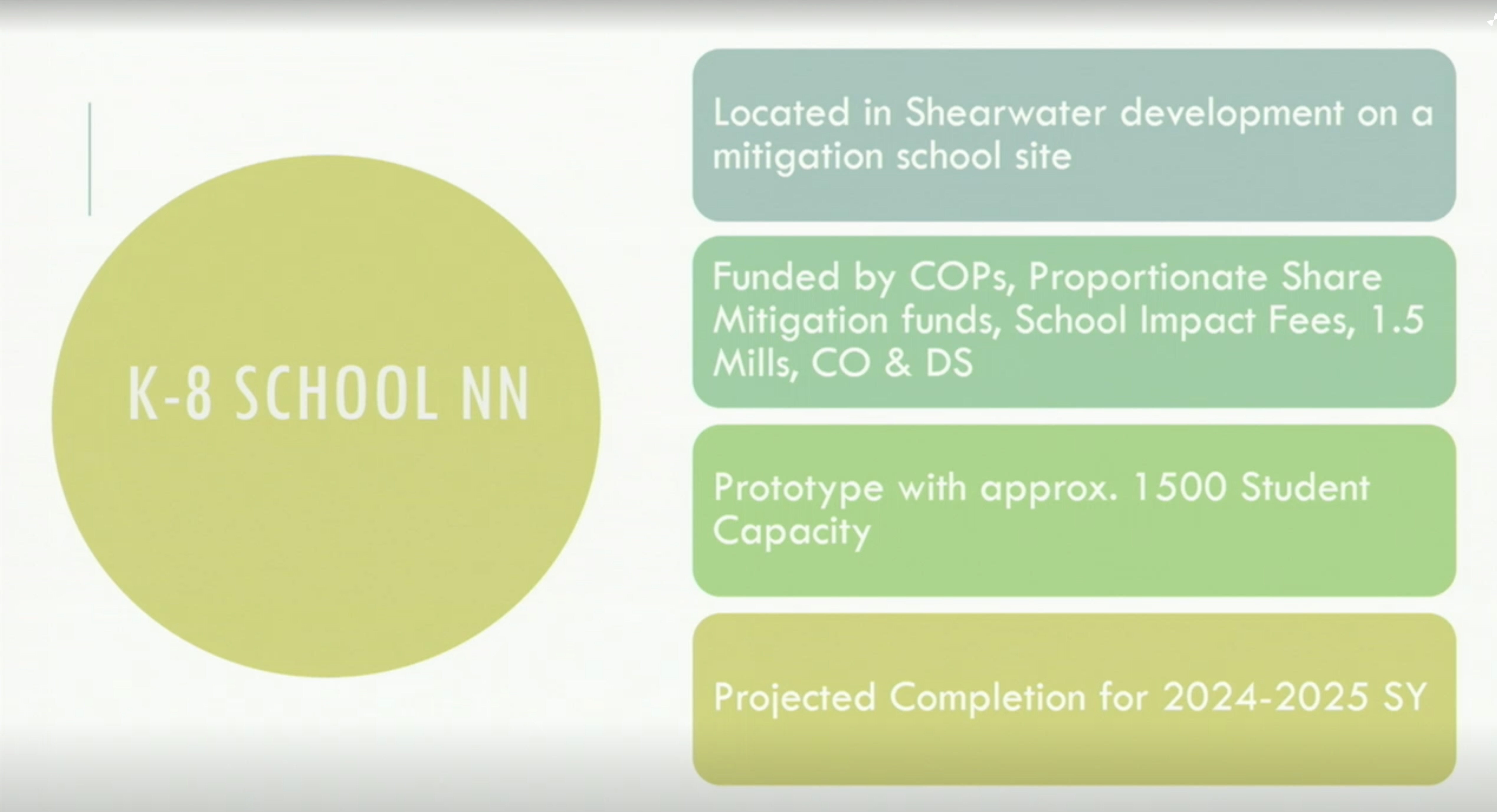
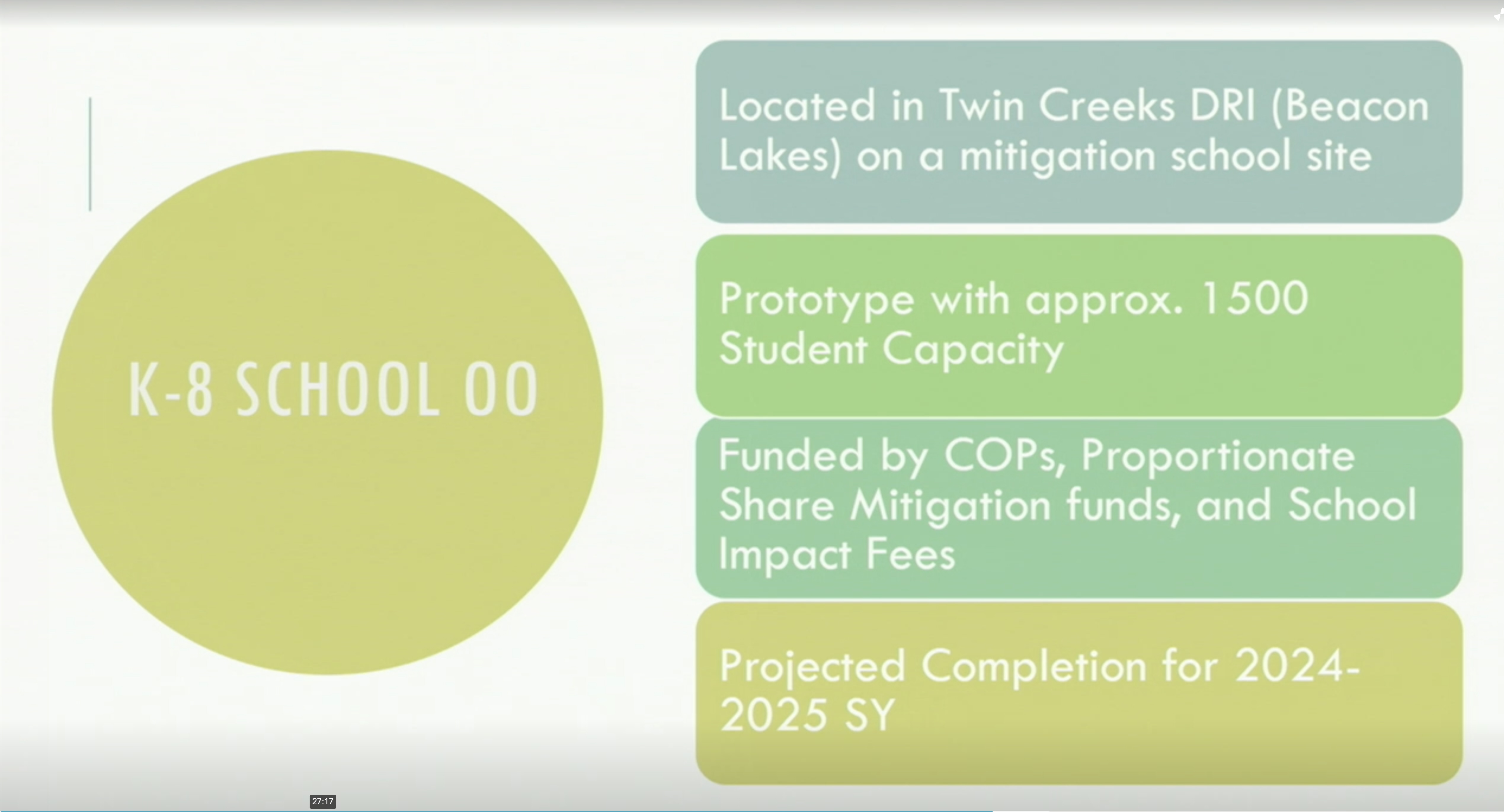
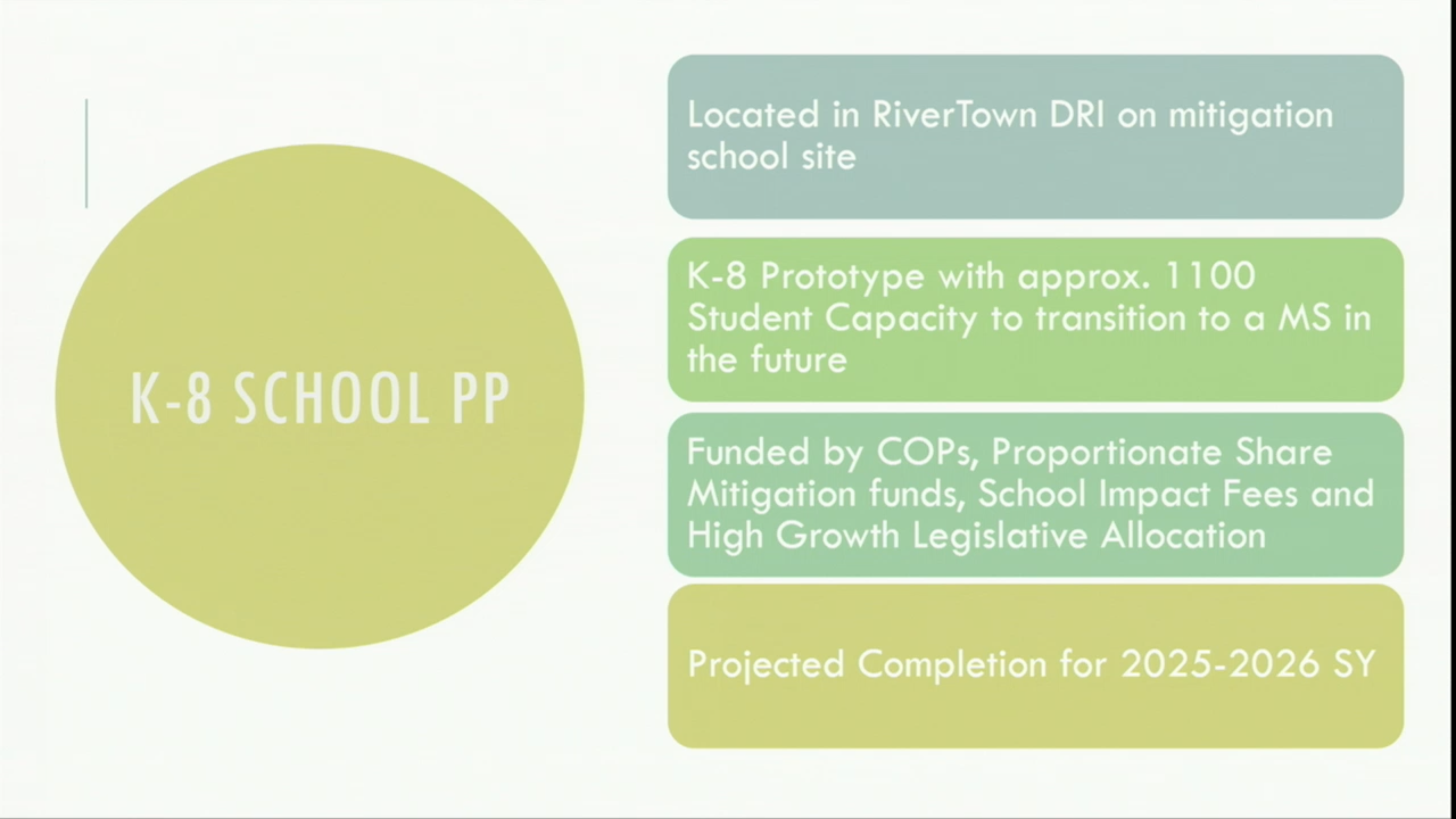
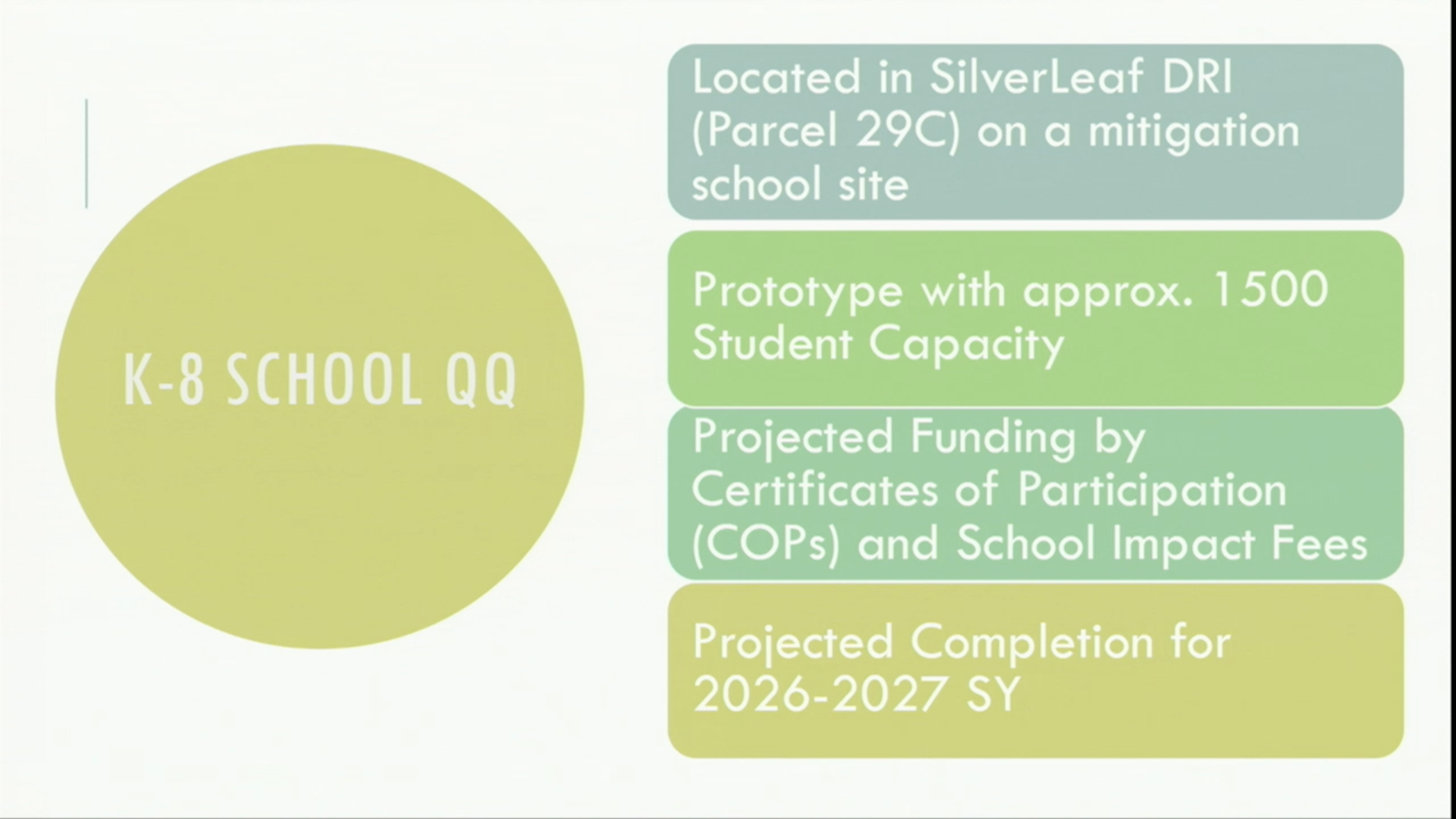
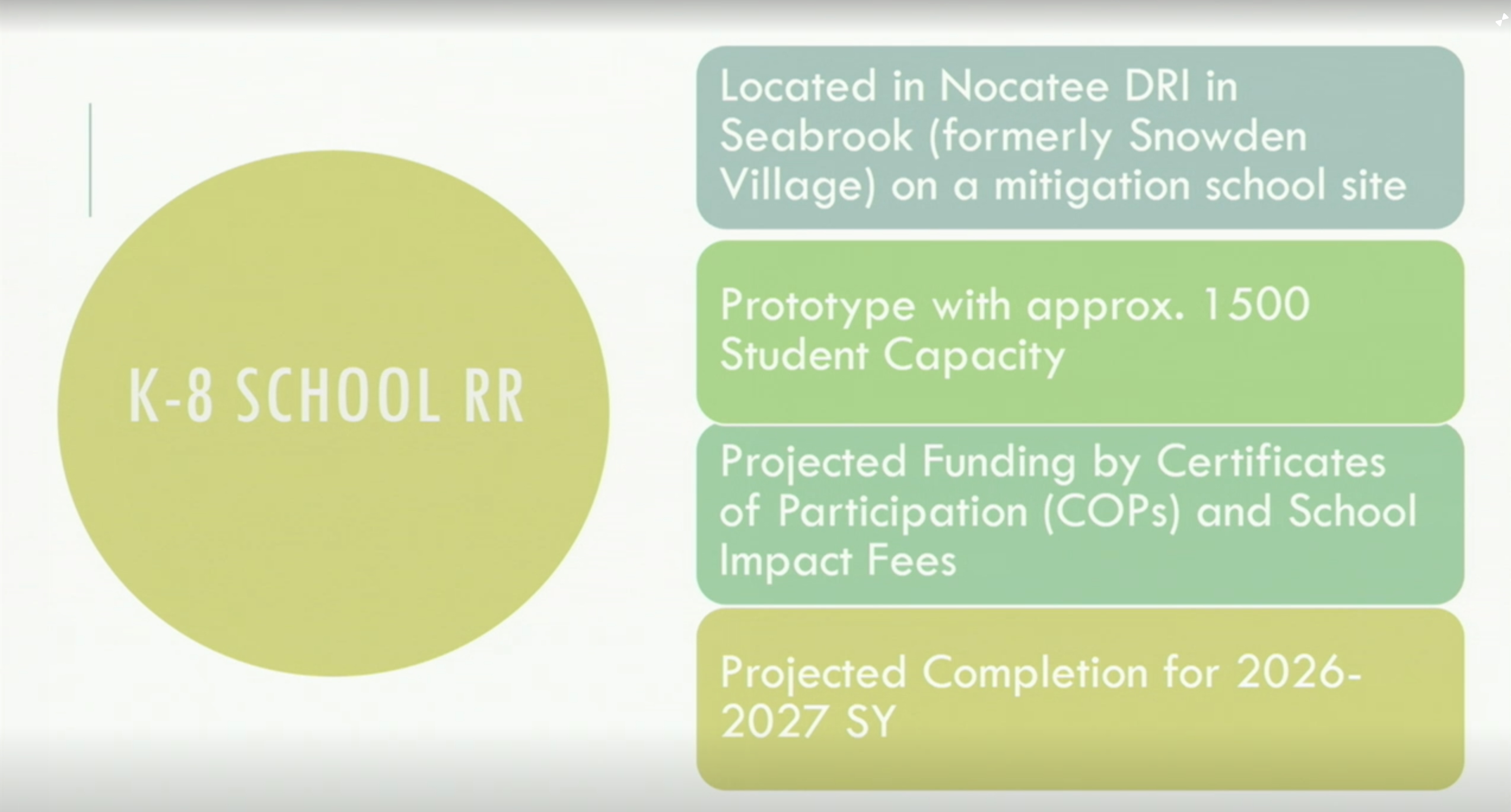

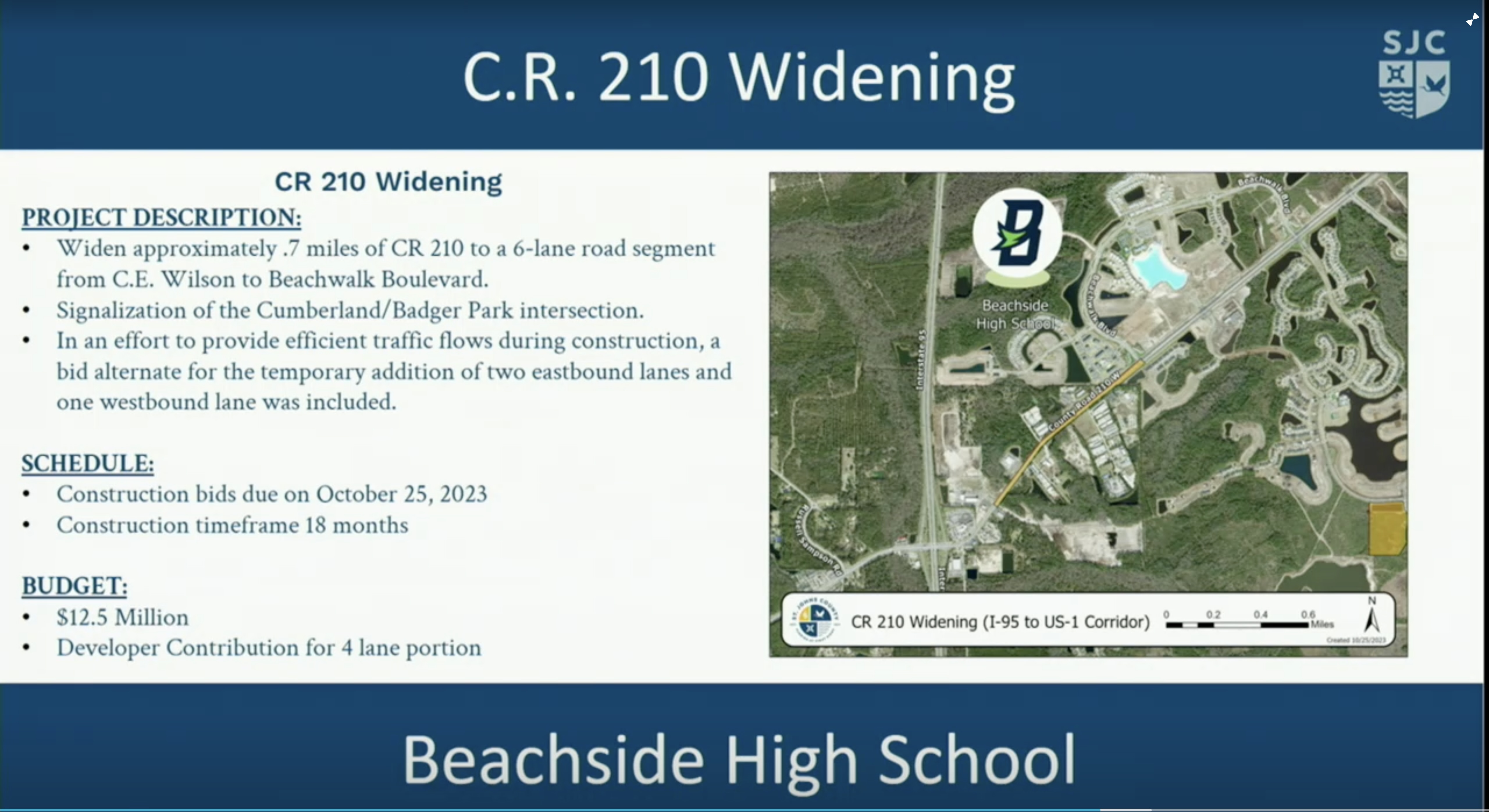
Colin Groff presented on the school related Infrastructure Projects

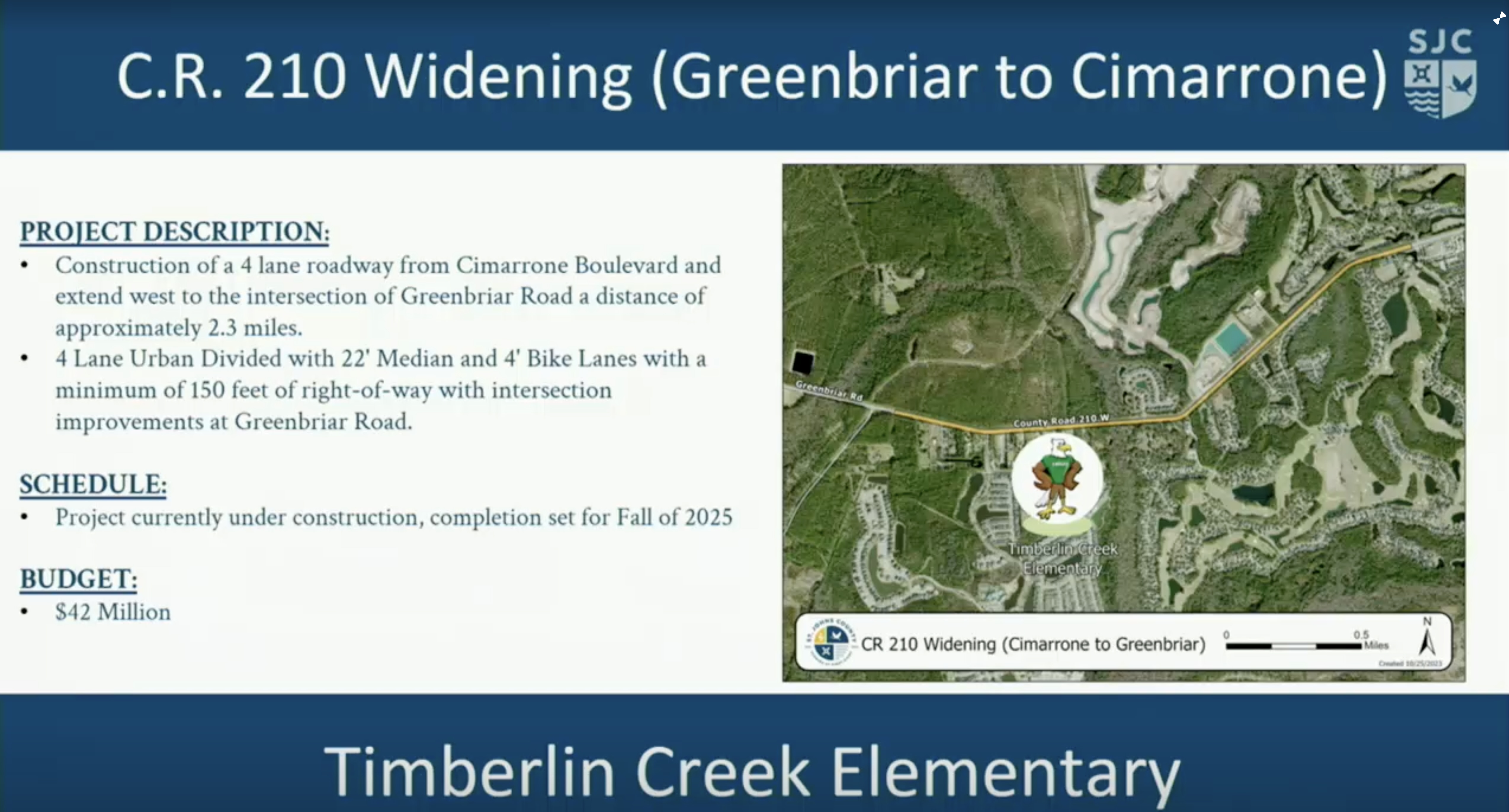
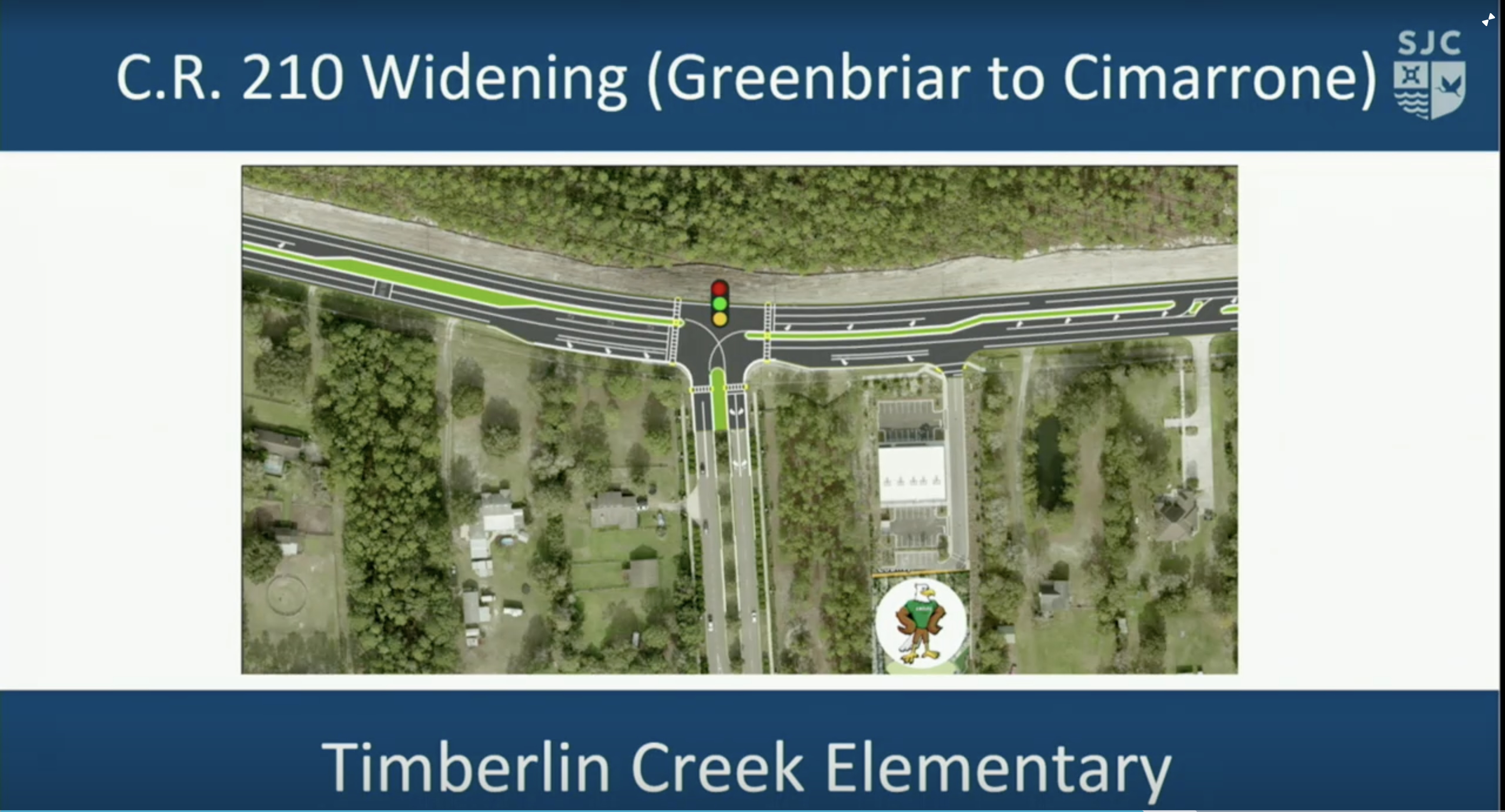
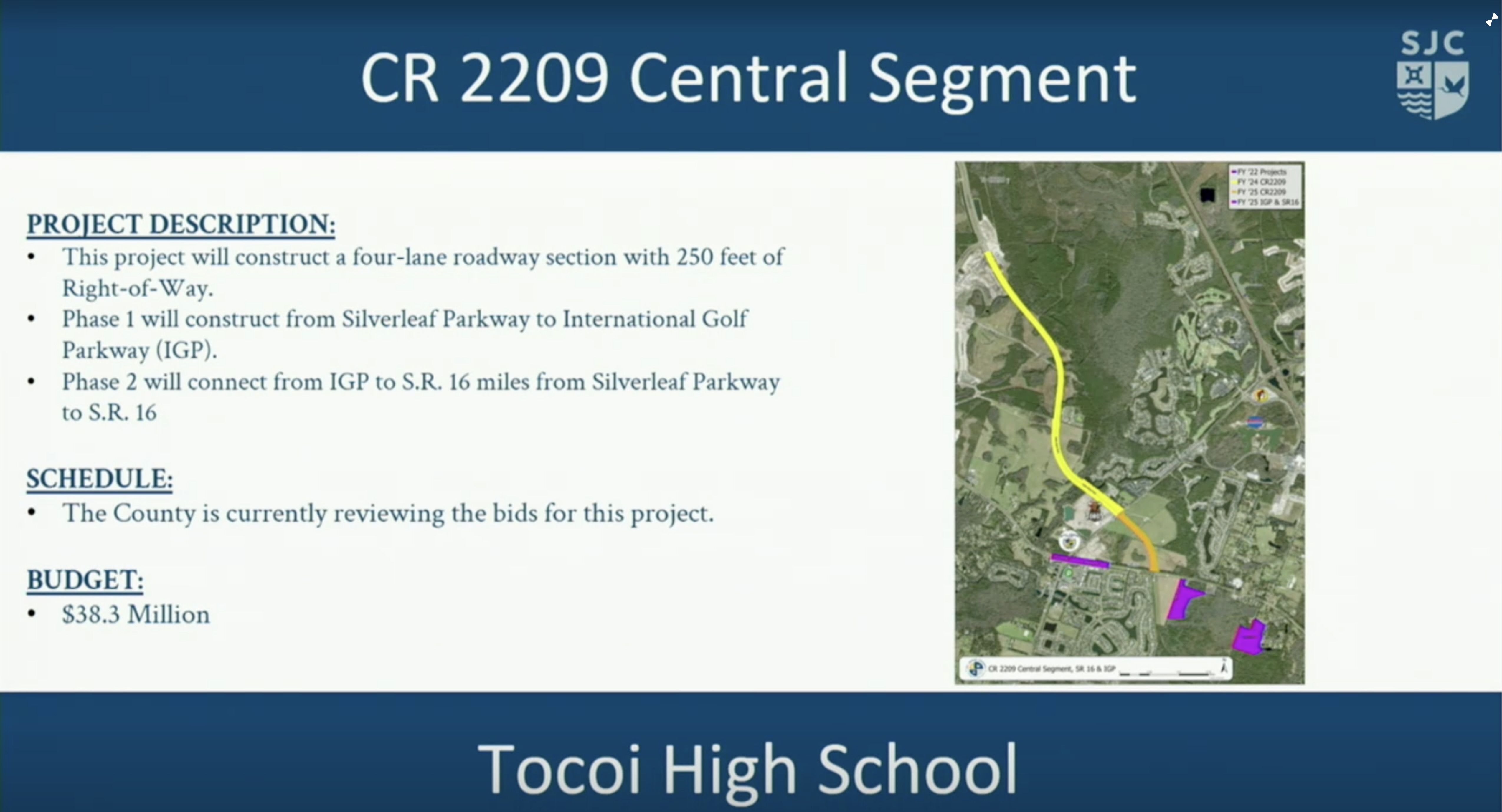
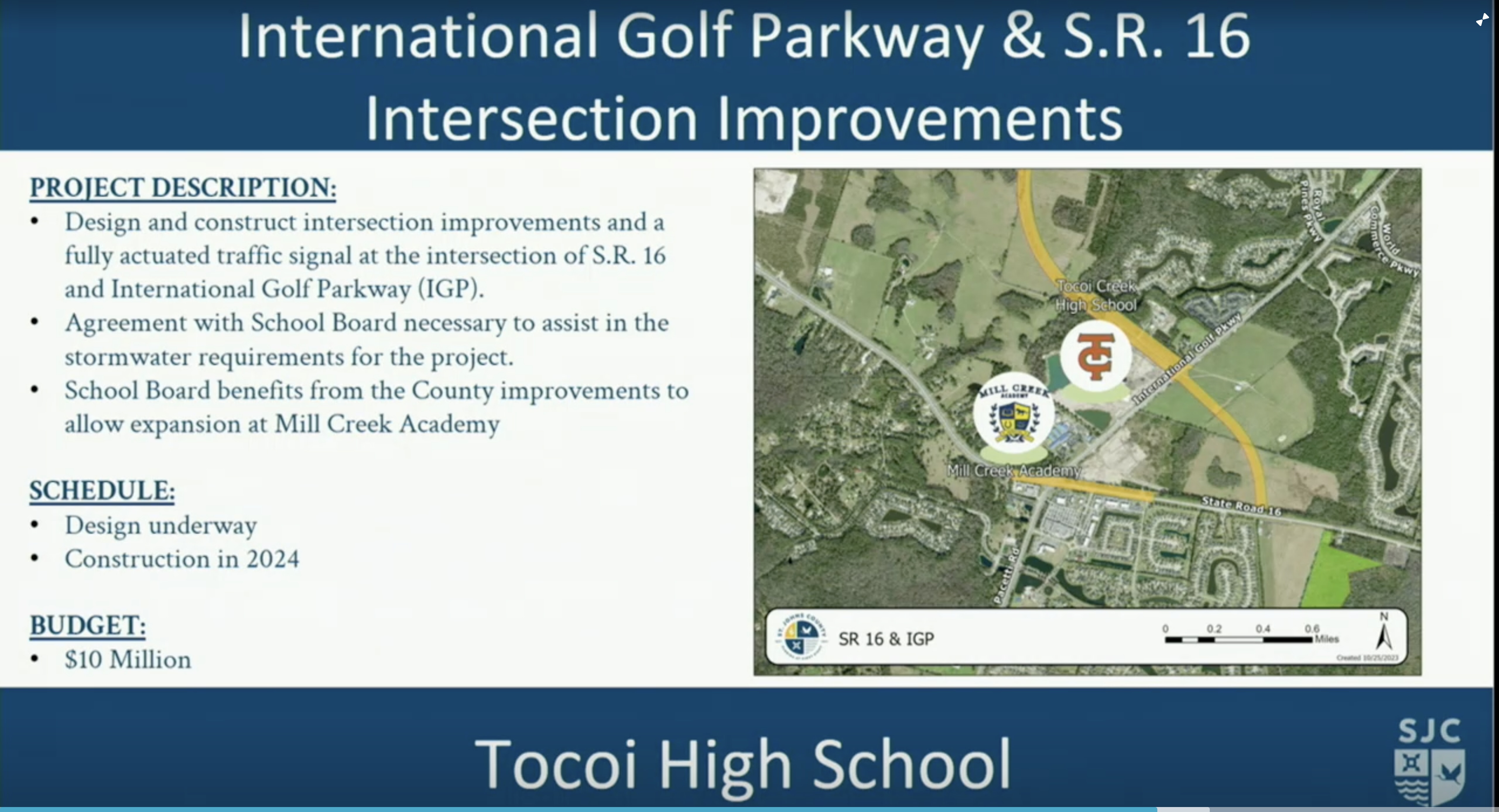
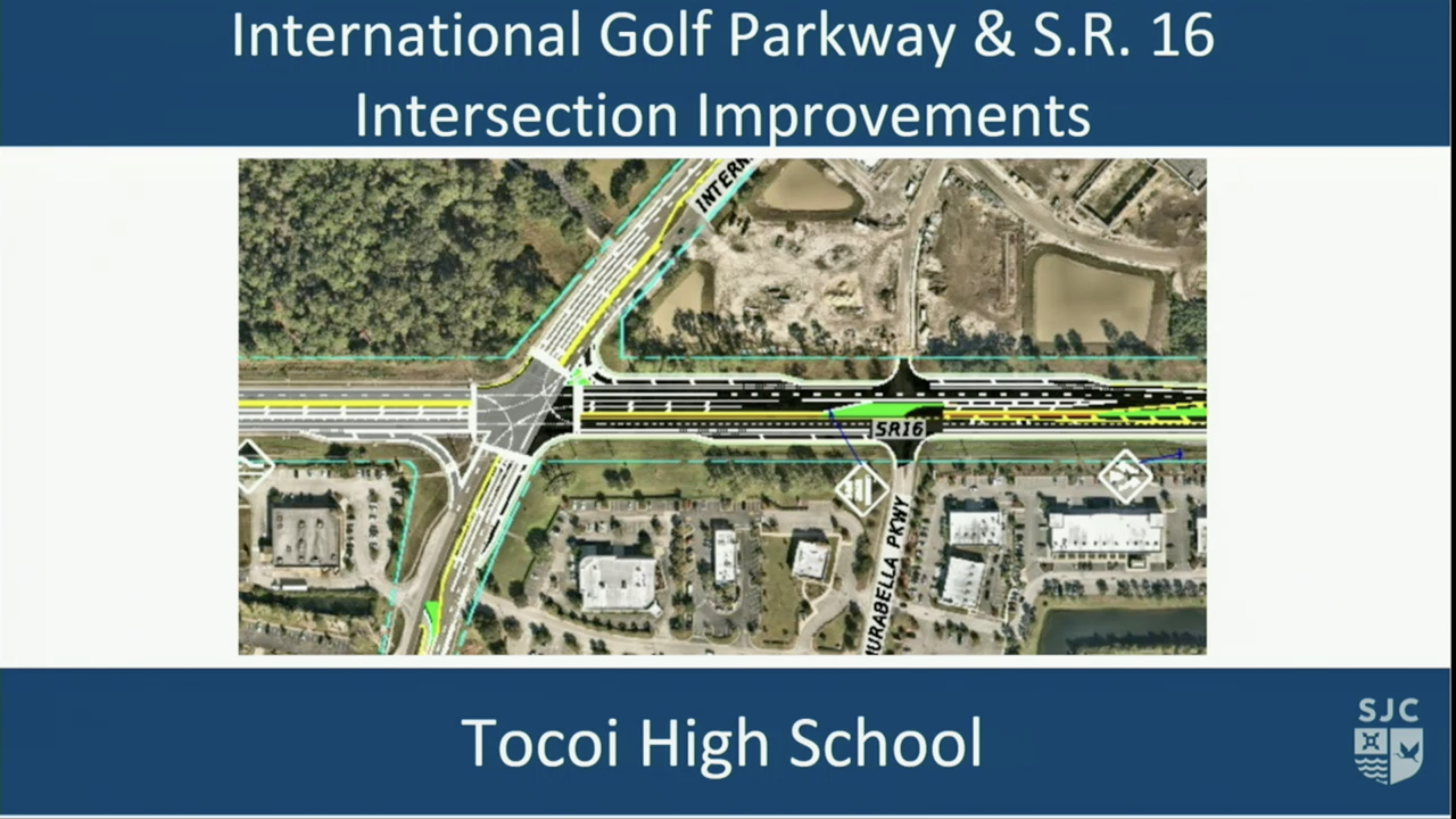
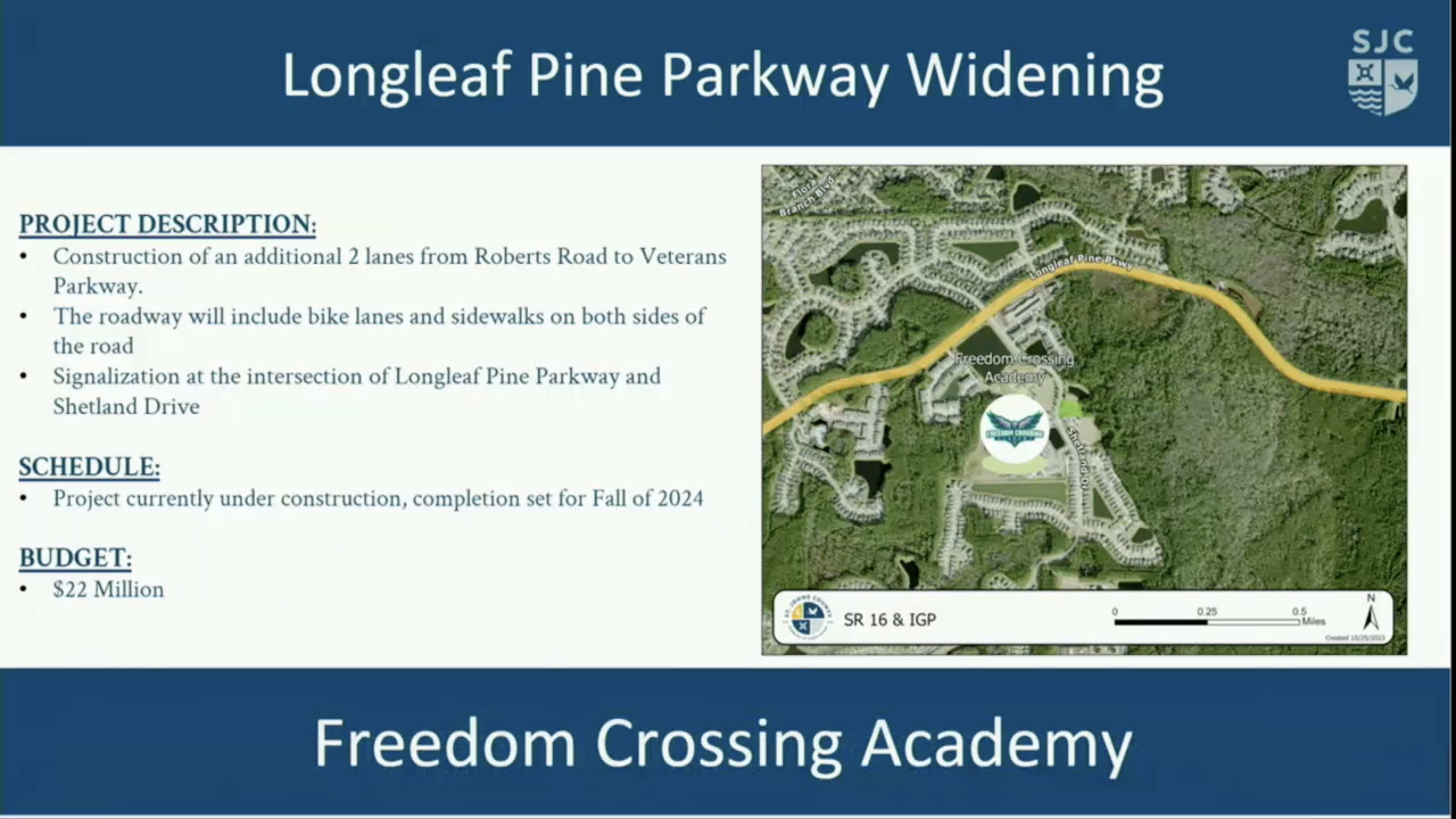
Adam Teckler, Legislative Affairs Manager, presented some next steps.
State Board of Education Report is due by November 1
Purpose is to reduce unnecessary regulation on public schools. Expected to review cost per student station formula and options for high growth school districts. May also address student transportation.
After a brief recess, they heard Public Comment.
Public comments were shared about:
- Teacher pay
- Appreciation for this meeting and hope for continued joint meetings
- Don’t forget the older communities and their school needs
- Need for more middle schools and high schools
You can watch the entire presentation at this link: https://stjohnscountyfl.new.swagit.com/videos/277579
If you are finding value in these updates, please subscribe to my blog so you get notifications when I publish an update. Feel free to share with others who may find value in the content.
 Beth Tate