We are down to the final days of what has been a contentious year of campaigning. Several of our key local elected officials will be decided in the August primary—not in the November general election:
County Commission Districts 2 and 4
School Board District 1
City of St. Augustine Commission Seat 5
The City Commission race will appear only on the ballots of voters who live within the City of St. Augustine.
This is not the primary to sit out.
Know Which Races You Can Vote In
This year, our County Commission races are Universal Primary Contests. Because all the candidates in these races are members of the same political party, every registered voter in St. Johns County may vote in them, regardless of party affiliation.
Many voters are confused about districts and which candidates will appear on their ballots.
For School Board, you may vote only for the candidate representing the district in which you live.
County Commission works differently. Commissioners must live in the districts they represent, but they are elected countywide. That means every registered voter in St. Johns County may vote in the District 2 and District 4 County Commission races—not only voters who live in those districts.
There has also been considerable discussion about where County Commission candidates are required to live.
A candidate does not have to live in the district throughout the campaign. The residency requirement must be met before taking office.
That distinction matters in the District 2 race. One candidate lived in District 5 during most of the campaign and recently shared that he moved into District 2 on August 1. Some voters have questioned whether he lives in District 2; he has responded that he does.
Voters can decide for themselves whether the timing of that move matters to them. But the legal question of residency and a voter’s judgment about a candidate’s connection to the district are two different questions.
Don’t Let Someone Else Choose for You
Every election cycle, a LOT of organizations produce voter guides recommending their preferred candidates.
In 2022, I was at a polling location where representatives were distributing three different guides: a Trump Club voter guide, a Republican Executive Committee voter guide and a Republican Liberty Caucus voter guide.
One young man stood there holding all three, trying to decide which one he should follow. Meanwhile, the people distributing them were arguing and shouting at him:
“Use this one!”
“No, use this one!”
If you wait until you arrive at the polls to pick up a voter guide, you have missed your opportunity to cast a genuinely informed vote. You are leaving your choice to another group whose priorities you may or may not share.
Voter guides can provide useful information. But they should be part of your research—not a substitute for doing it.
Look Beyond the Campaign Message
Read the candidates’ answers to questionnaires. Watch the recorded forums. Compare what candidates say to different audiences.
Forums are especially helpful because they reveal more than prepared campaign positions. They can give you a glimpse of how a candidate thinks, communicates and responds when challenged.
Before casting your ballot, consider:
Does this person represent the values I want on the board?
Do they demonstrate the character and judgment the office requires?
Do they understand the responsibilities—and the legal limits—of the position they are seeking?
What do they stand for, beyond what they oppose?
What specifically do they want to accomplish to move our county forward?
Have they explained how their proposals would be implemented and funded?
Do they have the temperament to work with colleagues, staff and community stakeholders?
How do they respond when challenged or asked a question they did not anticipate?
Are their claims supported by facts?
Are they offering workable solutions, or primarily identifying people and institutions to blame?
Do they demonstrate a meaningful connection to the district they seek to represent, even though the entire county votes in County Commission races?
Who is supporting and funding their campaign, and what might those supporters expect from them?
No candidate will agree with you on everything. The question is whether that person has the values, competence, judgment and temperament to govern responsibly.
I have been sent some endorsements for candidates and been asked to share them. I am intentionally not including endorsements, just the forums and tools for you to do your own research.
I have included links below to recorded candidate forums and official election information. Take the time to watch and read them before you cast your ballot.
Then show up—during early voting or on Election Day—and make your own decision.
League of Women Voter’s Interview with Tammie McClafferty.Candidate for School Board District 4
There was an April Candidate Forum sponsored by the St. Johns County Republican Assembly. I was unable to find a link to the video of that event. If I locate it, I will add to the post.
If you are finding value in these updates, please subscribe to my blog so you get notifications when I publish an update. Feel free to share with others who may find value in the content.
And the Commissioner and School Board races have shifted with some surprises. The biggest shift this year is that the 2026 elections for Board of County Commissioners are Universal Open Primaries. What does that mean? Because all candidates who qualified for these races are members of the same political party and there are no write-in candidates, Florida election law requires these races to be conducted as Universal Open Primaries, allowing all registered voters to participate regardless of party affiliation.
For the first time in recent history, all registered voters, regardless of party affiliation, will be able to vote in the Primary for Commissioner. In the past, voters who had registered as NPA, Democrat, or one of the minor parties had no voice in the Commissioner votes.
That means this year more voters will have a direct voice in selecting County Commissioners than in past election cycles. Whether that translates into higher turnout remains to be seen, but it certainly creates an opportunity for broader participation in local government. Previously, many voters just stayed home as the Commissioner’s race was the most critical vote for the County in the Primary. This year, having more non-Republican registered voters show up at the polls could impact the down ballot votes for School Board and special districts, as well. This will be an exciting year for all St. Johns County voters!
As of the close of qualifying, here is what the ballot currently looks like for St. Johns County voters.
Commissioner Races:
Commissioner, District 2
As anticipated, incumbent Commissioner Sarah Arnold did not file to run. In a surprise move, a 4th candidate entered the race just 5 days before qualifying, and qualified.
As you listen to candidates and learn about their platforms this year, I encourage you to hear from them directly. Attend a town hall. Ask questions. Visit their websites. Follow their social media pages.
Too often, voters learn about candidates through attack ads, social media rumors, or secondhand commentary. This year, let’s make an effort to evaluate candidates based on their own words, ideas, and vision for St. Johns County.
Let’s learn what a candidate stands FOR, not simply what they oppose.
Let’s learn how a candidate intends to move our county forward, not just how they plan to stop someone else.
Most importantly, let’s remember that public service requires courage. Every candidate on this ballot has stepped forward, completed the qualification process, and offered themselves for public scrutiny and voter consideration. Regardless of who earns your vote, that commitment deserves a measure of respect.
Behind every candidate are family members, friends, neighbors, and supporters who care deeply about them. Let’s have spirited debates, ask tough questions, and engage thoughtfully—but let’s also be kind to one another.
If you are finding value in these updates, please subscribe to my blog so you get notifications when I publish an update. Feel free to share with others who may find value in the content.
Continuing the discussion on the 2026 St. Johns County election, let’s focus on the School Board races today.
School Board positions in St.Johns County are Non-Partisan positions. Unlike the Board of County Commissioners where every one in the county votes for Commissioners, School Board positions are voted on only by the voters in the specific District the Board Member represents.
School Board elections begin in the Primary Election. They are open to all voters in the District with an open seat and will appear on all ballots, regardless of party affiliation. So you do NOT have to be registered with a particular Party to vote for these non-partisan positions.
If a race has 3 or more candidates, the election may move on to the General. If a candidate gets a majority (50% + 1 vote) that candidate will win in the Primary. If none of the 3 gets a majority, the top 2 candidates move on to the General Election.
This shows why it is important to vote in the Primary AND the General Election!
This year we have open seats in Districts 1, 3, and 4. Those seats are currently held by Beverly Slough (D1), Jennifer Collins (D3), and Kelly Barrera (D4.) We’ll walk through the candidates in each district.
Beverly Slough and Jennifer Collins have both filed to run again; Ms. Barrera has not.
Information below is provided to assist you with your own research and is not an endorsement of any particular candidate.
He has begun conducting small group meetings in District 1 for voters to learn more about him.
Matthew (Matt) Ross – The candidate appears to be using his personal FB page to advocate for School Board. I was not able to find an independent FB page or website.
Beverly Slough – Ms. Slough has served on the School Board since 2002 and is currently the Board Chair. I was not able to find a separate FB page or website for Ms. Slough’s campaign.
As you consider the right choice for your vote in District 1, 3, or 4, I encourage you to review their websites. Understand their motivation for running for this important role, and what their vision for the School System may mean for the future of education in St. Johns County.
If you are finding value in these updates, please subscribe to my blog so you get notifications when I publish an update. Feel free to share with others who may find value in the content.
Yesterday was a rare occurrence, a joint meeting of the 2 Board that have the future of our County in their hands.
The live audience was sparse, with more School District and County employees on hand than general public. This may be because of short notice and little publicity about the meeting.
The meeting opened with a surprise guest invited by Commissioner Chair, Christian Whitehurst.
Commissioner Whitehurst had met with Senator Travis Hutson last week and discussed some of the items on the agenda for the joint meeting. He invited Senator Hutson to speak to the group. As he introduced Senator Hutson, he pointed out that the school concerns are a “three-legged stool” with the School District, the County, and the delegation in Tallahassee providing solutions.
Senator Hutson shared that he had already begun some work on deregulation around education. He noted that St. Johns County has always been a high growth county, since he was elected to the House, working with Senator Thrasher at the time, they brought millions of dollars back to the county for education. He shared that the money that can be brought back to the county is based on a mathematical formula based on the needs and performance of the county.
Last year the total funds that could be used were about $40 million in total and 3 or 4 other counties made that list, with St. Johns County falling to be bottom of that list. Out of that dollar amount, St. Johns County only got about $1 million based on needs, compared to the other counties on the list.
He noted this is a statewide issue. There are policies on the books that have “hamstrung” the school districts with the bureaucracy. Example is that you have to build schools to hurricane standards now. This is requiring schools to be built to higher standards than necessary and that increases the cost. Not all schools need to be built that way – changing this formula could allow funds to be used for additional schools, not hardening schools.
There are also limits on how specific dollars can be spent for specific uses. That means dollars are tied to very specific uses – they can’t be used for other uses.
In the next couple of weeks, they will be launching a series of deregulation bills (for education) and will be working directly with the school board and others to refine those bills. Senator Hutson’s bills will be specifically about construction and the physical impact. He has a draft, but it is not ready for prime time.
During comments from the dais for Senator Hutson, School Board Member Canan mentioned the frustrations about money for the teachers as well as some of the mandates that are placed on teachers by Tallahassee.
Commissioner Dean took the time to point out that many of the homes that are being built today were actually approved long before the existing School Board and County Commissioners were on the boards.; 80% of the homes constructed since 2016 were approved during the process between 2000 and 2008. Roughly 40,000 homes remain to be built that were approved prior to 2008.
Overview of the School Construction Funding Process
Next up was School Superintendent Tim Forson and a presentation on how new schools are funded.
Mr. Forson talked about the complexity of funding sources for building new schools.
There are 2 silos of budget funds, Operating Funds and Capital Funding. The two funds cannot be intermingled or used for other purposes. Operating Funds are more Human Resources focused, daily operations of the schools. Capital Funding is for buildings.
He shared that when the county was building schools in 2006, 2007, and 2008, there were significant state dollars that were used with local dollars to build the schools. That state funding is now gone.
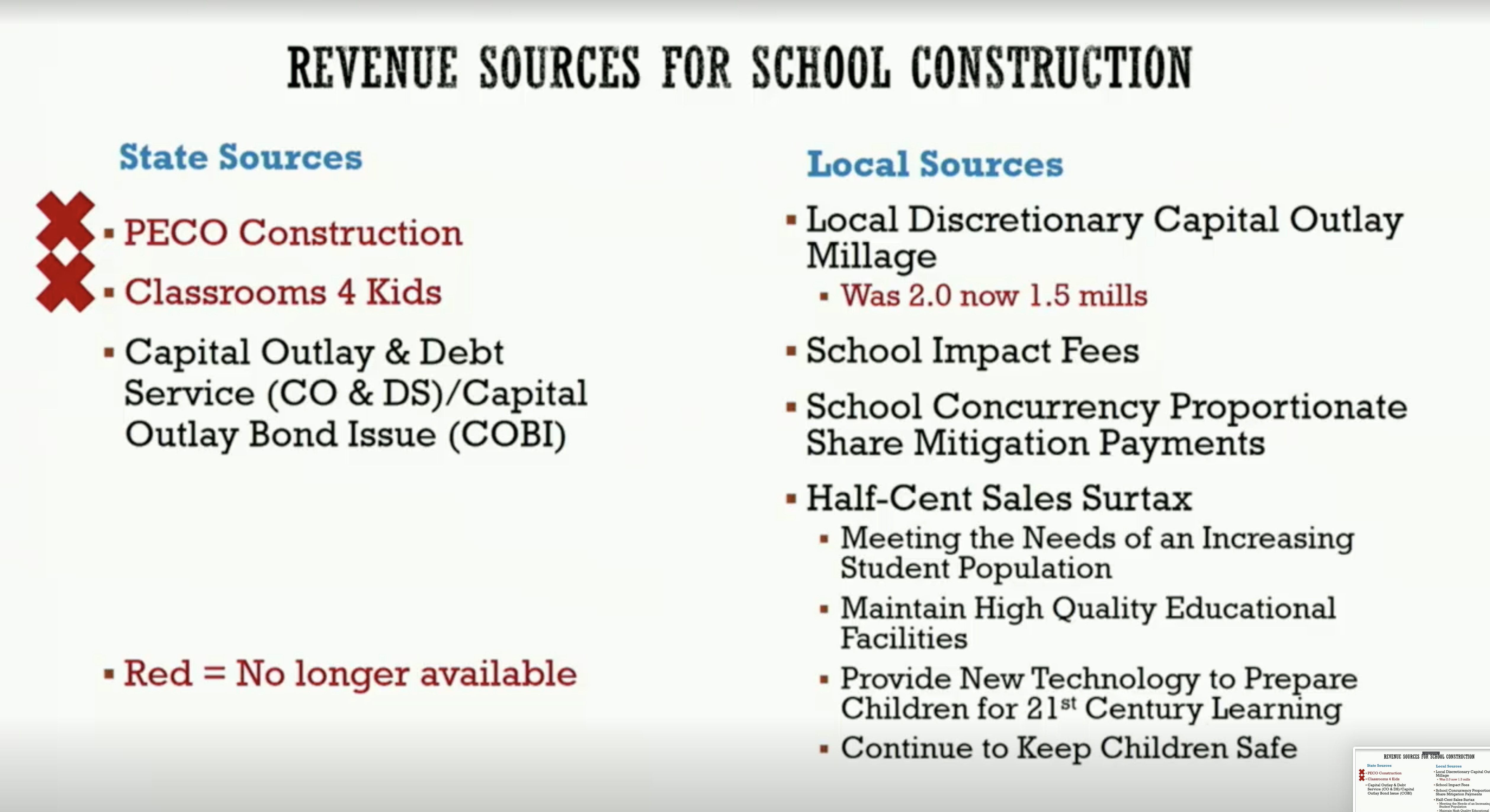
Today, new construction of schools falls on the local communities. State sources and PECO (Public Education Capital Outlay) funding no longer exists. That is not because the state is not allocating the funds; it is because the funding sources have dried up.
NOTE: PECO funding comes from the state gross receipts tax from the sale of electricity, gas, and communications services (cable, cell phones, and land lines). As these tax receipts have decreased, so has funding for PECO.
There is no state source that will help build schools in today’s environment.
Commissioner Dean asked about the money from the Florida Lottery that is supposed to fund education. The lottery money is largely for Bright Futures, not K-12 education.
Looking at Local Sources, there are 4 primary sources:
Local Discretionary Capital Outlay Millage (was 2.0, is now 1.5 mills)
School Impact Fees
School Concurrency Proportionate Share Mitigation Payments
Half-Cent Sales Surtax
Capital Outlay millage can ONLY be spent on capital projects.
Impact fees are tiered based on the value of the home – timing is an issue.
School Proportionate Share Mitigation are based on a formula that is applied to a new construction project.
The Half-Cent surtax can only be spent on the four designated categories:
Meeting the Needs of an Increasing Student Population
Maintain High Quality Educational Facilities
Provide New Technology to Prepare Children for 21st Century Learning
Continue to Keep Children Safe
Timing of the sources:
The Millage is property tax – the school district doesn’t see that until the first time a property owner pays their property taxes. They money has to accumulate over time to fund new construction. Timeline is about 18 months before the district sees that money.
School Impact fees – paid by the homeowner when the new home is closed on.
School Concurrency fees – Mitigation fees. When a large project is phased, the proportionate share is paid when they are ready to move forward on a project. This is money that the school district gets in advance.
Sales Tax – purely economically driven
Why don’t more of these funding sources come earlier? It is taxpayer dollars and you can’t get too far ahead of the funding sources.
Not every county has Impact Fees and not every county does the work on the Proportionate Share funds. This is because not every county has capacity issues.
Not every county has the additional sales tax revenue for funding.
Observation was made that Florida’s funding of schools is not the same as other states and that can be confusing for parents coming from other states. The tax structures are so different as well as how schools are funded.
Commissioner Dean raised a question about the common belief that new schools cannot be built until the schools are at least 50% over capacity.
Answer? Statutes have changed over the years, since Mr. Forson has been involved since 2006, they have never been held from building a school because of a capacity number issue. They create a 5 year work plan, develop that workplan, and it’s approved. What stands in the way is the flow of dollars, not the state saying yes, you can build or no you can’t build.
You do need to build new schools at a size to operate in the black – there must be enough funding based on numbers of students to operate in the black.
The bonding capacity IS regulated by the state so the reduction in Millage from 2 to 1.5 did have an impact. They must complete a project before they can issue more bonds.
NOTE! School Board members have been perpetuating this urban legend – refer them back to this presentation the next time you hear it!
Commissioner Joseph asked if the School Board wanted more input into the approval of new homes.
Mr. Forson pointed out there are some legal considerations into how that happens. There are statutory and local requirements and mandates that drive the process. He did point out, they are at the table. The School Board does see the project and approves the mitigation portion before it goes to the Board of Commissioners.
School Board Member Mr. Canan wanted to refer the audience to the sales tax portion of the funding and underscore its importance. This was voted on and put in place at a time when school funds were drying up and there was no money for new schools. He asked Mr. Forson what the sales tax had funded.
Response:
2 new schools
2 partial schools that would probably have been only 1 school
1 school expansion
5,655 student stations have been built as a result of sales tax
The district would probably have about 4000 fewer seats in the system.
Mr. Forson indicated that In 10 years, the district has grown by 13,467 students to 52,000 students. Doing some fact checking, numbers in 2012 were 32,187 and numbers today are at ~52,000.
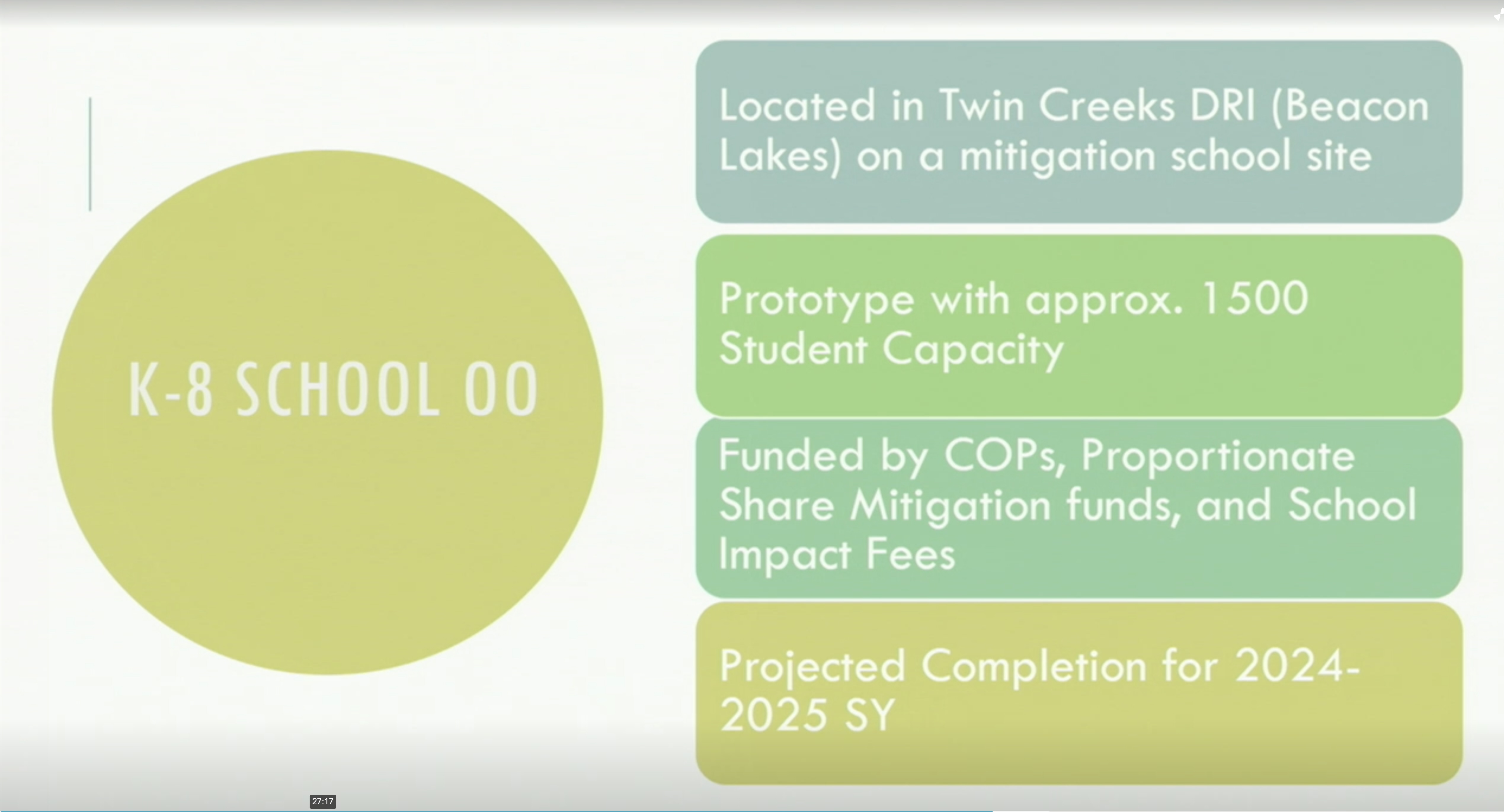
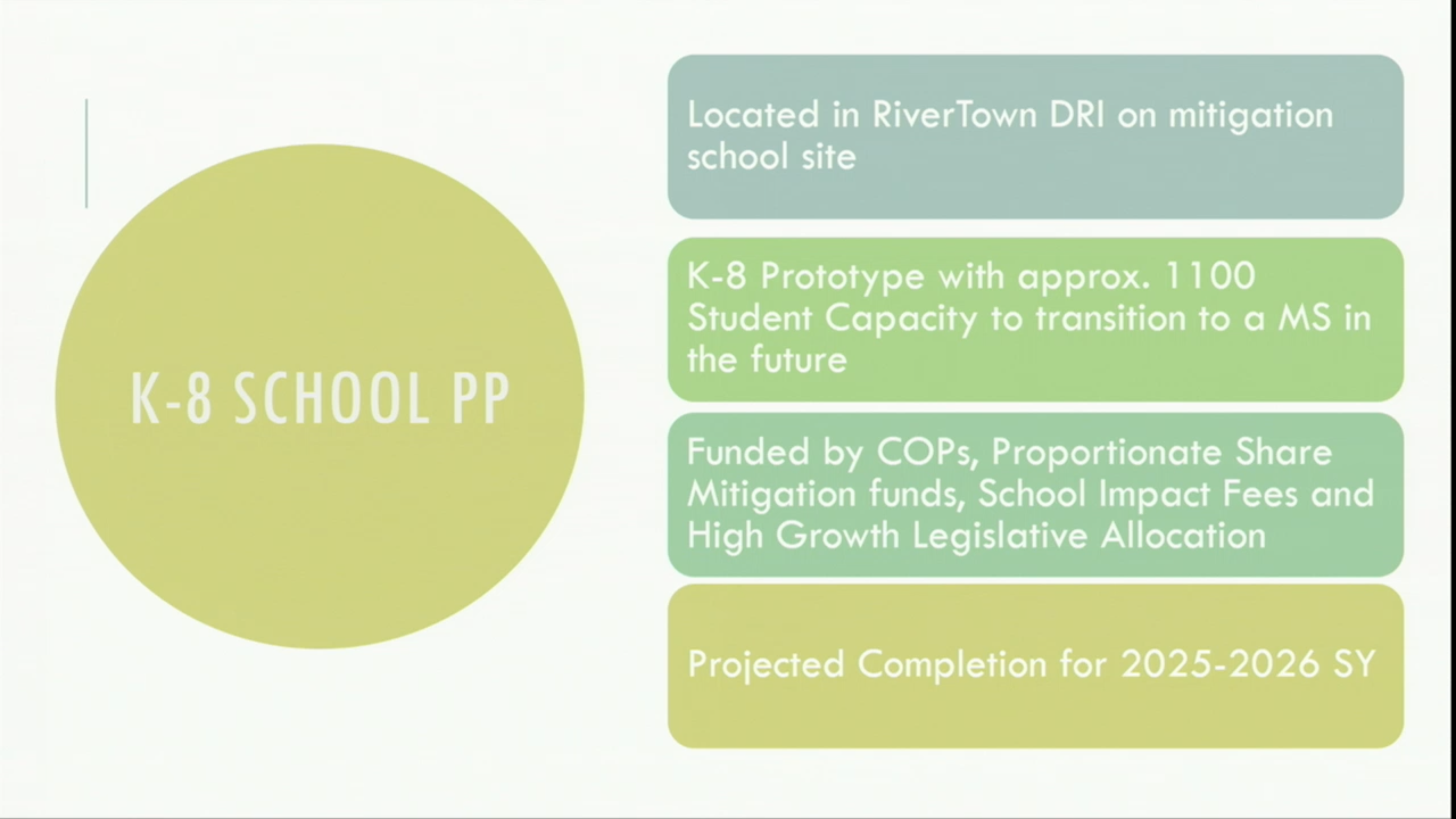
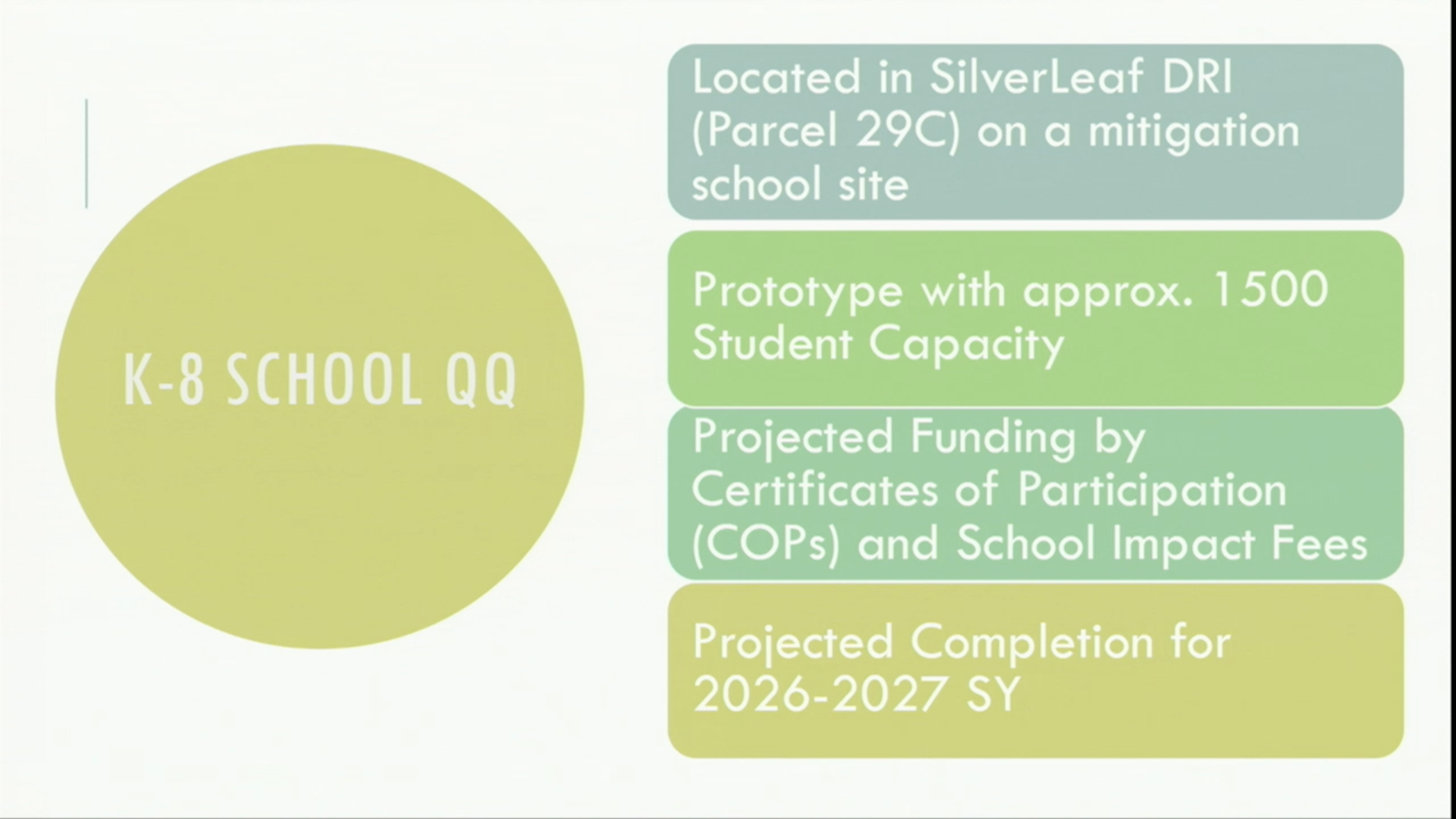
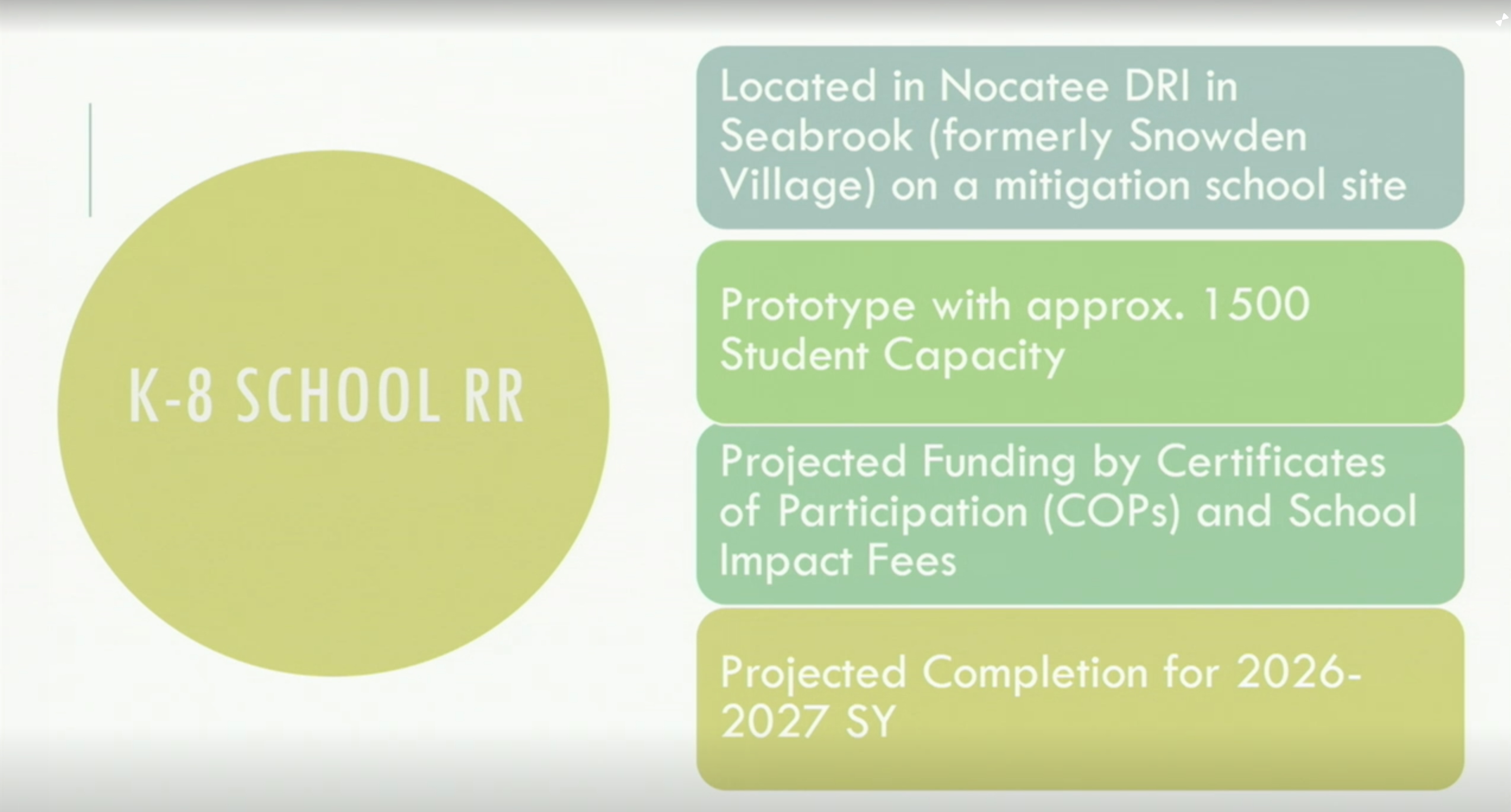
During that time, they have built 9 new schools, 3 expansions, and 3 are under construction now.
40% of that construction was based on sales tax funding.
There was further discussion about communication between the School Board and the County Commissioner’s regarding approval of new developments. Both School Board representatives and County representatives emphasized there is communication, and the School Board is engaged and aware of all new developments. They determine the proportionate fair share the developers pay and that is approved by the School Board before the Commissioners make their determination.
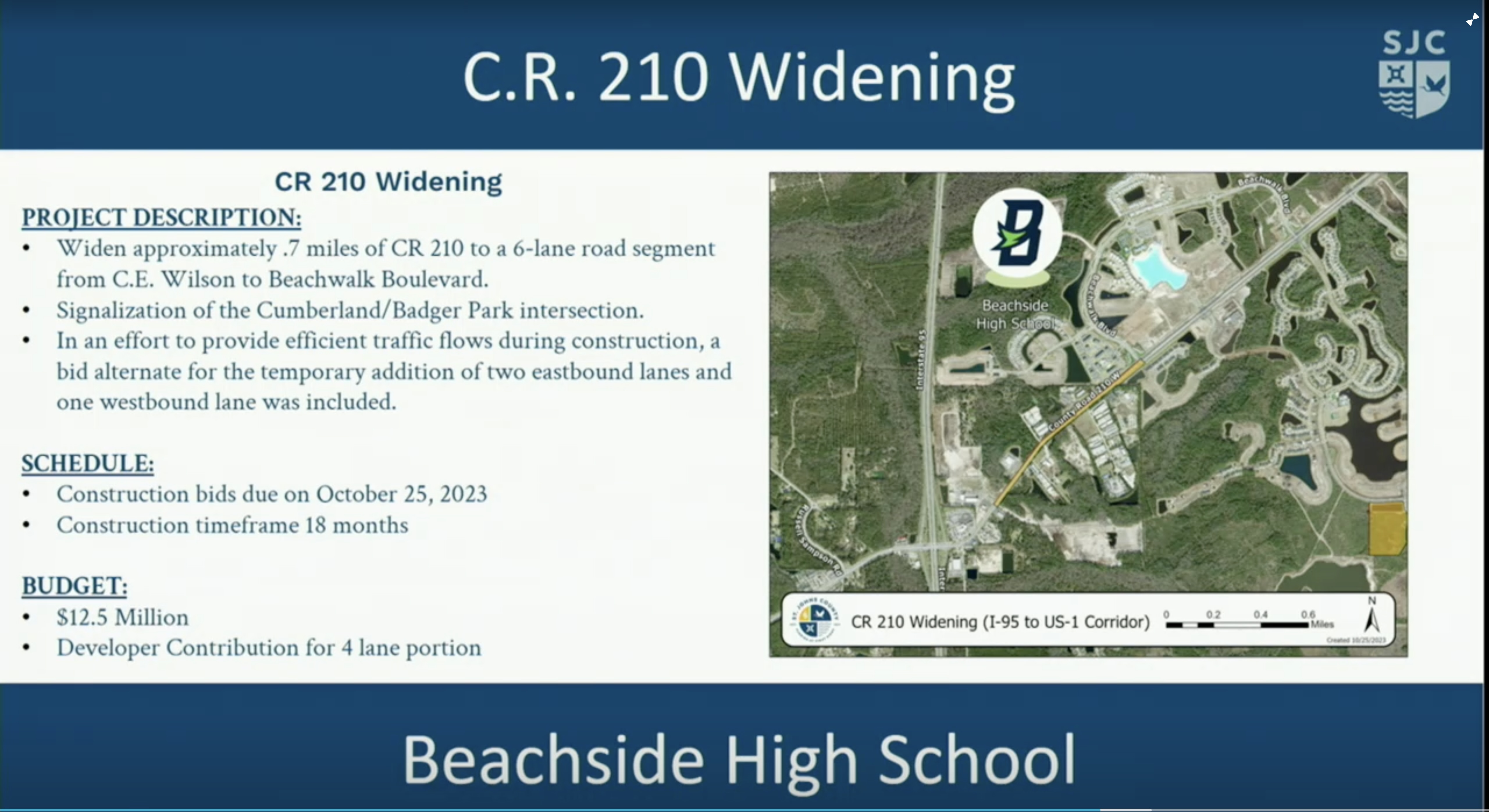
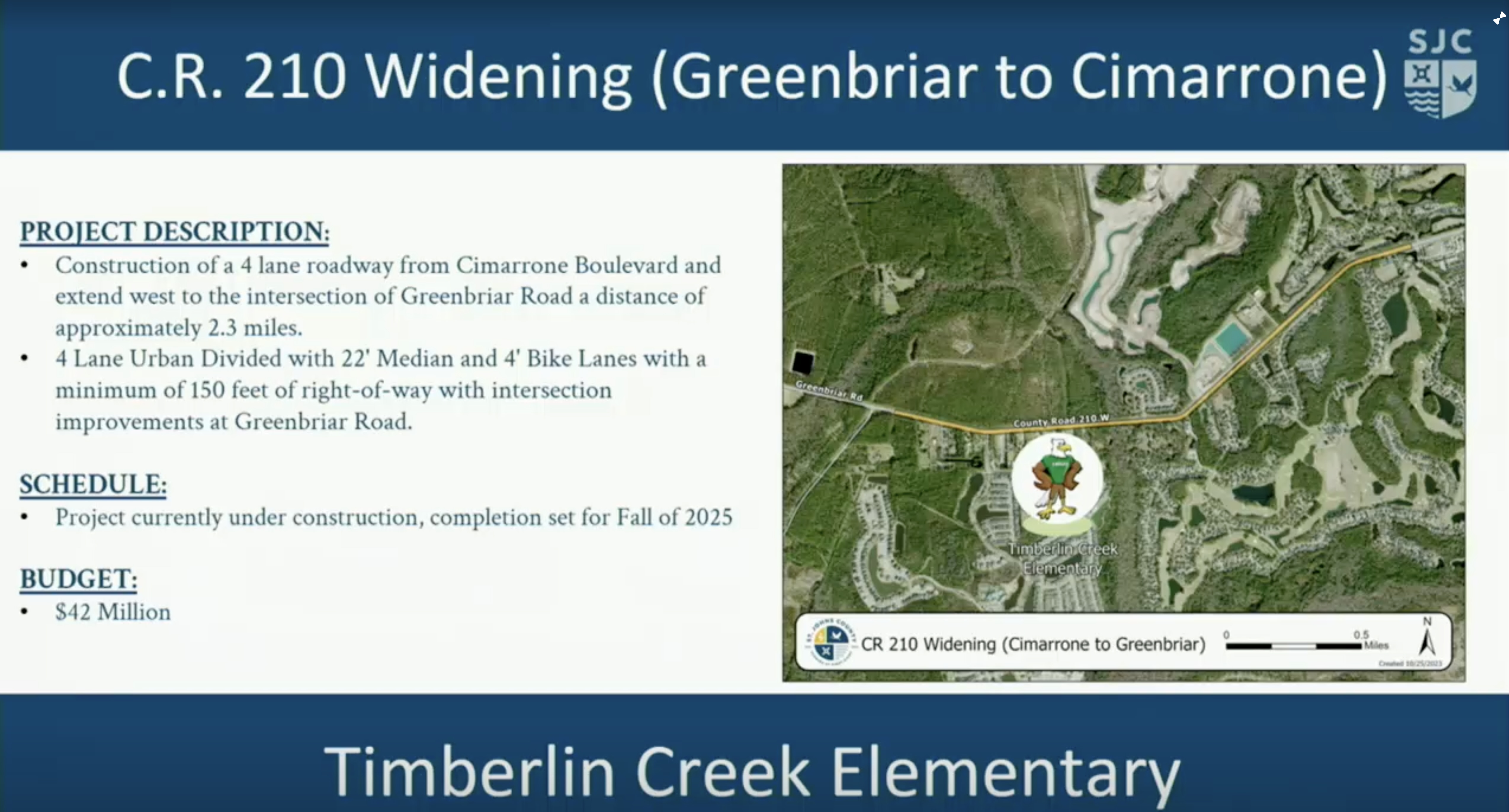
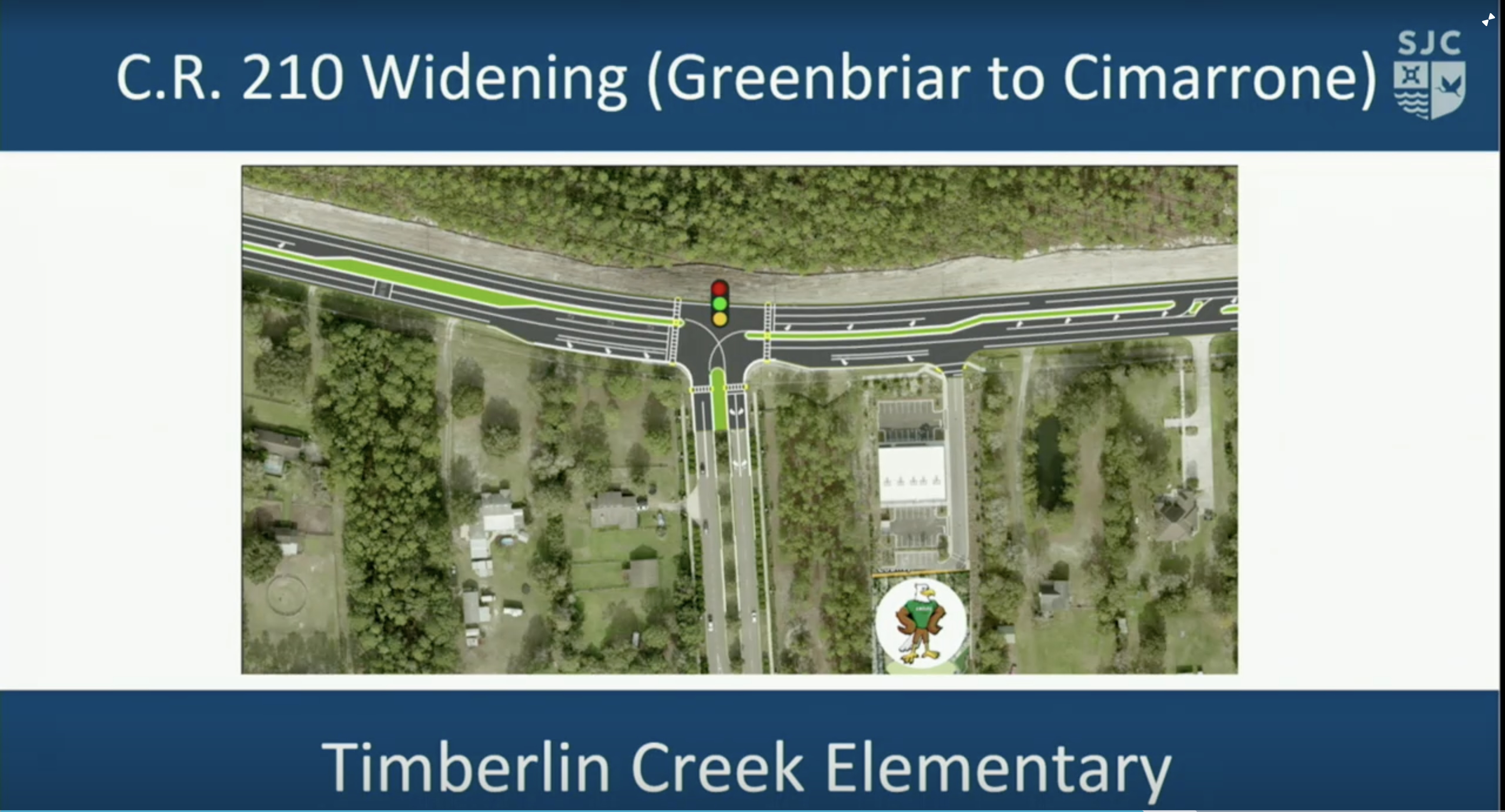
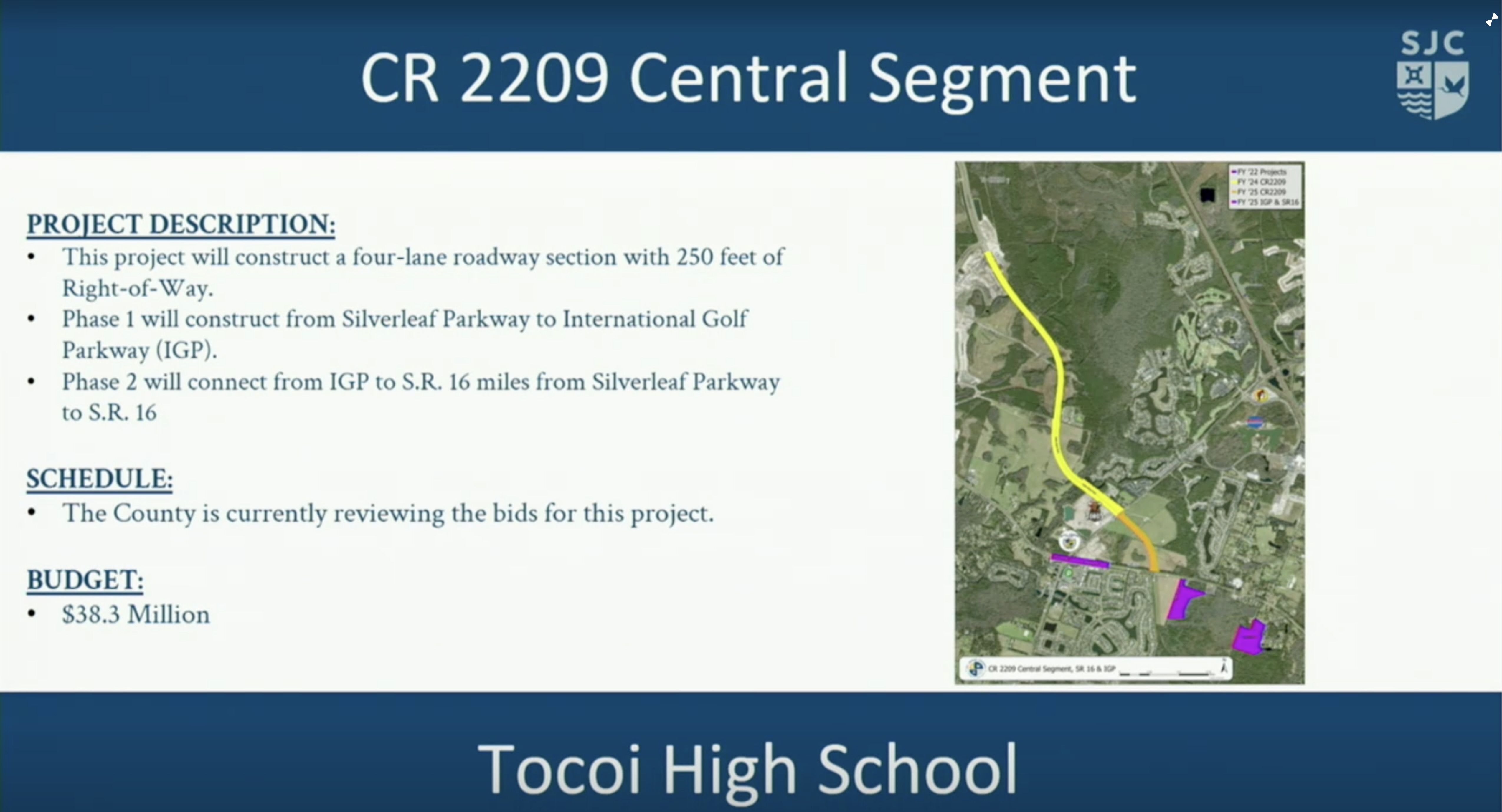
Presentation of school-related infrastructure projects
Colin Groff Interim Deputy County Administrator presented on the Infrastructure projects.
He began the discussion with an explanation about the concurrency and proportionate share process.
When a developer brings forward a project, before anyone on the Board of Commissioners sees it for approval, that project has gone through the School Board and they have looked at the concurrency and said, “yes we have the capacity.” If they do not sign off on the project, it stops right there and does not move forward until the capacity deficit is addressed.
If the capacity is not there, the developer may choose to pause, or to pay the proportionate share agreement that is approved by the School Board for the developer to fund their portion of future schools.
Important to note that the process stops and the project does not move forward to the County Commissioners for review unless there is capacity or an agreement to fund future capacity. The School Board does play a role in that process.
Capital Project Updates
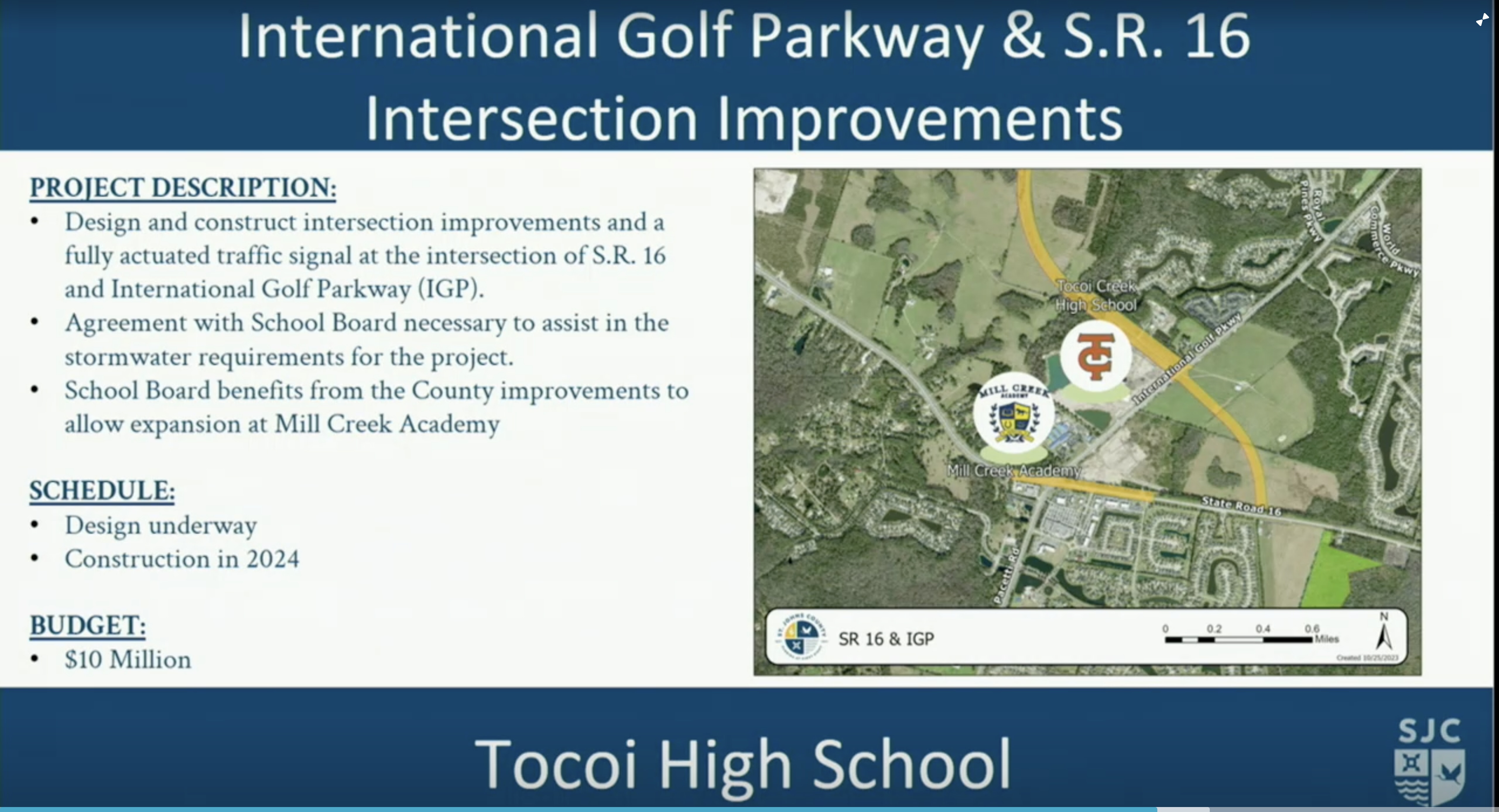
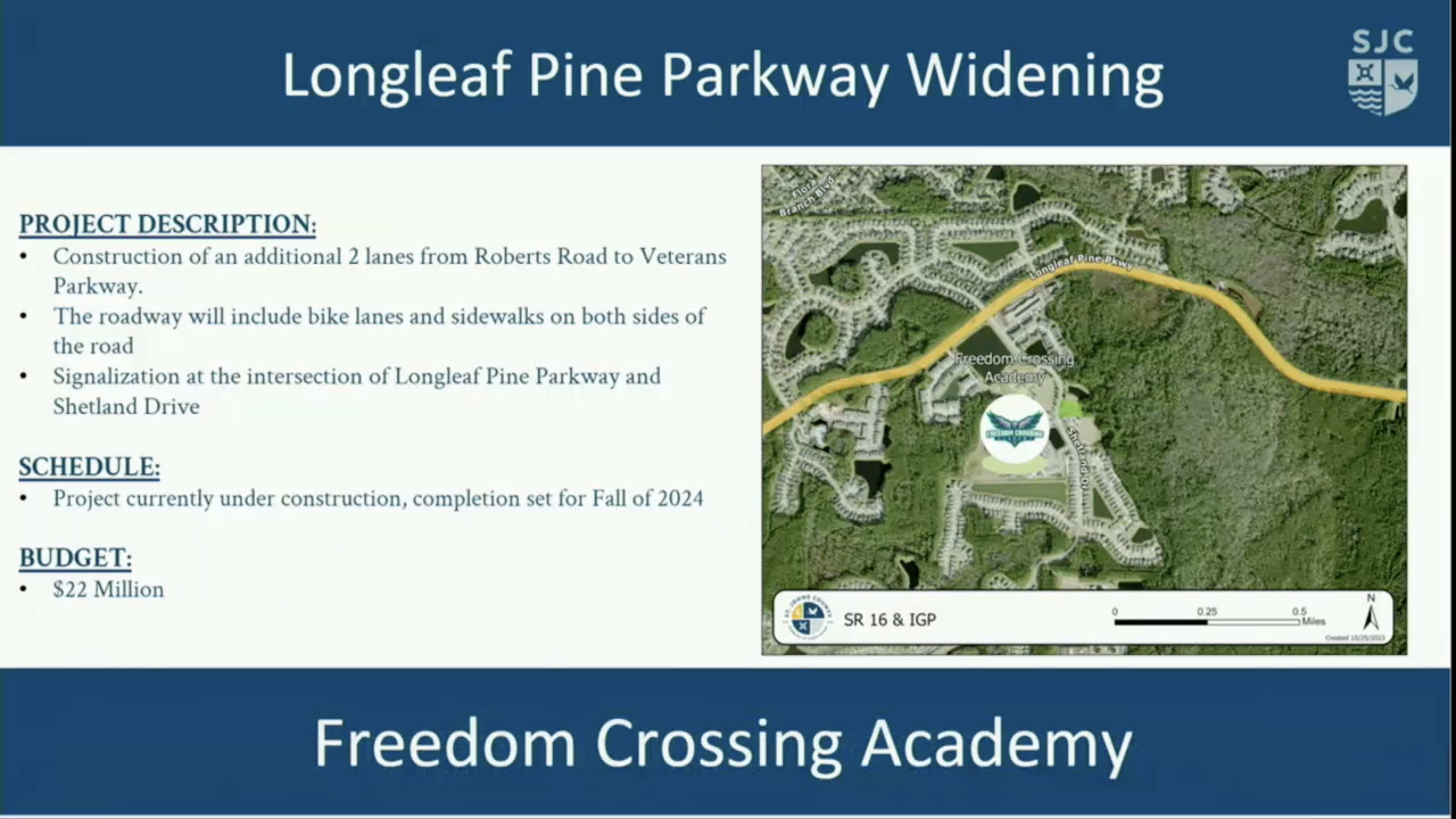
Dr. Asplen presented on the current school projects. He answered a question about a new High School with a projected date of around 2027 – 2028.
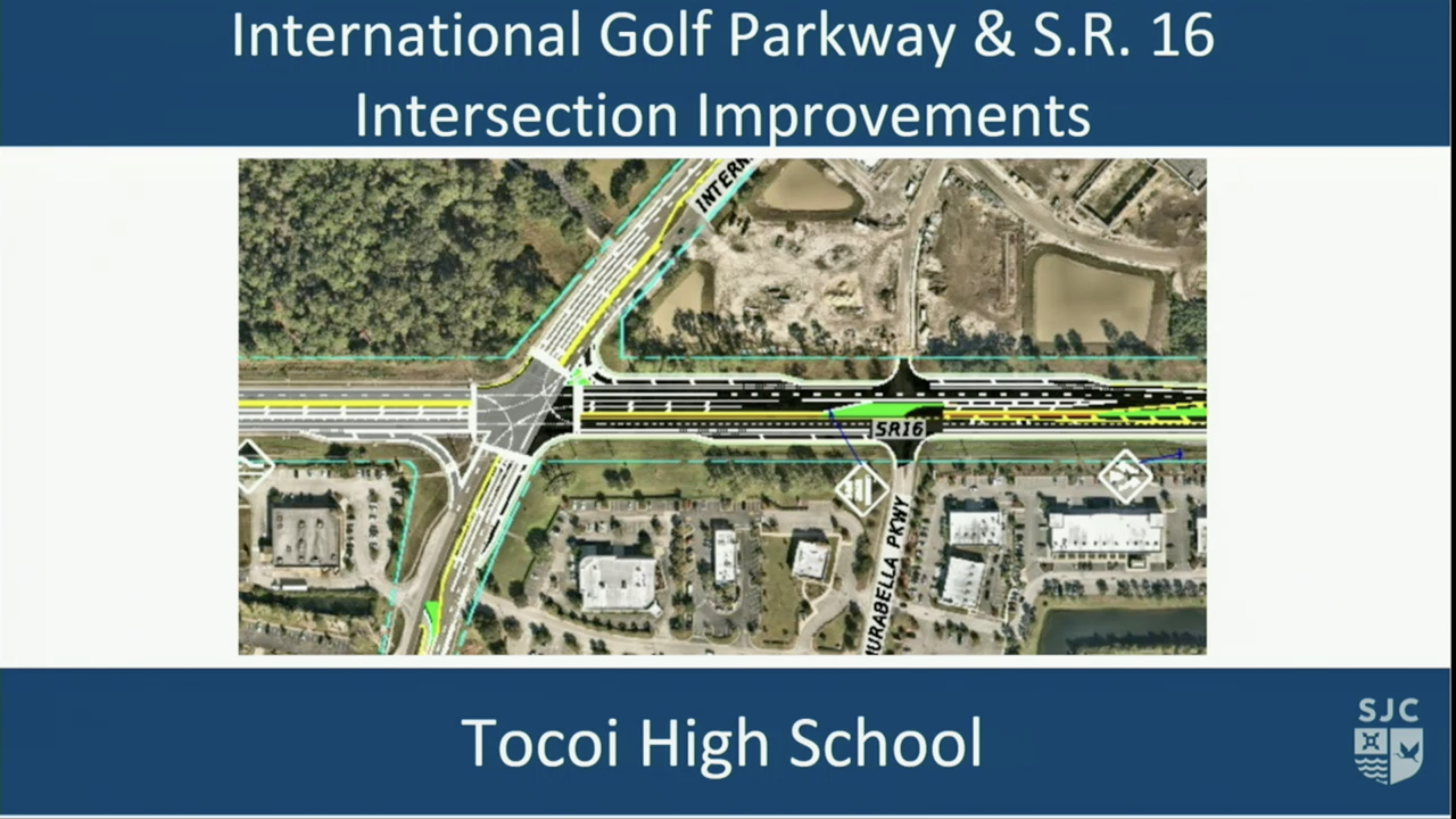
Colin Groff presented on the school related Infrastructure Projects
Adam Teckler, Legislative Affairs Manager, presented some next steps.
State Board of Education Report is due by November 1
Purpose is to reduce unnecessary regulation on public schools. Expected to review cost per student station formula and options for high growth school districts. May also address student transportation.
After a brief recess, they heard Public Comment.
Public comments were shared about:
Teacher pay
Appreciation for this meeting and hope for continued joint meetings
Don’t forget the older communities and their school needs
If you are finding value in these updates, please subscribe to my blog so you get notifications when I publish an update. Feel free to share with others who may find value in the content.
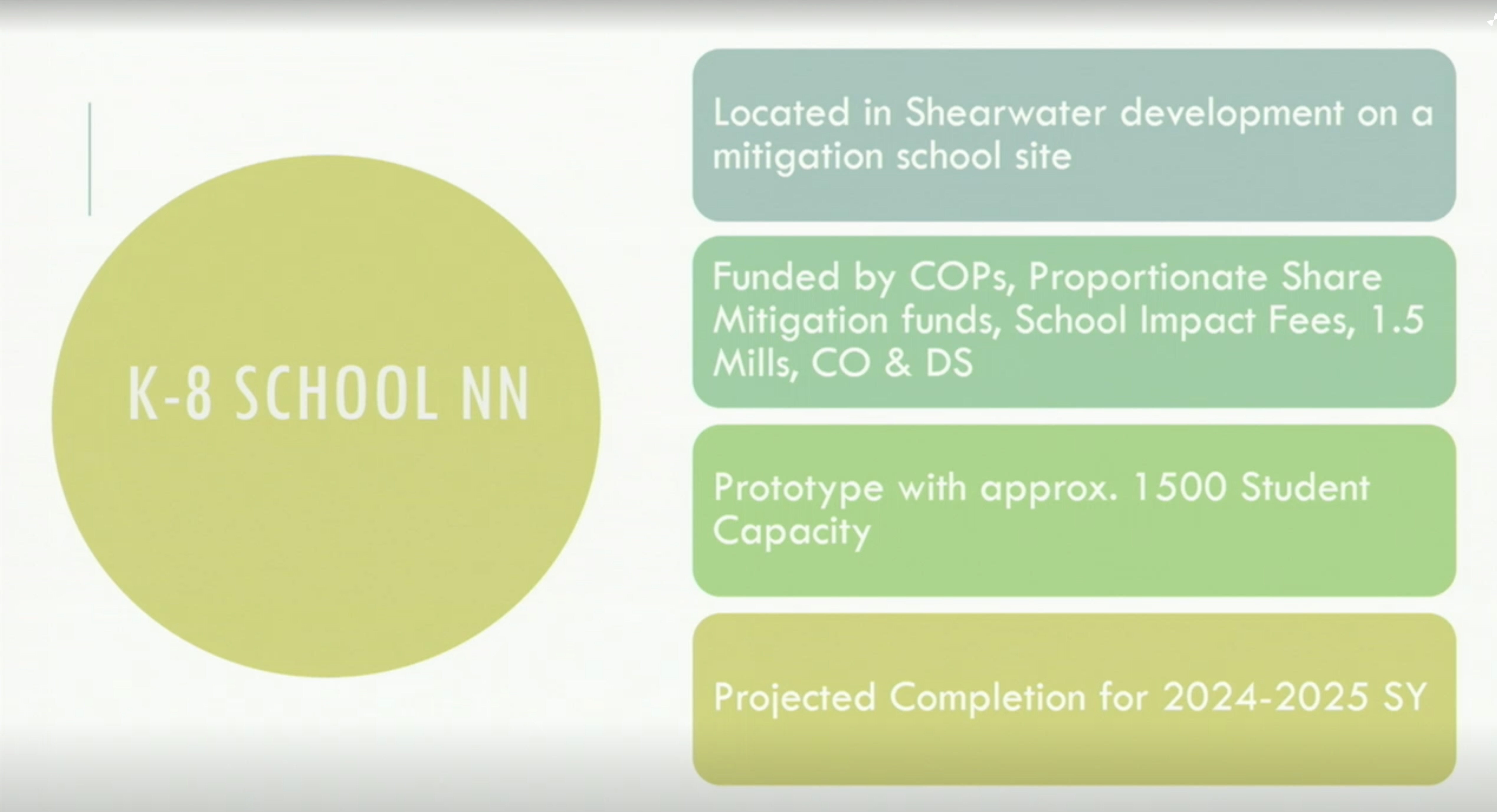
A very long day, indeed! The theme for the day was Schools!
The meeting began with a moving presentation of a Certificate of Remembrance for the Tristyn Bailey family honoring 13-year-old Tristyn Bailey who was murdered on Mother’s Day in 2021.
During the Public Safety Report, Director Skip Cole also spoke to the Bailey Family, honoring their grace and actions during such a difficult ordeal. He focused his remarks to the Commissioners on National Police Officer’s Memorial Day and noted that 1 fallen officer from St. Johns County was being added to the Memorial Wall and that the SJSO Honor Guard traveled to Washington to support and honor his placement on the wall. Director Cole then read out the names of St. Johns County officers lost in the line of duty.
The Clerk of Court’s Report included an interesting presentation on some of the oldest historic records maintained in the Clerk’s office. Included were historic deeds, including one for a property on Aviles Street, recorded in 1821. The oldest County Commissioner meeting records were from April 30, 1866. It was noted they did not meet during the Civil War and the Sheriff was asking for reimbursement of expenses incurred prior to the start of the war!
Consent Agenda
There was one public comment on the Consent Agenda with a representative from CARE expressing appreciation for the approval of the contract for Home Again St. Johns. This was long awaited funding for a permanent facility on SR 16.
Agenda Item 1 – The Landings at St. Johns was one of the highly anticipated presentations. This development on the south side of Greenbriar Road, 1.5 miles east of State Road 13 is planned to be an Age Restricted community (55+) and thus would have in impact on the school system while generating about $1 million in annual ad valorem revenue that could be used to fund schools. The developer has committed to upfront road way improvements and, importantly, is paying for road improvements at Switzerland Middle School and Bartram Trail High School that would alleviate the traffic backups during school opening and closing times. These improvements were not required but included by the builder to provide benefit to the county.
Commissioner Joseph had several questions about the development related as related to school concerns. The developer’s representative referred back to this development not adding children to the school system and generating tax revenue that would benefit the school system.
Commissioner Joseph noted 130 letters against the development. Questions were asked by the developers representative about the letters because there is insufficient indication of where the letters originated (in the impacted area or even within the county.)
Side note: This highlights the need of residents who write to the Commissioners to include their property address so there is no question if they are part of the impacted communities. This comes up often in discussions.
During Public Comment on The Landings, Christine Mullis, representing the Greenbriar Preservation Group, presented concerns about traffic in the area and the inadequate infrastructure. A second representative from the group spoke about concerns related to the wetlands in the area. She noted some of the comments made by staff in the application process about the wetlands area.
During rebuttal, the developer’s representative pointed out that the comments made by staff about environmental concerns during the application process had all been cleared or they would not have been able to move forward to the application hearing today.
Several other residents spoke both for and against the development with those in favor noting the upfront infrastructure improvements and that this was active adult and not impacting the schools.
Some residents spoke on the need to slow down development in general because of the impact on schools in the County.
During the Commissioner’s discussion, Commissioner Dean noted the argument for compatibility as this property is surrounded on 3 sides by Res B zoning. He noted that you can’t have improved infrastructure without the development happening and that the timeline shows that the infrastructure needs will be addressed by the time the housing is complete. He also noted that new schools will be opening in 2025 – 2026.
Commissioner Whitehurst noted in his comments that when he graduated from Nease High School in 2000, it was over capacity at that time. He went on to talk about the constraints in the school budgets around not being able to build schools until they are over capacity. He commented that “that’s a bad policy.” He acknowledged the school related concerns and referenced a comment made by a resident that approval of this portion of the project is tacit approval of the remaining portions that will impact schools. He does not believe that is the case.
The Landings was approved 3:1 with the No vote from Commissioner Joseph. Commissioner Alaimo was absent.
General Public Comment
During General Public Comment, there were many residents of Rock Springs Farms speaking about a county managed park that somehow became the responsibility of the Roxbury Farms HOA to fund. Residents have spoken with Commissioner Alaimo and staff is working on a presentation to discuss this at the June 6 County Commissioner’s Meeting.
One resident wanted to share with the Commissioner’s the results of the ALICE Report for St. Johns County. The ALICE report is published by the United Way each year with ALICE being Asset Limited Income Constrained Employed residents. These are residents who make more than the poverty level so don’t qualify for financial assistance yet cannot afford rent and food in our county.
You can read the ALICE report for yourself here, ALICE Report
Kerri Gustafson spoke on behalf of teachers and the group she started (with over 3000 members on FB) SOS, Save Our Schools, and expressed concern about the pay for teachers. She referenced the recent magistrate’s report stating that the school system does not have funds to build new schools. She stressed that the schools need help both from Tallahassee and the County.
Agenda Item 2 – Marsh Landing
After a break for lunch, the long awaited Hamstra report on the conditions in Marsh Landing was presented by Mr. Hamstra. This was followed by a report from Attorney Wayne Flowers regarding the County Ordinances that are relevant to the Marsh Landing Storm Water Management System concerns.
After hearing both reports and public comment, staff agreed they have the necessary information to proceed with analysis and follow through on any violations that need to be addressed.
Agenda Item 5 – Project Krew
Project Krew is the code name for a “large scale manufacturing facility” slated to open in 4Q 2025. This project would bring $70 Million in tangible personal property and $14 million in building improvements to the county. The building improvements are anticipated to be robotics equipment.
Initially the project would provide 116 jobs, growing to 324 producing about $7.8 million in labor income at the beginning of the project. No land use or zoning changes would be required for this project.
They are requesting a $4.6 million dollar incentive via ad valorem taxes and expedited permitting.
The project was approved unanimously.
Closing Public Comment
The auditorium was fairly empty by the time we got to Closing comments however one stalwart resident spoke about the danger of St. Johns County losing its status of the #1 School District in the state because of over-crowding and the inability to hire enough teachers to support the growth.
Commissioner’s Reports
During Commissioner’s Reports, Commissioner Joseph shared her recent awareness of the University of Florida IFAS Extension service. Our residents in the agricultural areas of the county and those of us who grew up in 4-H have long benefited from the Extension Service. You can learn more about the many services provided by the IFAS Extension service here: St. Johns County Extension Service
Commissioner Dean suggested that it is time for a review of how much money has been spent and how it has been spent for schools in the county. His perception is that a tremendous amount of money has been allocated for schools and it is not clear that the problem is related to growth but related to the timing of schools being built.
Commissioner Joseph asked if the Commissioners could meet with the School Board to have these discussions. (Indicative that she has not been in such discussions since joining the Board.)
Commissioner Arnold noted that there has not been such a meeting since she has been on the Board (since 2021.)
There was agreement that there needs to be more communication between the School Board and the Commissioner’s regarding the growth in the county and impact on schools.
Commissioner Whitehurst noted that there is currently a slowdown in Building Permits with a 29% decrease compared to 2022.
If you are finding value in these updates, please subscribe to my blog so you get notifications when I publish an update. Feel free to share with others who may find value in the content.