
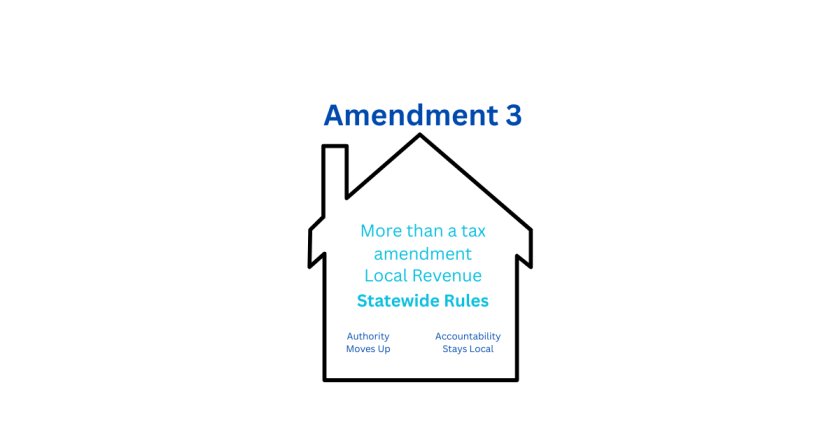
Amendment 3 is not only a tax proposal. It changes who controls local revenue and spending decisions.
This is the final article in my series explaining what Florida’s proposed Amendment 3 would mean for St. Johns County residents.
Most of the focus on Amendment 3 is around the financial aspect – will I save money on my property tax? Will local governments have to slash spending, find the waste? But there is another component that is often overlooked. And that is the shift in governance models.
There is often much concern about local control and what preemption bills are being passed taking away local control of zoning decisions. Amendment 3 functions as a significant preemption measure. It would place statewide constitutional limits on decisions currently made by local governments.
During the Florida Senate Appropriations Committee’s discussion of the proposal, several senators raised concerns that the amendment went much further than reducing property taxes. Their concern was that it would change governance in Florida by shifting control over local budgets from counties and municipalities to Tallahassee.
Link to the committee meeting here: Senate Sub-Committee – Amendment 3
That concern deserves more attention. Amendment 3 is both a tax amendment and a preemption amendment.
Fiscal Authority Is Governing Authority
The amendment would place new statewide restrictions in the Florida Constitution governing:
- How much homestead property local governments may tax
- How quickly most non-homestead assessments may increase
- When new Florida residents qualify for the larger exemption
- How counties and municipalities may use their remaining property tax revenue
Let’s look more closely at that last bullet. The amendment identifies several permitted uses for the remaining property-tax revenue, including public safety, education and schools, infrastructure, natural-resource projects, bond debt service, employee retirement benefits, and government operations and administration. It also allows local governing bodies to approve other expenditures unless the Legislature prohibits them through general law. Local discretion would not disappear, but the Legislature would gain constitutional authority to restrict it. Governor DeSantis has indicated that, if Amendment 3 passes, a special session would be needed to implement the amendment and address support for rural counties.
Paying close attention, the ballot summary goes beyond the initial $150,000 and $250,000 exemptions. It directs the Legislature to establish a uniform procedure allowing counties and municipalities, for their own levies, to increase the exemption up to the homestead’s full assessed value. Special districts could do so only with voter approval.
That does not automatically eliminate every non-school homestead tax statewide, but it creates a constitutional pathway for local exemptions to reach the property’s full assessed value.
That sequence matters. Voters are being asked to place a broad direction in the Florida Constitution before all the implementing rules have been written.
What if we don’t like the outcome? Unlike a legislative BILL, this is a Constitutional Amendment. If the results are unfavorable, the Legislature could not simply repeal the provision. Changing or removing it would generally require another constitutional amendment approved by at least 60% of Florida voters.
One Structure for Very Different Counties
St. Johns County is not facing the same conditions as every other Florida county. It continues to add residents and new development, creating demand for roads, fire stations, emergency personnel, law enforcement, parks, libraries and stormwater improvements.
New construction adds taxable value, but it also creates recurring costs. A completed fire station, park or library requires employees, equipment, maintenance, utilities and eventual replacement.
There is also a frequent call to “slow the growth.” But slowing development also slows the addition of new taxable value—and the growth in revenue available to fund these recurring costs.
There is often a cry, “make the developers pay for it.” By state law, Impact-fee revenue must be tied to the additional capital-facility needs created by new development and must benefit the new users paying the fee. It generally cannot be used for routine maintenance or to correct unrelated deficiencies in older infrastructure.
Although impact fees are assessed to development, those costs can be incorporated into the price of new homes. This increases the costs of new homes in the NEW development and does nothing to help older infrastructure that needs maintenance or expansion.
Amendment 3 would impose one constitutional framework across counties with very different populations, growth rates, tax bases and service needs. A county commission could not simply adjust that framework when local conditions require something different.
More than two dozen Florida counties are classified as fiscally constrained, including neighboring Putnam County. Significant reductions in property-tax revenue would raise difficult questions about how those counties could continue providing required services.
Fiscally Constrained Counties impact
Authority Moves Up Accountability Stays Local
If Amendment 3 passes, statewide constitutional restrictions and the Legislature’s implementing laws will affect local revenue decisions. When a road project is delayed, a park is not built, a fee rises or library hours are reduced, residents are unlikely to call their state legislators. They will call their county commissioners.
Local officials will remain responsible for public safety, infrastructure and service delivery. Residents will continue to hold them accountable. But those officials will have less control over the principal general-revenue source used to address those needs.
That creates a mismatch: authority moves upward while responsibility and public accountability remain local.
Supporters describe this shift as a necessary taxpayer protection. They argue that statewide constitutional limits are warranted because property-tax collections have grown rapidly, and that local governments would retain discretion within the listed categories and over other expenditures unless the Legislature prohibits them. The disagreement, then, is not whether Amendment 3 would shift some authority, but whether that shift is a necessary protection for taxpayers or an unnecessary restriction on home rule.
The Question Before Voters
For many homesteaded property owners, Amendment 3 would provide real and meaningful relief. That benefit should not be minimized.
But the decision is larger than whether we would like a lower property tax bill. Voters are also deciding how local services will be funded, how costs may be redistributed and who will control those decisions in the future.
Should decisions about funding St. Johns County’s particular needs be made primarily by local officials accountable to St. Johns County residents—or through a statewide constitutional structure controlled largely by the Legislature?
Before voting, Floridians should understand both the tax relief and the transfer of local authority that comes with it.
Florida Division of Elections Amendment Summary
If you are finding value in these updates, please subscribe to my blog so you get notifications when I publish an update. Feel free to share with others who may find value in the content.


