Posted in BOCC, Comprehensive Plan, Florida Legislature

Why Can’t St. Johns County Simply Vote “No” on Ag Enclave Applications?

Understanding how SB 686 changed the County Commission’s role.

If you’ve been following the recent discussion about Ag Enclave applications in St. Johns County, you’ve probably heard one question repeated over and over:

Why can’t the County Commission simply vote “no”?

There has been a lot of discussion in Northeast Florida over the past week about SB 686, the Ag Enclave bill. With our first applications filed, I thought it would be helpful to give some background on this bill and how we got here. Then we can talk about what the county can, or cannot, do.

Residents want to know why the County Commission can’t simply deny these six Ag Enclave applications the same way it could deny a Comprehensive Plan Amendment.

The answer is that these applications are not processed like Comprehensive Plan Amendments or rezonings. SB 686 created an entirely different process under state law, and understanding that process explains why the Commission’s role is very different than many people realize.

This may feel like another rezoning request.

It isn’t.

SB 686 created an entirely different legal process.

This article isn’t about whether SB 686 is good or bad policy. It’s about understanding what the law requires and how we arrived here.


Two Different Questions Are Being Asked

There are really two separate questions being debated.

The first is whether SB 686 was good public policy. Reasonable people can disagree on that.

The second is what authority the County Commission has now that SB 686 is law. That is the question this article addresses.

Before writing this article, I reviewed SB 686, the House and Senate bill analyses, legislative history, Florida Association of Counties updates, and four Ag Enclave certification applications filed in St. Johns County.

Before SB 686, counties had broad discretion in zoning changes. Comprehensive Plan Amendments and rezonings were legislative decisions. County Commissioners could make decisions, within the law, on local impacts of a Comprehensive Plan Amendment or zoning waiver

After SB 686, the Legislature created the Ag Enclave Certification process. Certification is essentially the county determining whether an application meets the criteria established in state law. It is not the same thing as deciding whether the county likes the project. Once certified, local decisions still occur but under a much narrower legal framework established by the legislature.

Certification is not the same as approval. There are specific steps that are very different from the usual Comprehensive Plan Amendment.

The process essentially is:

1. Developer submits certification application.

2. County reviews statutory eligibility. (Staff performs the analysis and presents to Commissioners.)

3. County issues certification if criteria are met.

4. Development application follows.

5. County still reviews engineering, infrastructure, concurrency, stormwater, utilities, etc.

6. But the County’s discretion is very different than under a traditional Comprehensive Plan Amendment.

SB 686 enacted

        ↓

Certification Application

        ↓

County determines statutory eligibility

        ↓

Certification issued (if requirements met)

        ↓

Development Review

        ↓

Construction approvals

Why can’t commissioners simply vote no?

Their discretion in the certification process is governed by state law rather than local judgment.

If the application meets the certification criteria, they must vote “yes” to certify. If the Commission denies certification even though the statutory requirements are met, the applicant may seek review in circuit court through a writ of certiorari. In other words, the court reviews whether the county followed the law, not whether the judges agree with the project.


So how did St. Johns County end up operating under this entirely new process?

The answer doesn’t begin with the six applications filed this month. It begins in Tallahassee, where SB 686 moved through the normal legislative process over several months before becoming law on July 1, 2026.

The Legislative Record

On December 1, 2025, Senator Stan McLain of District 9 (Central Florida District) filed the Ag Enclave bill, SB 686.

Agricultural Enclaves; Authorizing certain persons to apply to the governing body of the local government for certification of certain parcels as agricultural enclaves; requiring the local government to hold a public hearing within a specified timeframe to approve or deny such certification; authorizing certain persons to submit certain development plans; authorizing the development of certain parcels for commercial, industrial, or single-family residential purposes under certain circumstances, etc.”

It then moved through committee hearings over the next several months before passing both chambers and being signed by the Governor on April 20, 2026, with an effective date of July 1.

The Florida Association of Counties exists in part to keep county governments informed about legislation that affects local government.

In the Florida Association of Counties FAC Legislative Bulletin: Week 2, dated January 23, 2026, they included a summary:
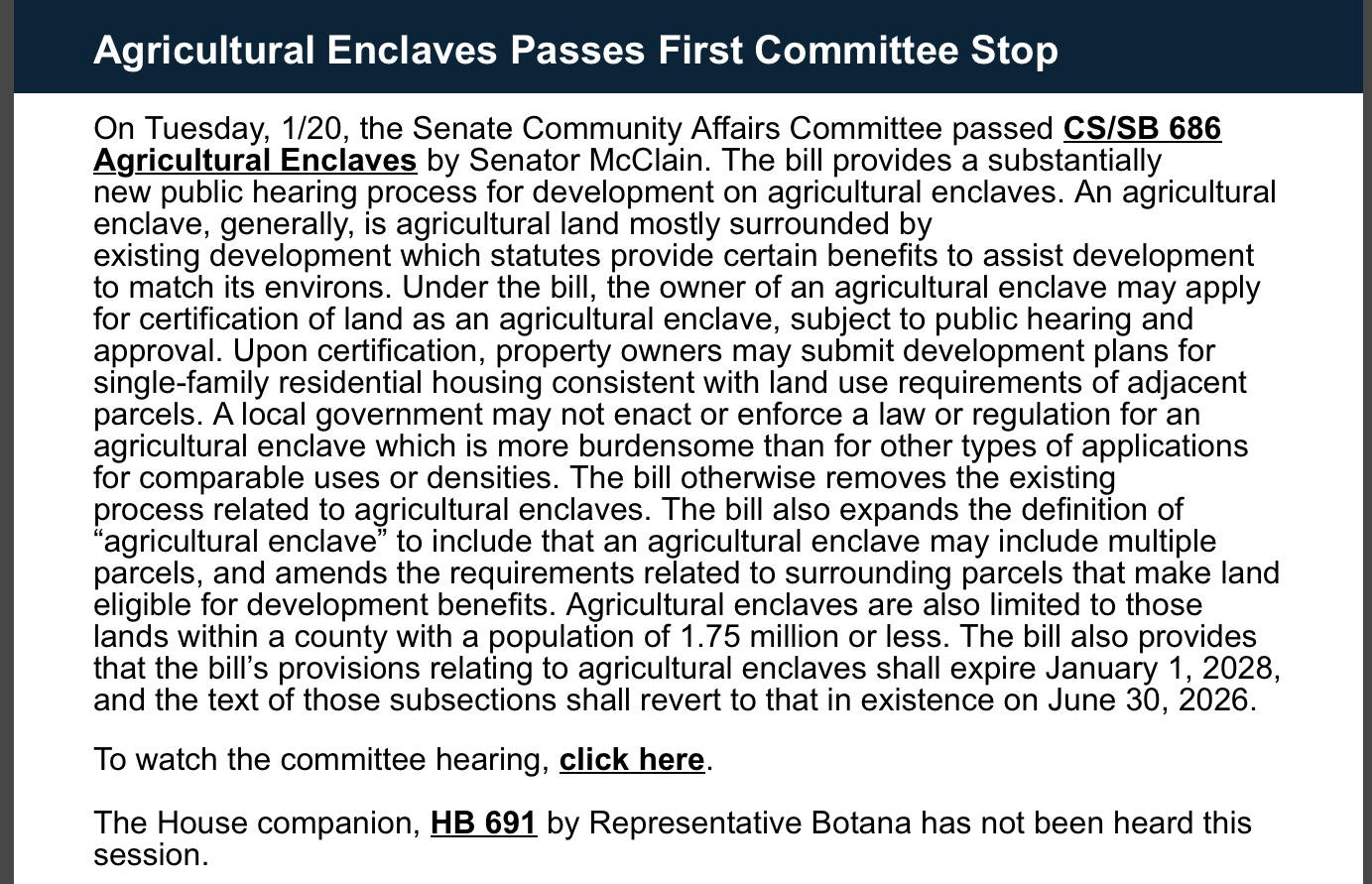
FAC Email Bulletin January 23, 2026

FAC legislative bulletins are distributed to county officials throughout Florida as part of the association’s legislative tracking.

The 1000 Friends of Florida shared an update about the bill in their February 11 webinar and strongly opposed the bill
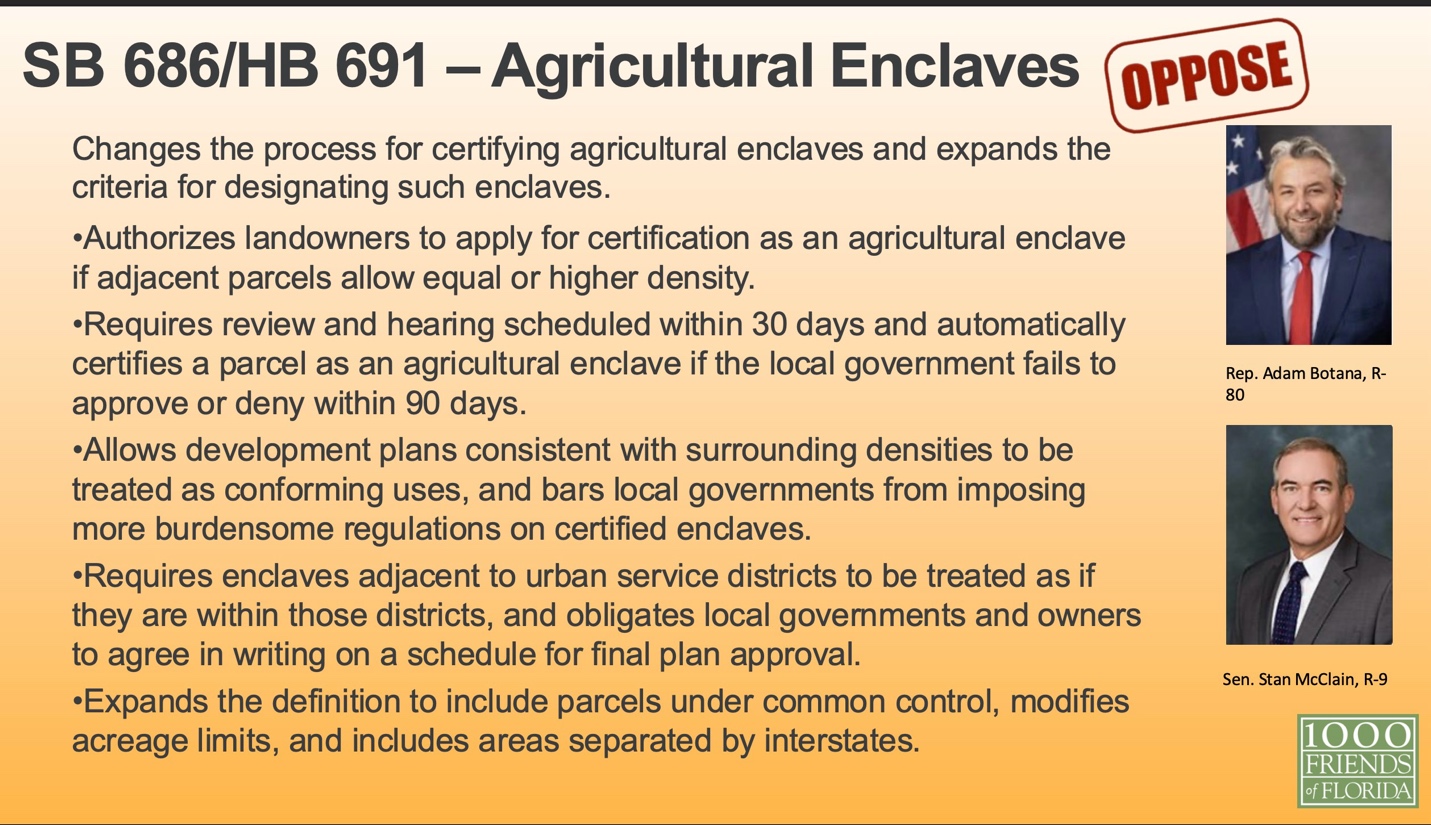
1000 Friends of Florida Webinar, February 11, 2026

Here is a link to the full history of the bill on the Senate website: SB 686 Senate Bill History

The related House Bill was HB 691 and filed on December 8, 2025 by Representative Adam Botana of District 80 (Bonita Springs, Leon and Collier Counties)

Link to the House Bill is here: Companion Bill HB 691

The bill was presented to the Governor on April 9 and signed April 20, becoming effective July 1, 2026.


SB 686 did not appear overnight. Whether someone agrees with SB 686 or opposes it, one thing is clear from the legislative record: this bill followed the normal legislative process over several months. It moved through Florida’s normal legislative process over several months, with committee hearings, legislative analyses, advocacy from supporters and opponents, and regular legislative updates distributed to county governments through the Florida Association of Counties.

The legislation also received support from members of the St. Johns County legislative delegation. Senator Leek voted Yes on February 26, and the bill was sent to the House where all 3 of our County Representatives voted Yes on March 11, 2026.

County commissioners are now responsible for administering a law that many local officials and planning advocates opposed.


Where are we now?

On July 1, the day the law became effective, 4 Ag Enclave certification requests were filed in St.Johns County. They were followed by 2 more on July 7.

Recent public comments have focused on whether county officials had advance warning that SB 686 was moving through the Legislature and whether the volume of applications could have been anticipated.

These are actually two very different issues.

One concerns the legislation itself.

The other concerns how quickly developers responded once the law became effective.

Those questions deserve to be evaluated separately.

Was the legislation itself foreseeable?

Could the volume of applications have been anticipated?

Regardless of where you stand on SB 686, one thing should now be clear.

By the time these six Ag Enclave applications reached the St. Johns County Commission, the fundamental policy decision had already been made in Tallahassee.

The discussion before the Commission is no longer Should Florida have adopted SB 686?

It is How should the County administer the law the Legislature has already enacted?

Those are two very different questions, and understanding that distinction is essential to understanding the months ahead.


Why this matters

The real lesson is broader.

SB 686 illustrates how profoundly state legislation can reshape local government authority.

Whether one supports or opposes the policy, understanding where decisions are made, and when citizens have the greatest opportunity to influence them, is essential.

By the time an Ag Enclave certification reaches the County Commission, many of the key policy decisions have already been made in Tallahassee.

Whether you support SB 686 or oppose it, understanding the legal framework helps all of us have a more informed discussion.


Over the past several days, I’ve reviewed four of the Ag Enclave certification applications filed in St. Johns County using a checklist developed directly from SB 686 and the supporting statutory requirements. In the coming days, I’ll be sharing those reviews separately. The purpose of those articles will be different from this one: not to explain the law itself, but to examine how the submitted applications compare to the requirements established by the Legislature.


If you are finding value in these updates, please subscribe to my blog so you get notifications when I publish an update. Feel free to share with others who may find value in the content.


Posted in BOCC, Comprehensive Plan, Uncategorized

May 20 St. Johns County BOCC Meeting – Change in Time!

Since the 2024 election we’ve heard about the desire to try an evening Board of County Commissioner’s meeting to give more people the opportunity to attend.

Well – that time is here! The May 20 BOCC meeting will begin at 5:00 PM in the Auditorium or you can watch on GTV, here: Link to GTV

Be prepared for a late evening. It usually takes an hour or more to get to the Regular Agenda, depending on how many people participate in Public Comment at the beginning of the meeting.


There are only 3 items on the Regular Agenda, a Non-Zoning Variance, review of the Comprehensive Plan, and review of a Reclaimed Water Meter Fee in Beacon Lakes.

The full agenda can be found here: May 20 Agenda


Interesting to see that one of the most impactful conversations of the year for the Commissioner’s will be on the agenda, Item 2, the review of the Comprehensive Plan update. This is a discussion only item with no vote scheduled on Tuesday evening.

We’ve already seen 2 Commissioners voicing their opposition to the plan on social media and asking people to show up at the meeting to express their opposition. You may want to read the proposed changes yourself before deciding if you agree or disagree.

You can read the full red-lined version at this link: 2025 Comprehensive Plan Update

For those not familiar with a red-line – you can see in red the proposed changes, omissions, modifications, deletions. It is a lengthy document, 289 pages, so be prepared to take some time to read it!


If you are finding value in these updates, please subscribe to my blog so you get notifications when I publish an update. Feel free to share with others who may find value in the content.
Posted in BOCC, Comprehensive Plan, St. Johns County

What’s Ahead at the March 18 St. Johns County Board of County Commissioner’s Meeting?

While many County Residents are on Spring Break next week, our County Commissioners have some meaty topics on the agenda!

Consent Agenda Items

Did you know there is a Northeast Florida Coordinated Mobility Plan? Consent Agenda Item 3 is Approval of the Northeast Florida Coordinated Mobility Plan. Essentially, this provides funding through Federal Transit Administration grants to cover the Sunshine Bus Program.

Read more about it here: Northeast Florida Coordinated Mobility Plan Item


Regular Agenda Items

Item 1 on the Regular Agenda is Board Discussion of Land Development Code Article IV (Tree Ordinance.) There has been a lot of social media chatter about this one. Important to note, this is NOT a reading of a new Ordinance. That requires public notice and two formal hearings. Instead, this is a presentation to seek Board Guidance on updates to the code. There should not be any vote on an ordinance at this point.

At the March 4, 2025 BOCC Meeting, Commissioner Whitehurst made a motion to move the meeting to March 25 (one week later) because so many people would be away on Spring Break vacation March 18. Commissioners Joseph and Taylor felt very strongly that the discussion could not be moved to allow more people to attend.

Here’s the discussion item: Agenda Item 1

Reading the social media posts, one might think Tuesday is the day to vote on the ordinance, but it is not. Again, Ordinance changes have to be published and then go through 2 readings before being voted on. It will be interesting to see why there is such a push to have this discussion on March 18.

Objective: Facilitate BCC discussion on the previously proposed 14 Tree Goals. Background: On October 17, 2023 BCC directed staff to bring a discussion item on current St. Johns County tree protection regulations in the Land Development Code (LDC) and to revisit the 14 Tree Goals in the context of the Comprehensive Plan amendment process. On December 17, 2024 BCC directed staff to again present the 14 Tree Goals for further discussion. Since December 17, 2024 staff has met with Chair Joseph twice to discuss the goals. Table 1 is a summary of the original 14 Goals with notation of considerations of changes from these 2 discussions.”

The requested outcome of the discussion on the 18th is:

 “Staff is seeking Board direction on either of the following: 1. Provide staff with direction to bring further analysis on one or more goals for further discussion at a future date TBD. 2. No further action.”

Here’s a link to the October 2023 discussion item, that may be important to review prior to reading the proposed changes: Analysis of Proposed 14 Points to Save Trees

Those who proposed the 14 points have been vocal that this will mostly impact developers as they develop new communities. Any of us who live in St. Johns County appreciate the beauty of the trees in our county and are in favor of preserving as many trees as we can! And those of us who are homeowners enjoy having trees in our landscaping for the beauty and shade provided. As homeowners, we also know the cost of maintaining trees, especially in new developments where trees are often planted too close to the foundation or lot lines and have to be managed in later years as root systems develop, not always in ways that are good!

There are some elements to the Land Development Code changes that would impact all homeowners, including new homebuyers. While it is easy to say, the developers will pay for this, as anyone who has built a home knows, these costs just get passed on to home buyers.

One proposed change that could have unintended consequences for homeowners is under Goal 5, More strongly discourage non-permitted tree removal. This is proposed to take place with increased fines for non-permitted tree removal.

Increase Fine (Goal 5)

  • Current: LDC 4.01.05.E.3 provides a tiered approach to fines based on the size of the tree, with fines ranging from $200 to $1,000 per tree removed. If unable to assess the number and size of Protected trees removed due to the site being completely cleared and graded, such violation shall be subject to a fine of $30,000 per acre.
  • Proposed: Trees removed illegally should be subject to a fine 10X the current fine to discourage such violations.
  • Background: Ordinance 2020-23 amended the LDC to add Sec. 4.01.05.E.3 fines for Protected tree removal without a permit.
  • Cost: The current fine ranges from $200 to $1,000 per tree or $30,000 per acre. Therefore, the proposed fines would range from $2,000 to $10,000 per tree or $300,000 per acre.

While this may be intended to stop developers and builders from removing too many trees, the unintended consequence is that as a homeowner, you are subject to tohese same fines if you remove a protected tree without a permit.

If you are a homeowner, or plan to be a homeowner in St. Johns County, it is worth your time to read through the proposal and make your thoughts known to our County Commissioners.


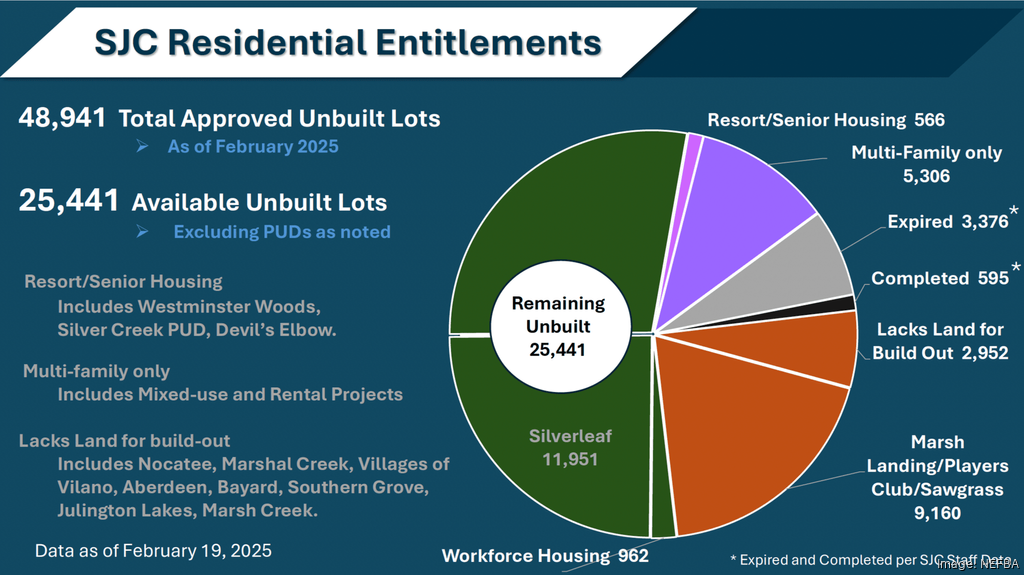
Agenda Item 2 is a discussion on Residential Entitlements Data. What is that? We often hear that there in the neighborhood of 60,000 homes that are entitled to be built but have not been built, therefore no new homes need to be approved until the Infrastructure catches up. The Northeast Florida Builders Association (NEFBA) has long said that the number is not correct. This discussion item is to explore the differences in what NEFBA believes is remaining to be built and what the County database shows is remaining to be built.

There was an article about this in the Jacksonville Business Journal March 10. I think this link is behind a paywall, Builders Want Accurate Lot Count so I’ll summarize.

The article by Stuart Korfhage, who has long covered St. Johns County, begins with this statement, “When it comes to planning for growth in St. Johns County, there are two main camps: those who want a major slowdown and those who want a practical path forward.”

The divide between those two camps is evident on our Commission and in our communities as the county continues to evolve and grow.

The difference in numbers is large – NEFBA says the number is really around 25,000. As an example from the article, Sawgrass is showing a remaining 5,700 residential units to be built that are highly unlikely to be built.

At the March 4 Commission Meeting, Commissioner Murphy asked Growth Management to come back to the Board with more data on the actual count that they can use for future planning.

NEFBA Analysis of Residential Entitlements

Agenda Item 3 is the 2050 Comprehensive Plan Update: Data and Analysis. An update was provided on February 18 and the Commissioners had questions. This is a response to those questions. Information is here: Comp Plan Discussion


Agenda Item 4World Golf Village Hall of Fame Discussion. Another follow up item from a previous meeting, materials are here, but very high level. World Golf Hall of Fame


Agenda Item 5 – Hearing to vacate a portion of an unopened 16’ wide alley right-of-way in Hastings Villa, in Hastings.


Agenda Item 6 – Rivertown Forest Phase 1 – this is the platting of 152 single family lots on 65.261 acres.

Check out the details here: Rivertown Plat


Agenda Item 7Silverleaf Market Loop Road – final plat approval for Silverleaf Market Loop road – no residential lots.

Details here: Silverleaf Market


Agenda Item 8 – County Attorney Advisory Review Committee Recruitment Update – status update on selection of the County Attorney. Recommended candidates for the final section by the Board and details about the special meeting scheduled for March 25.

The Jax Daily Record reports on the 3 finalists here: County Attorney Recommendations

The finalists are, Rich Kommando (current interim attorney), Brad Bulthius (former assistant county attorney) and Michael Rodriguez (attorney in Boca Raton.)


Agenda Item 9Appointments to the Affordabe Housing Advisory Committee (AHAC) – Due to resignation and end of term for 2 members, 3 candidates are under consideration. CVs and recommendations here: AHAC Appointments


If you are finding value in these updates, please subscribe to my blog so you get notifications when I publish an update. Feel free to share with others who may find value in the content.
Posted in Comprehensive Plan, St. Johns County

Plan for the July 18 St. Johns County Board of County Commissioner’s Meeting

There are several important topics on Tuesday’s Agenda. Plan for a long day.

Only one Proclamation will be presented, recognizing the Graduation of the 100th Veteran from the St. Johns County Veterans Treatment Court.


Items of Interest on the Consent Agenda

Consent Agenda Item 6Silverleaf DRI Impact Fee Credit Agreement (Fire/Law Enforcement/Public Buildings) will surely raise questions. Largely because most residents don’t understand what the term “Impact Fee Credit” means.

Background materials are here: Consent Agenda Item 6

“The proposed Impact Fee Credit Agreement with Whites Ford Timber, LLC (Owner) seeks to establish Fire/Rescue, Law Enforcement, and Public Buildings impact fee credit for dedication of a 4.58 acre parcel on CR 2209 within Parcel 19 of the DRI. As required by Special Condition 27 of the Silverleaf DRI Development Order, Resolution 2006-65 (DRI DO), as amended, the Owner is required to convey a three (3) to five (5) acre parcel to the County for fire and police protection. The Owner is proposing to dedicate a 4.58 acre parcel valued at $1,950,000 based County appraisal. The Owner is requesting that the total impact fee credit be divided equally under the Fire/Rescue, Law Enforcement, and Public Buildings impact fee categories at $650,000 each. The impact fee credit will be awarded following the conveyance and acceptance of the subject property by the BCC.”

Read carefully the background documentation where it says, “WHEREAS, St. Johns County Ordinance Nos. 87-59 (“Public Capital Facilities Impact Fee Ordinance”), as has been or may be amended, allow for impact fee credits to be granted by the Board of County Commissioners for the property dedicated to St. Johns County and/or improvements made or funded by the Owner as identified within the Impact Fee Credit Agreement attached hereto and incorporated herein.”

Further, “The appraised value of the Public Safety Parcel to be dedicated to the County shall be One Million Nine Hundred Fifty Thousand and No/100 Dollars ($1,950,000.00). A summary of the Public Safety Parcel appraised value is set forth on Exhibit “C” attached hereto and incorporated herein by this reference.”

Bottom line – the developer has paid for the land that will be used to build the fire/rescue, law enforcement, and other public buildings. The value of the land they are conveying is being credited towards the Impact Fees they were assessed.


Consent Agenda Item 19 is important. Recognize and Appropriate unanticipated revenue from developers for certain road Capital Improvement Projects.

“In FY 2024 developers have made required contributions to St. Johns County to fund capital improvements to roads in the impacted area of their developments. To date the following contributions have been made to the County and need to be recognized and appropriated for expenditure: $574,691.68 for the CR 210 Widening – Greenbriar to Cimarrone; $214,229.70 for the Woodlawn Road Improvements; $1,196,879.92 for the CR 210 Road Improvements from I-95 to US 1. Staff is requesting the funds be recognized and appropriated into the Transportation Trust Fund and Impact Fee Roads B Fund Major Collector Road budgets.”

This is the action to move the funds received from developers through impact fees over into the Transportation Trust Fund to pay for these improvements. Details are here: Consent Agenda Item 19


Consent Agenda Item 25 is of interest to those of us who travel SR 1 (Phillips Highway in the north) between Race Track Road and St. Augustine. Award of Invitation for Bid (IFB) No: 1850; US-1/Pine Island Road Intersection Improvements – FDOT FPN 210418-9-54-01

“St. Johns County identified the need to construct intersection improvements at US 1/Pine Island Road/Stratton Road in St. Johns County, Florida. Improvements consist of milling/resurfacing, roadway striping, roadway signage, drainage improvements, installation of traffic signal w/ preemptive connection to railroad, improvements/added lanes to Pine Island road and US-1, improvements to Stratton Road. This project is partially funded under State of Florida Department of Transportation State-Funded Grant Agreement No. G2T28, FPN #210418-9-54-01. The Purchasing Department issued an Invitation for Bids (“IFB”) for construction of intersection improvements at the US-1/Pine Island Road in St. Johns County, Florida. Six (6) Bids were submitted, with the responsive and responsible bid being submitted by DB Civil Construction, LLC, at a lump sum bid price of $1,689,920.50. Staff recommends Board approval to award IFB No: 1850 to DB Civil Construction, LLC, and to execute a contract in substantially the same form and format as attached for completion of the project in accordance with IFB No: 1850.”

Details are here: Consent Agenda Item 25


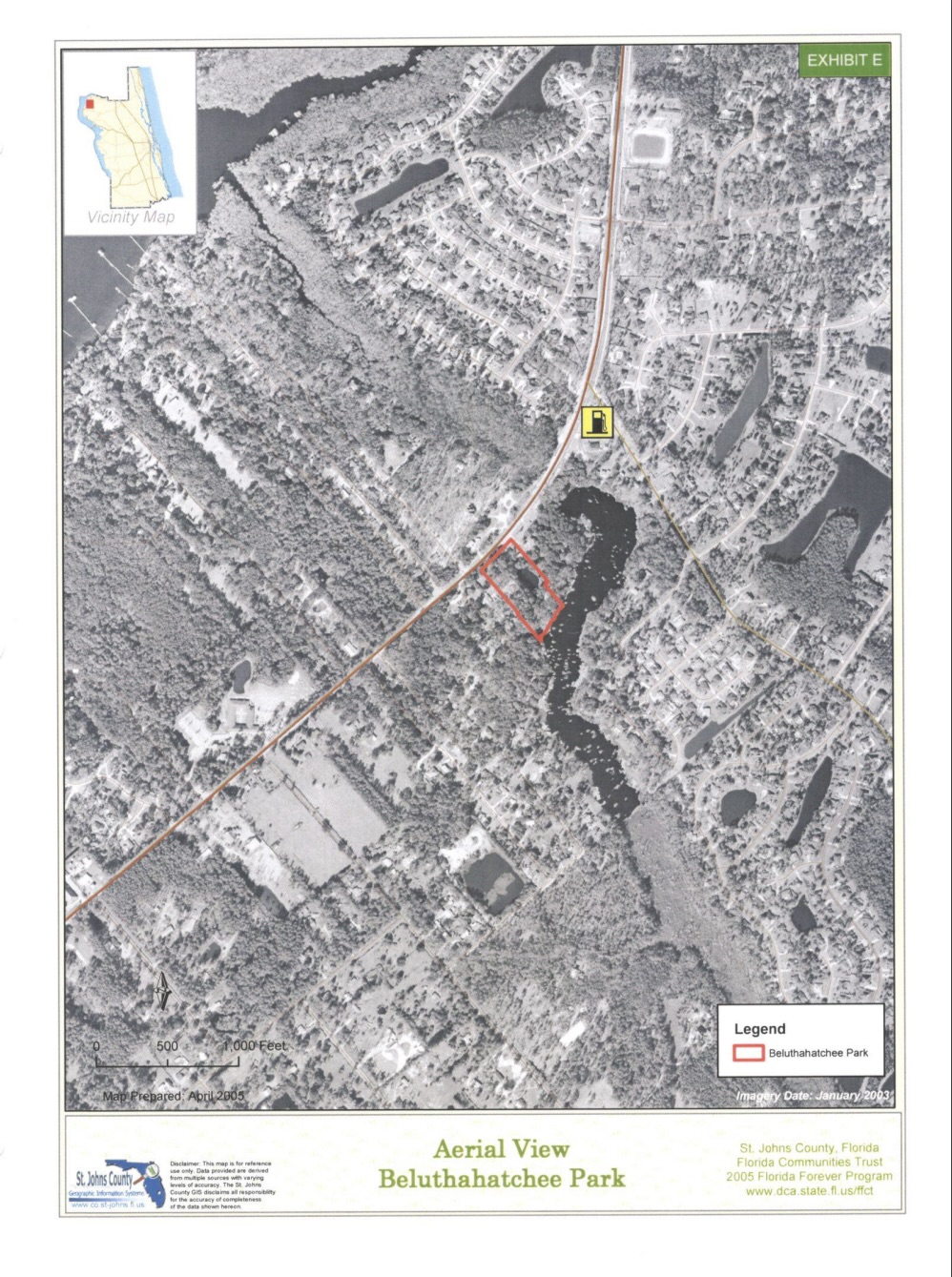
Consent Agenda Item 33 is another of great interest, particularly in the Northwest. Request to Apply for Beluthahatchee Park to be Listed on the National Register of Historic Places

“The National Register of Historic Places is the official list of the Nation’s historic places worthy of preservation. Authorized by the National Historic Preservation Act of 1966, the National Park Service’s National Register of Historic Places is part of a national program to coordinate and support public and private efforts to identify, evaluate, and protect America’s historic and archeological resources. Beluthahatchee Park is located on the William Bartram Scenic Highway (SR 13) approximately one-fourth of a mile south of Roberts Road and approximately 200 feet north of Cricket Hollow Lane. Beluthahatchee Park originated out of the 10,000 acre land grant given to Francis Philip Fatio in 1774. This land grant created the Switzerland community today located in St. Johns County, Florida. In 1945, George Wallace Kennedy, dammed Mill Creek that originally ran through the property to create Lake Beluthahatchee. His son, William Stetson Kennedy acquired the 50 acre property in 1948 and added a further 20 acres. Stetson Kennedy was an author, folklorist, labor and human rights activist, and environmentalist. He became highly involved in the Civil Rights Movement and marched with Dr. Martin Luther King in St. Augustine, FL. By the 1970s, Kennedy wanted to make Beluthahatchee is permanent home, building a more substantial house that replaced more primitive camp-style cabins on the property. This property is already designated as a St. Johns County Historic Landmark, a Florida State Historical Landmark, and a Literary Landmark.”

Location of the Park

Details are here: Consent Agenda Item 33


Regular Agenda Items

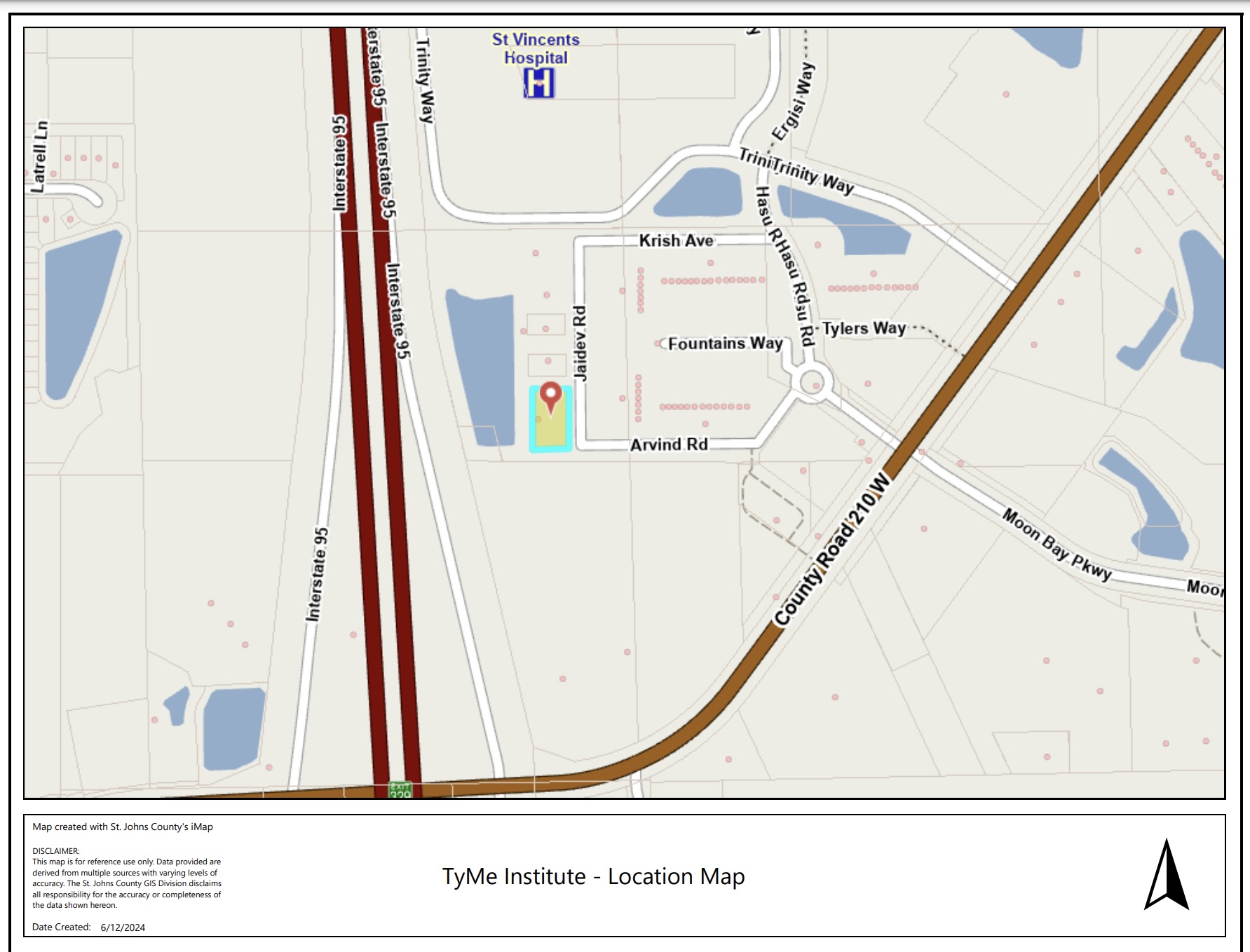
Item 1 – TyMe Institute Economic Development Incentive Request

“The St. Johns County Economic Development Agency has received an application from the TyMe Institute for economic development incentives to develop a total of 30,165 square feet of space for a cancer prevention clinic that will also in the future include a cancer research laboratory and smallscale cancer drug manufacturing facility. After the Applicant submitted their application, they subsequently withdrew their request for confidentiality. The project scored 7 points under the new industry category of the County’s Business Incentive Program, which makes it eligible for expedited permitting and an economic development incentive of up to 100% of fees paid to the County by the Applicant (impact fees), four years ad valorem taxes paid by the Applicant (general County portion) on capital improvements, and four years tangible personal property taxes paid by the Applicant (general County portion). Completion of the project is anticipated by the fourth quarter of 2025. With this schedule, the first annual incentive payment would be anticipated during FY27. The total estimated value of the incentive is $621,031. In accordance with Program requirements, the Agency is required to review the application and make a written report to the Board of County Commissioners. Staff recommends support of this incentive application.”

Background materials are here: Tyme Economic Incentive Request

Proposed location of TyMe

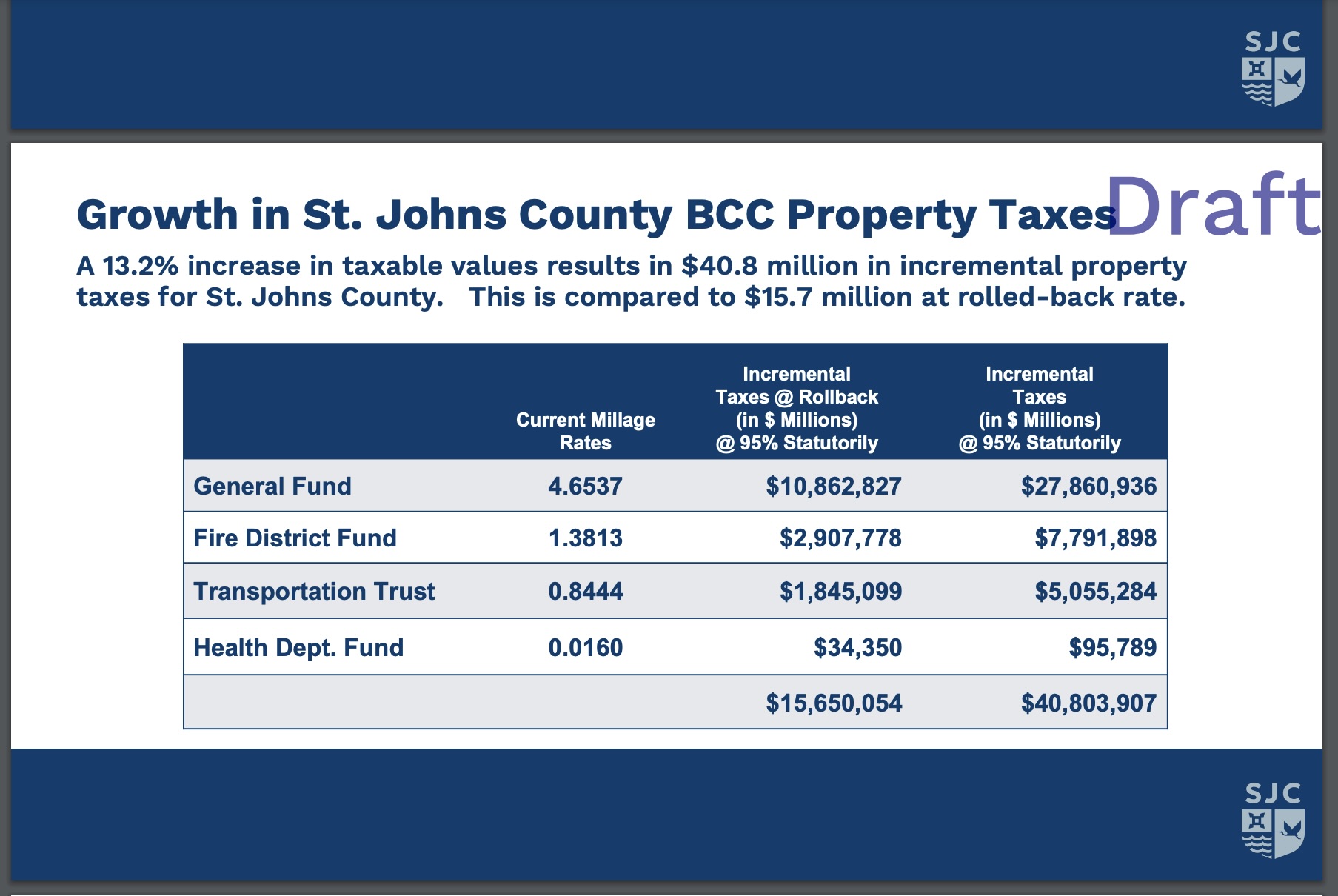
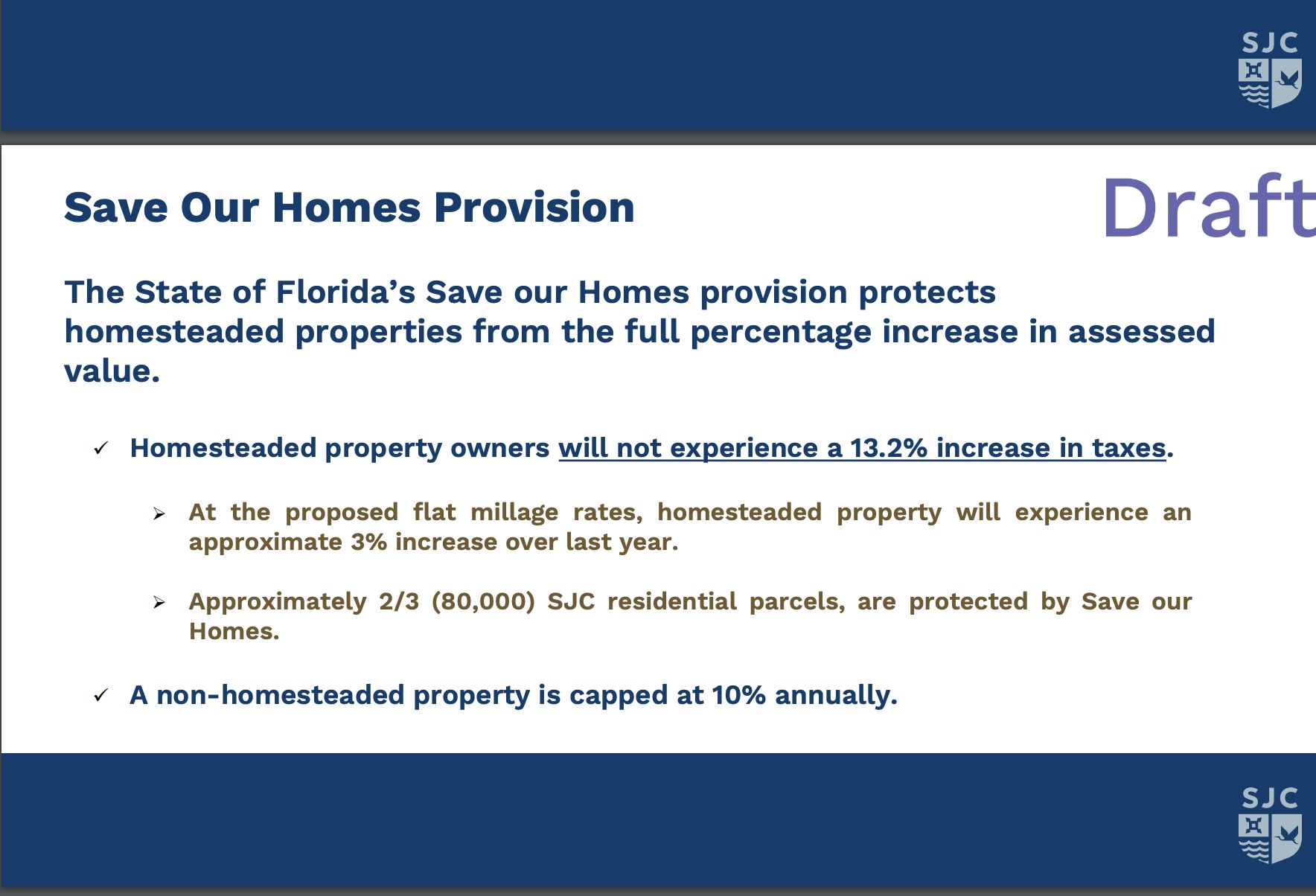
Item 2Fiscal Year 2025 Recommended Budget & Proposed Millage Rates

Details of the presentation are here: Budget Presentation

“The BCC will need to approve proposed Millage rates (see the attached sheet) for the County’s TRIM mailing, and approve September 3, 2024 @ 5:01 PM in the County Auditorium as the Date, Time and Place of the first public hearing for the adoption of the FY 2025 Budget for the St. Johns County Board of County Commissioners”

Projected Budget Growth
Save Our Homes Provision

Details of the budget are transparently presented at this link: Office of Managment and Budget Website

Drill down into the various components. It is very educational to spend some time on this website.


Item 3 – 2050 Vision – Comprehensive Plan Update

This will be an update from the Consultant on the Comp Plan update. There is no presentation posted at the time of this writing.

Item 4 – Evaluation and Appraisal Report (EAR) Based Comprehensive Plan Amendments – Transmittal Hearing

“The State of Florida requires local governments to evaluate and update their Comprehensive Plans every 7 years, this process is known as the Evaluation and Appraisal Report (EAR). The County’s consultant, Inspire Place Making Collective, has provided an analysis of the County’s current comprehensive plan and identified proposed changes in order to meet current state regulations. The proposed changes reflect updated Florida Statute code sections and citations, as well as an expansion of the current planning horizon from 2025 to 2035, as required by Florida law. The Planning and Zoning Agency is scheduled for a Transmittal Hearing on July 11th. Recommendation of the PZA will be presented to the Board after the recommendation has been made.”

Link to the materials is here: Comprehensive Plan Details


Item 5 – RFP 1480 Enterprise Resource Planning (ERP) Solution

“The purpose of implementing an Enterprise Resource Planning (ERP) system is to create efficiencies and improve the effectiveness of the internal service departments that provide support to all County departments in its daily operations within budget, procurement, finance, human capital and other business systems. This project will allow the integration, consolidation, and automation of business processes currently handled in separate systems as well as the elimination of duplicative, manual, and offline processes. The County’s current systems are outdated, disconnected and undersized, and not able to meet the needs of the County. Implementing a modern, integrated ERP software system with increased functionality, user access, reporting, automation, integration, and data structures will support the comprehensive needs of the County, including the internal service departments and end-user departments that use these core resources within their daily functions. The Purchasing Department issued a Request for Proposals (“RFP”) for the implementation of a cloud-based, centralized Enterprise Resource Planning (ERP) Solution, for four (4) main functional areas: Finance, Human Resources, Procurement and Budget. The RFP was developed with the assistance of the County’s ERP Consultant, Plante & Moran, PLLC. The County received six (6) responsive Proposals, which were evaluated, and demonstrations were presented by a shortlist of two (2) firms. The evaluation committee, based upon Proposals and demonstrations, identified Cognizant Worldwide Limited as the top ranked firm. Cognizant is the firm who is responsible for developing and implementing the ERP Solution. The proposed ERP Solution is Workday, Inc for the procurement, finance and human resource functions, with Sherpa Government Solutions, LLC (EUNA) proposed for the budget function, and Can/Am Technologies, Inc proposed for the cashiering function. Staff has negotiated Statement(s) of Work and agreements with the four (4) firms that will make up the entirety of the ERP Solution. Each of these agreements with their respective Statement of Work is attached to this agenda for review and approval. Staff recommends Board approval to award RFP 1480; Enterprise Resource Planning Solution, to the top ranked team of Cognizant, Workday, Sherpa (Euna) and Can/Am and to execute the contracts, as negotiated, in substantially the same form and format as attached hereto. Due to the size of the Exhibits and Attachments, they are available upon request from Jaime Locklear.”

Materials are here: ERP Proposal


Items 6 and 7 – PUD 2023-22 Shearwater 210 PUD

These two items will be heard together as they are companion pieces.

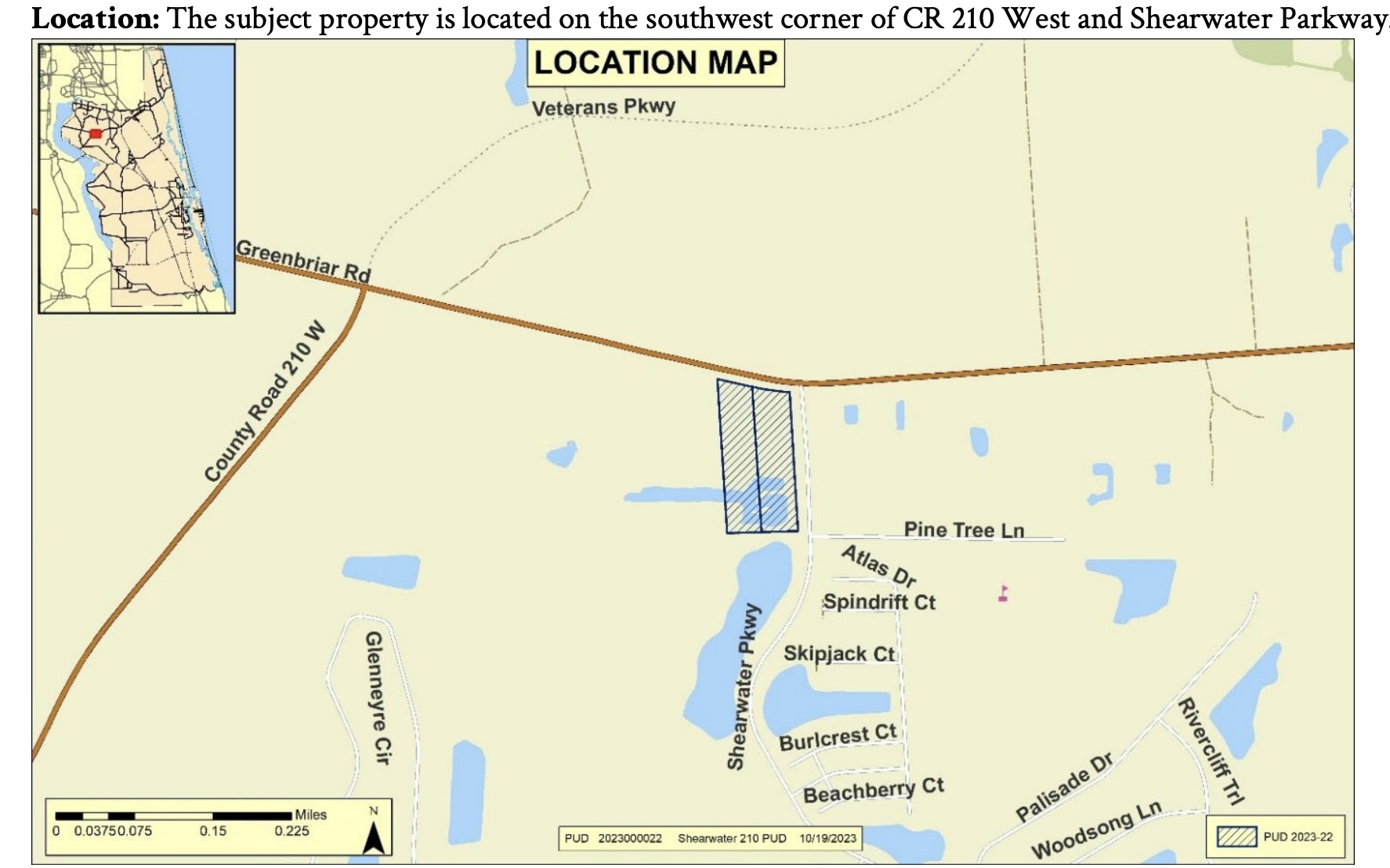
“Request to rezone approximately 6.04 acres of land from Open Rural (OR) to Planned Unit Development (PUD) to allow for a maximum of 72,480 square feet of commercial, retail, and/or office uses; located on the southwest corner of CR 210 W and Shearwater Parkway. This request is a companion application to CPA (SS) 2023-11. This request was originally heard at the 4/18/2024 PZA, where it was continued with a 4-2 vote. At the 6/20/2024 PZA, it was recommended for denial with a vote of 6-0. Agency members and nearby residents discussed a range of topics, including compatibility, traffic on CR 210 W and the status of it being widened, the approved CR 210 Town Center PUD located to the north, and the demand for non-residential uses in general for the nearby area.”

Item 6 details: Agenda Item 6

Item 7 details: Agenda Item 7

Shearwater PUD

Item 8 – PUD 2023-09 Rivers Self Storage PUD

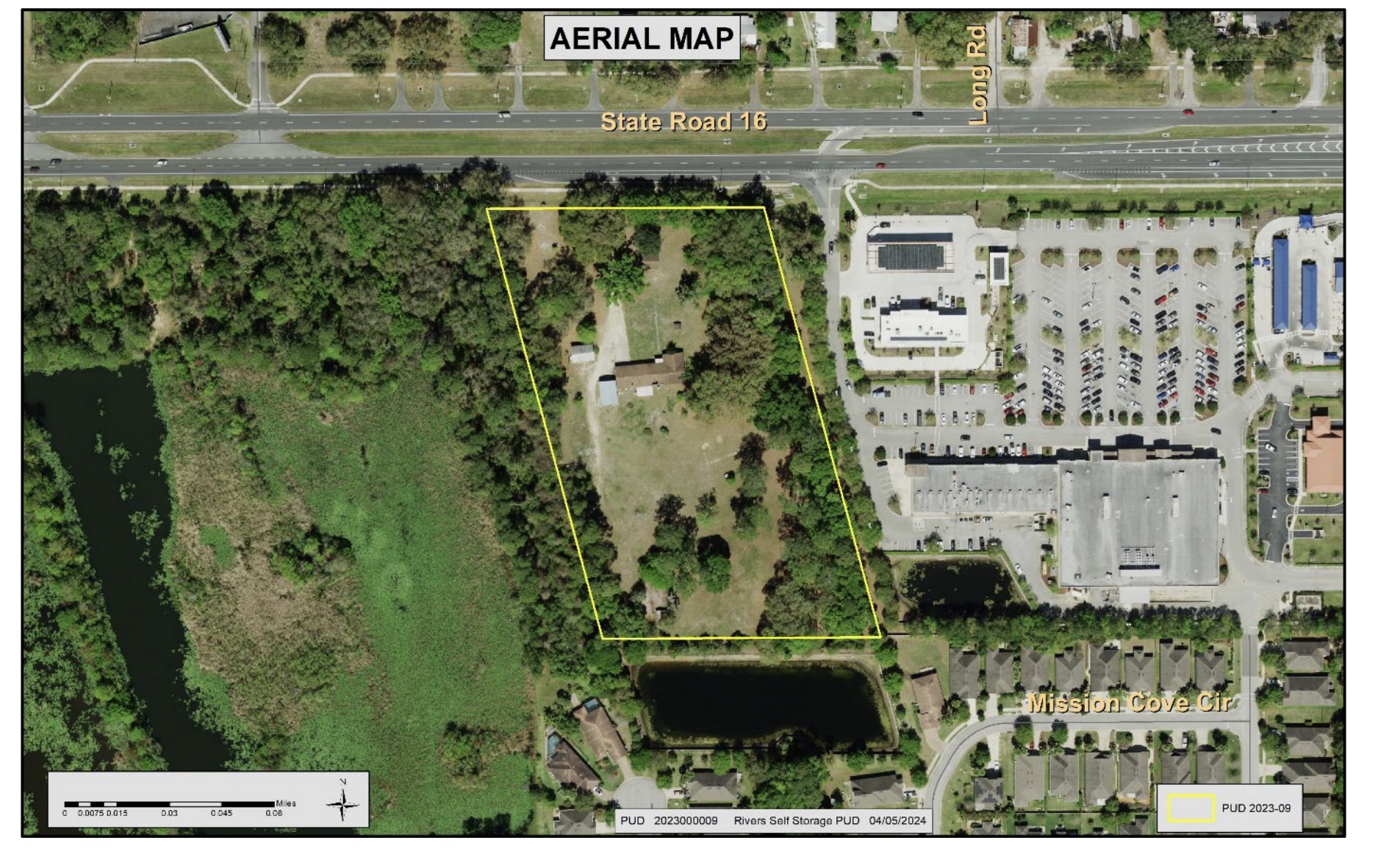
“Request to rezone approximately 5.99 acres of land from Open Rural (OR) to Planned Unit Development (PUD) to allow for a maximum 100,000 square foot Self Storage facility, specifically located at 1065 State Road 16. The Planning and Zoning Agency (PZA) heard this request at their regularly scheduled public hearing on June 20, 2024 and recommended approval with a vote of 6 to 0. Agency members discussed the Applicant’s plan to provide buffers along SR 16 and Mission Trace, where the Applicant highlighted that the buffer reduction was limited to the southwest corner of the site. They also noted that the reduced setback was adjacent to the open space parcels for Mission Trace to the south and west. The Agency discussed the Applicant’s plan for the preservation of significant trees, controlled onsite lighting, security fencing, and acknowledged the Project Team’s outreach through unofficial meetings with Mission Trace neighbors. There was only one member of the public who spoke during public comment, and they presented the Applicant’s agreement to address site/area security, adequate stormwater management, prevention of damage/trespass during construction, and appreciation for the courtesy meetings hosted by the applicant.”

Materials are here: Agenda Item 8

Proposed location for Item 8

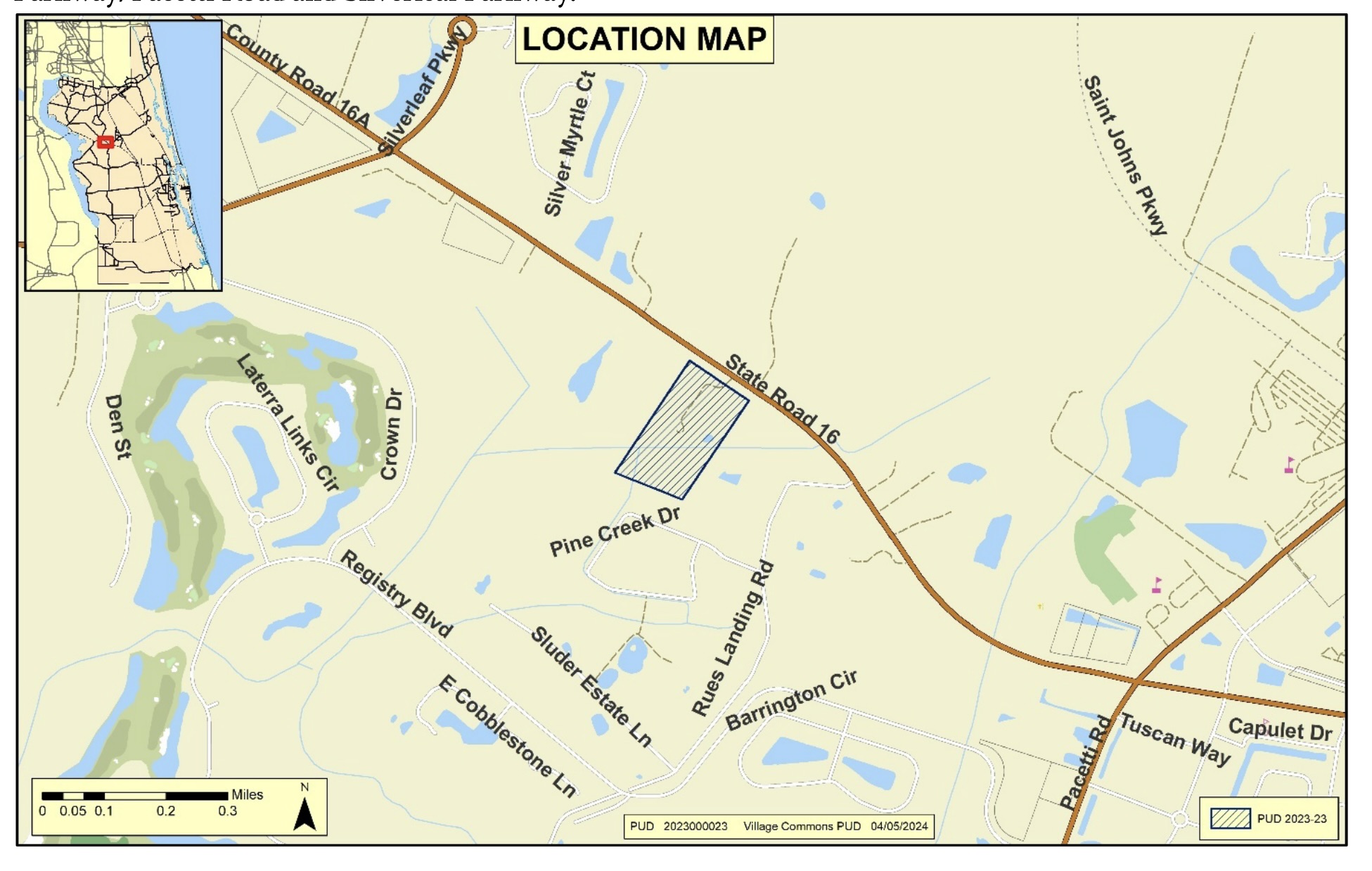
Item 9 – PUD 2023-23 Village Commons PUD

“Request to rezone three (3) parcels from Open Rural (OR) and PUD (Ord 2008-20) to PUD to accommodate a maximum of 55,000 square feet of commercial/retail uses as permitted in the Neighborhood Commercial zoning designation of the Land Development Code, and a 7,000 square foot expansion of the existing church, specifically located at 5845, 5865, and 5885 State Road 16, Saint Augustine. The Planning and Zoning Agency held a Public Hearing on this item on June 6, 2024, and voted 5-1 in favor of recommending approval. Concerns raised by Agency members included increased traffic, and that the church expansion and proposed commercial uses appeared to be incongruent. The applicant waived any right to develop the property pursuant to the Live Local Act, Chapter 2023-17, Laws of Florida, and any subsequent amendments.”

Village Commons Location

If you are finding value in these updates, please subscribe to my blog so you get notifications when I publish an update. Feel free to share with others who may find value in the content.
Posted in BOCC, Comprehensive Plan

What’s Ahead at the June 4, 2024 St. Johns county Board of County Commissioner’s Meeting

There are no proclamations for this meeting.


Consent Agenda

Consent Agenda Item 5 – LAMP purchase recommendations seem to be hot topics recently and this is one for the purchase of 6.8 acres of land in Elkton.

Check out the details here: Consent Agenda Item 5

Consent Agenda Item 8 – modifying land use to add a library to the permitted uses of the Northeast Regional Park in Nocatee.

Details are here: Consent Agenda Item 8


Regular Agenda

Agenda Item 1 is the presentation of the budges for the Constitutional Officers; St. Johns County Sheriff, Clerk of the Circuit Court and Comptroller, and the Property Appraiser.

The link is here: Constitutional Officers Budgets

Highlights:

The Sheriff is requesting a budget of $128,702,884 for the 2025 year.

The Clerk of the Court is requesting a budget of $4,477,646.


Agenda Item 2 is Presentation of the Annual Reports of Boards and Committees. This includes reports from the 20 boards appointed by the BOCC.

Presentation is here: Boards and Committees Annual Reports


Agenda Item 3 is the Pavo Economic Incentive request continued from the May 21 BOCC meeting because the applicant was not present.

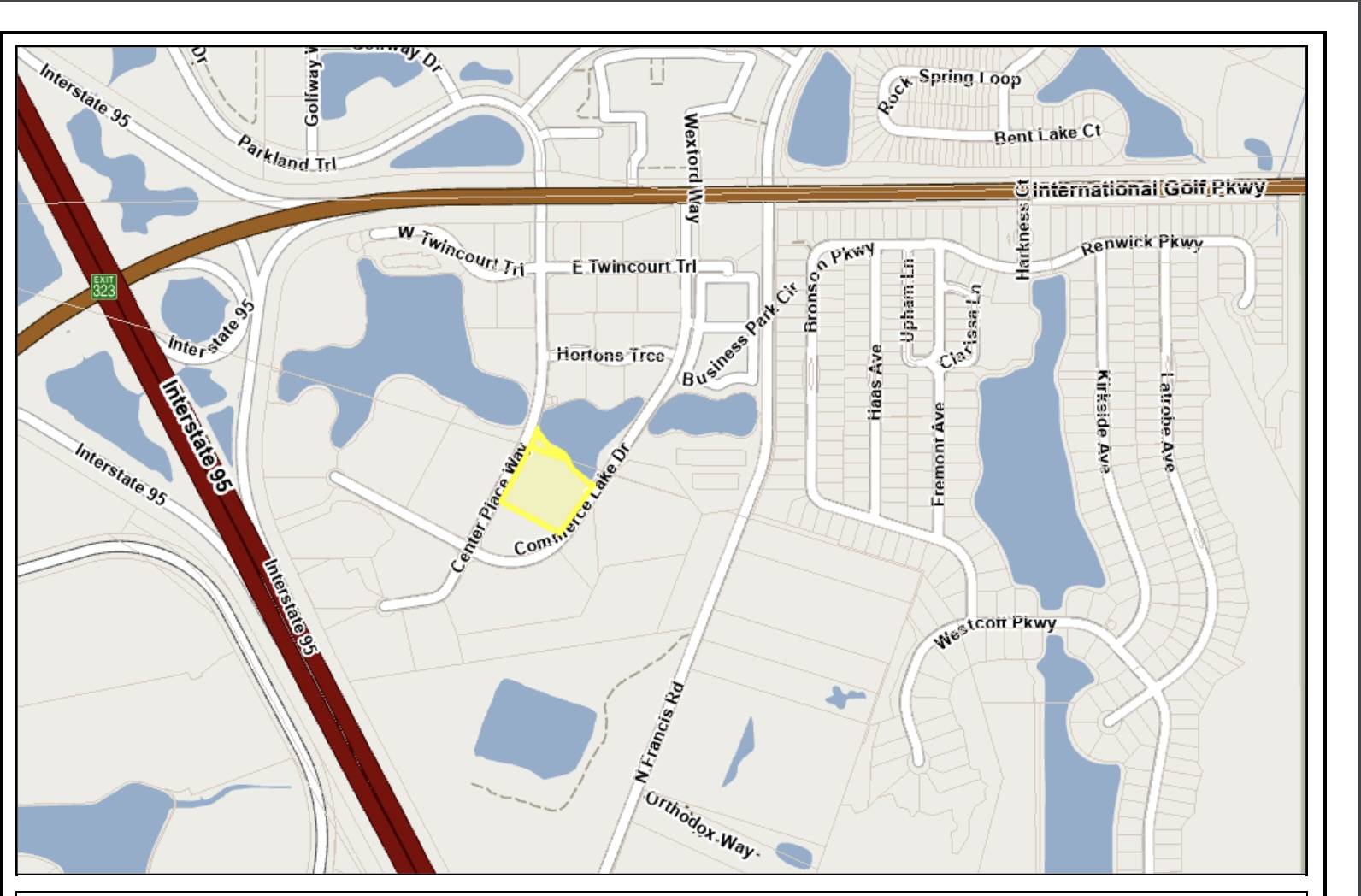
The application is for incentives to develop a total of 22,680 Sq. Ft of speculative industrial/office space (no known tenant) near the intersection of I-95 an dInternational Golf Parkway.  They are seeking incentives of $107,224 with anticipated net benefit to the county of 387,933.

Location of Pavo Project

The full report is here: Economic Incentive Request


Agenda Item 4 is the Adoption Hearing for updates to the Comprehensive Plan to bring it into compliance with Florida statutes (HB 1379) passed in 2023. The transmittal was approved at the BCC on April 16, 2024.

Full details are at this link:  Comp Plan Update


Agenda Item 5 is a petition to add 102.96 acres to the current ~437 acre Entrada CDD.

Details are here: Entrada CDD Expansion


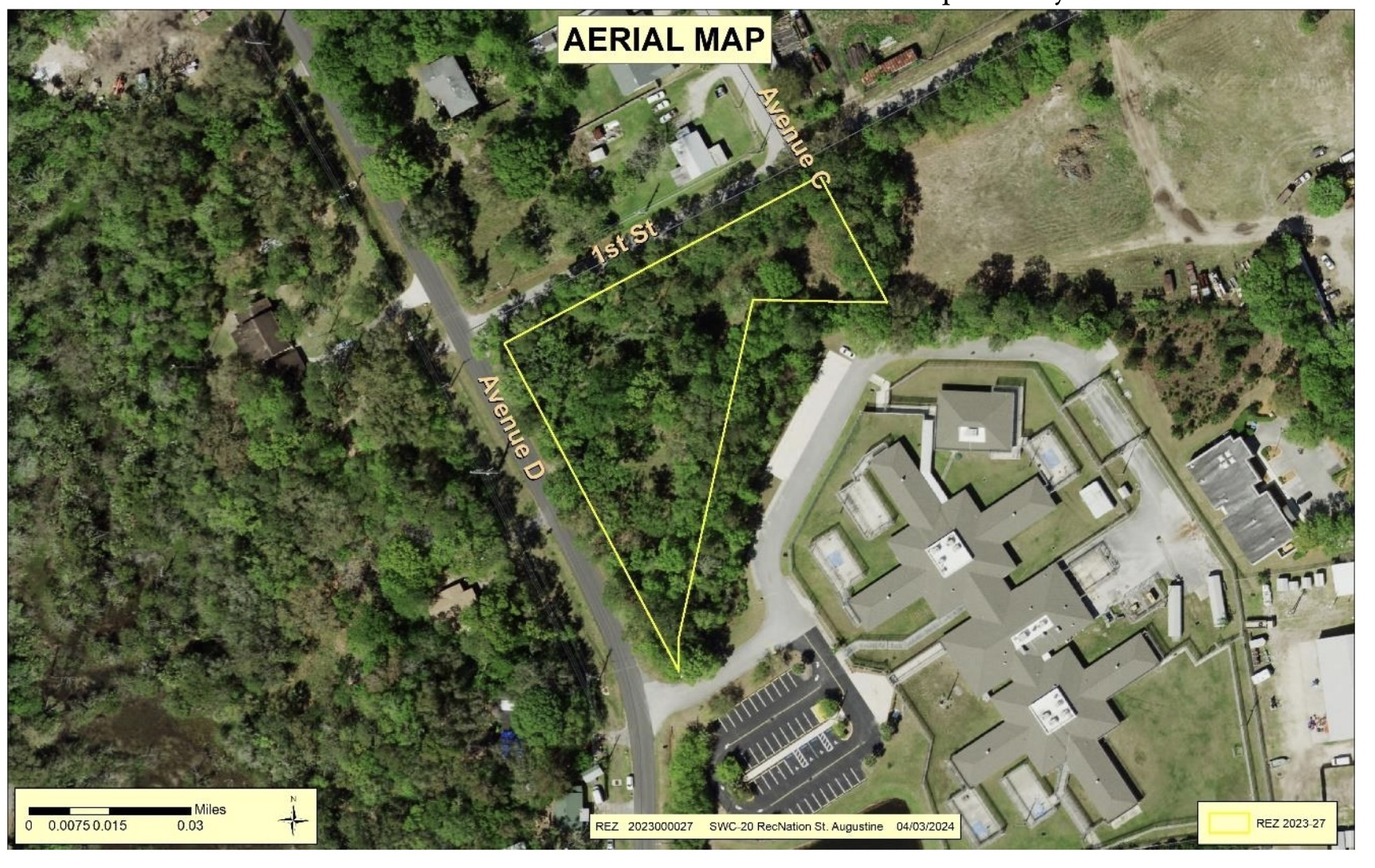
Agenda Item 6 is a request to rezone 1.52 acres of land from Residential, Single Family to Industrial Warehousing for the purpose of building a 189,320 Sq. Ft RV & Boat Storage Facility. This parcel is located at the intersection of Avenue D and 1st Street, west of US 1.

Location of proposed RV/Boat Storage

Details are here:  Details of RV Boat Storage request


Agenda Items 7 and 8 are interesting because this seeks to provide what may be the first Charter School in St. Johns County.

The request is to remove 5 acres of land from the Treaty Grounds Planned Unit Development and to rezone those 5 acres to Open Rural to allow for a K-8 Charter School and Early Learning Cetner at 1600 Brinkhoff Road (near SR 207.)

Details are here: Agenda Item 7 and Agenda Item 8


If you are finding value in these updates, please subscribe to my blog so you get notifications when I publish an update. Feel free to share with others who may find value in the content.