
Posted in Politics, St Johns County Schools, St. Johns County

Don’t Outsource Your Vote

Early voting begins August 8 in St. Johns County.

We are down to the final days of what has been a contentious year of campaigning. Several of our key local elected officials will be decided in the August primary—not in the November general election:

  • County Commission Districts 2 and 4
  • School Board District 1
  • City of St. Augustine Commission Seat 5

The City Commission race will appear only on the ballots of voters who live within the City of St. Augustine.

This is not the primary to sit out.


Know Which Races You Can Vote In

This year, our County Commission races are Universal Primary Contests. Because all the candidates in these races are members of the same political party, every registered voter in St. Johns County may vote in them, regardless of party affiliation.

Many voters are confused about districts and which candidates will appear on their ballots.

For School Board, you may vote only for the candidate representing the district in which you live.

County Commission works differently. Commissioners must live in the districts they represent, but they are elected countywide. That means every registered voter in St. Johns County may vote in the District 2 and District 4 County Commission races—not only voters who live in those districts.

There has also been considerable discussion about where County Commission candidates are required to live.

A candidate does not have to live in the district throughout the campaign. The residency requirement must be met before taking office.

That distinction matters in the District 2 race. One candidate lived in District 5 during most of the campaign and recently shared that he moved into District 2 on August 1. Some voters have questioned whether he lives in District 2; he has responded that he does.

Voters can decide for themselves whether the timing of that move matters to them. But the legal question of residency and a voter’s judgment about a candidate’s connection to the district are two different questions.


Don’t Let Someone Else Choose for You

Every election cycle, a LOT of organizations produce voter guides recommending their preferred candidates.

In 2022, I was at a polling location where representatives were distributing three different guides: a Trump Club voter guide, a Republican Executive Committee voter guide and a Republican Liberty Caucus voter guide.

One young man stood there holding all three, trying to decide which one he should follow. Meanwhile, the people distributing them were arguing and shouting at him:

“Use this one!”

“No, use this one!”

If you wait until you arrive at the polls to pick up a voter guide, you have missed your opportunity to cast a genuinely informed vote. You are leaving your choice to another group whose priorities you may or may not share.

Voter guides can provide useful information. But they should be part of your research—not a substitute for doing it.


Look Beyond the Campaign Message

Read the candidates’ answers to questionnaires. Watch the recorded forums. Compare what candidates say to different audiences.

Forums are especially helpful because they reveal more than prepared campaign positions. They can give you a glimpse of how a candidate thinks, communicates and responds when challenged.

Before casting your ballot, consider:

  • Does this person represent the values I want on the board?
  • Do they demonstrate the character and judgment the office requires?
  • Do they understand the responsibilities—and the legal limits—of the position they are seeking?
  • What do they stand for, beyond what they oppose?
  • What specifically do they want to accomplish to move our county forward?
  • Have they explained how their proposals would be implemented and funded?
  • Do they have the temperament to work with colleagues, staff and community stakeholders?
  • How do they respond when challenged or asked a question they did not anticipate?
  • Are their claims supported by facts?
  • Are they offering workable solutions, or primarily identifying people and institutions to blame?
  • Do they demonstrate a meaningful connection to the district they seek to represent, even though the entire county votes in County Commission races?
  • Who is supporting and funding their campaign, and what might those supporters expect from them?

No candidate will agree with you on everything. The question is whether that person has the values, competence, judgment and temperament to govern responsibly.

I have been sent some endorsements for candidates and been asked to share them. I am intentionally not including endorsements, just the forums and tools for you to do your own research.

I have included links below to recorded candidate forums and official election information. Take the time to watch and read them before you cast your ballot.

Then show up—during early voting or on Election Day—and make your own decision.

League of Women Voter’s Interview with Bev Slough, Candidate for School Board District 1
League of Women Voter’s Interview with Tammie McClafferty.Candidate for School Board District 4

There was an April Candidate Forum sponsored by the St. Johns County Republican Assembly. I was unable to find a link to the video of that event. If I locate it, I will add to the post.

St. Johns County Supervisor of Elections


If you are finding value in these updates, please subscribe to my blog so you get notifications when I publish an update. Feel free to share with others who may find value in the content.

Posted in Ag Enclaves, BOCC, Florida Legislature

How We Will Evaluate Agricultural Enclave Applications Under SB 686

Before we jump into how each of the Ag Enclave applications stacks up against the statute, I thought it would be helpful to lay out the requirements.


But first, let’s talk about the suggestions that the County should seek an injunction to stop the certification process from moving forward. Asking for an injunction is not as simple as disagreeing with the law—or believing it will produce bad results.

The County would first need a viable legal claim. That might involve an argument that the statute violates the Florida Constitution, exceeds the Legislature’s constitutional authority, violates due process or conflicts with another constitutional provision.

The County could also ask the court for a temporary injunction while the larger case was being decided. To obtain that relief, it would generally need to demonstrate a substantial likelihood of success on the merits, irreparable harm, the absence of an adequate legal remedy and that an injunction would serve—or at least not harm—the public interest.

Would merely filing the lawsuit stop the applications already pending? No. The law would remain in effect unless and until a judge entered an order temporarily preventing its enforcement. Whether that order would apply to applications already filed would depend upon the precise relief requested and granted.

Litigation could also take months or years. Meanwhile, SB 686 gives the County only 90 days to approve or deny certification before a property is certified by default. That is why, unless a court says otherwise, the County must continue evaluating the applications under the law currently in effect.


So let’s jump into what we will be looking for as we analyze the applications already submitted.

When Florida’s new agricultural enclave law took effect on July 1, 2026, it created a highly structured and unusually compressed process for reviewing qualifying properties.

Under SB 686, the St. Johns County Board of County Commissioners cannot simply decide that a proposed development is too large, too controversial or inconsistent with the county’s existing growth plans. If an application satisfies the requirements established by the Legislature, the county must certify the property as an agricultural enclave.

But that does not mean every application labeled an “agricultural enclave” automatically qualifies.

The law contains numerous factual, geographic and legal requirements. Our review will focus on whether each applicant has produced sufficient evidence to establish every required element, not merely whether the application contains the right words or conclusions.


Start With the Property as It Existed on January 1, 2025

Several of the law’s threshold requirements depend upon conditions that existed on January 1, 2025.

The property must have been:

  • Located in unincorporated county territory;
  • Undeveloped;
  • One parcel or a legally identifiable group of parcels; and
  • Owned or controlled by a single person or entity.

That makes the property’s history important.

The County should carefully review deeds, property-appraiser records, corporate records, contracts, options and other documents to determine who owned or controlled the property on the statutory date. Parcels acquired or assembled after January 1, 2025, will require particularly careful scrutiny. These documents are included in the applications but including them is not the same as demonstrating the requirement has been met.

The meaning of “undeveloped” may also become a significant issue. Agricultural property is not necessarily unimproved property. A site may contain homes, barns, roads, utilities, mining activity or other structures. Those conditions should be identified rather than simply described by the applicant as agricultural land.


Verify the Agricultural History

The property must have been in continuous bona fide agricultural use for at least five years before the application.

An agricultural classification from the property appraiser is important evidence, but it is not necessarily sufficient on its own. There should be supporting records establishing both the classification and the actual agricultural activity on every parcel during the required period.

Those records might include:

  • Agricultural leases;
  • Farm, crop or livestock records;
  • Receipts and tax schedules;
  • Historical aerial photographs; and
  • Site inspections or other documentation of the property’s use.

Any part of the property that was not used for agriculture should be mapped and evaluated separately. The evidence should demonstrate a genuine, continuous agricultural operation—not an activity established primarily to create eligibility for future development.


Check Every Foot of the Perimeter

The perimeter calculations are likely to be among the most complicated and contested parts of these applications.

A survey should identify the property’s complete perimeter in linear feet. Every boundary segment should then be classified, measured and supported by evidence. The applicant’s calculations should be independently checked.

The law provides more than one way for a property to satisfy the surrounding-development requirements.

One alternative generally requires at least 75 percent of the perimeter to be surrounded by a qualifying combination of existing development, land designated and substantially developed for residential, commercial or industrial uses, or certain interstate and urban-service-area conditions.

A second alternative applies to properties of 700 acres or less. It requires that at least 50 percent of the perimeter is surrounded by appropriately designated property and at least 50 percent is surrounded by property within an established urban service district, area or line.

A third alternative involves property located within a rural study area adopted into the local comprehensive plan and intended for residential development.

For each application, we will look to see which alternative the applicant is claiming and whether the evidence proves it.

Roads, canals and bodies of water require special attention. The qualifying land use is generally determined by examining the parcel directly across the feature—not by counting the roadway, canal or water itself as surrounding development. Corner touches and point contacts are not to be treated as portions of the perimeter.

The law also prohibits one locally certified agricultural enclave from being used to establish the qualifying perimeter of another.


Confirm the Acreage Limits

The general acreage limit is 1,280 acres.

Larger properties may qualify only under additional requirements involving their perimeter, surrounding residential development and projected population at buildout. No qualifying property may exceed 4,480 acres.

Those calculations should be documented rather than accepted at face value. Any reliance on “authorized” future development should be supported by valid development approvals, and projected buildout population should include the methodology and assumptions used.


Examine Public Services and Infrastructure

Certification does not make infrastructure limitations disappear.

Applications should address water, wastewater, transportation, schools and recreation. The review should identify the responsible service providers, available capacity, required extensions or improvements, projected timing and costs.

If those services are not presently available or scheduled through the county’s capital improvements program, the applicant may offer to pay for or construct its proportionate share of improvements or contribute necessary land. Any such offer should be sufficiently specific and enforceable to form a binding agreement.


Identify Protected Property and Environmental Constraints

Certain lands are excluded or subject to additional protections, including property within specified protected areas, military installations or ranges, and land encumbered by qualifying conservation easements.

Certification also does not erase environmental requirements.

The review should consider wetlands, floodplains, stormwater, listed species and established wildlife corridors. Where habitat connectivity may be affected, measures such as clustering, retained open space and wildlife crossings should be evaluated.

The county may be constrained in how it applies its land-use regulations, but existing environmental and conservation protections must still be identified and preserved.


Test the Adjacent Density Comparison

To obtain certification, an applicant must identify genuinely adjacent property that legally permits the same or a higher residential density.

The important question is not necessarily how many homes have already been constructed nearby. It is what density the adjacent property is legally entitled to develop under its future land use designation, zoning, development order, PUD or other valid approval.


Track the Deadlines Carefully

SB 686 imposes strict deadlines:

  • A written compliance report is due within 30 calendar days after the application is received.
  • A public hearing must be held within 30 calendar days after the report.
  • The county must approve or deny certification within 90 calendar days after receiving the application.
  • If the county fails to act within 90 days, the property must be certified.
  • After development plans are submitted, the county and applicant must establish a written review process within 30 business days.
  • The development-plan review process may not exceed 180 days.

These deadlines run from receipt of the application—not necessarily from the date the county considers it complete. That creates a risk if an application is missing information but the statutory clock continues to run.


Certification Is Only the First Stage

This is an important element. Certification establishes that a property qualifies for treatment under the new law. It is not the same thing as approving a final development plan.

After certification, the applicant must submit plans showing the proposed uses, density or intensity, infrastructure and site design. The law limits the county’s ability to reject a qualifying plan solely because it conflicts with existing comprehensive-plan or zoning designations. It also restricts the county from imposing requirements more burdensome than those applied to comparable developments.

Nevertheless, the applicant must still demonstrate that the proposed development is an eligible use and does not exceed what the law permits based upon the relevant adjacent property.


The Bottom Line

Our assessment of each agricultural enclave application will ask a straightforward question:

Has the applicant proven every element required by the statute with verifiable evidence?

Each application must be evaluated parcel by parcel, boundary segment by boundary segment and requirement by requirement. Where information is missing, we will identify it. Where calculations are questionable, we will test them. Where the law leaves room for interpretation, we will distinguish the legal question from the underlying facts.

SB 686 significantly limits local discretion—but it does not eliminate the obligation to conduct a careful, consistent and evidence-based review.


One caveat: I am not an attorney, and this is not a legal opinion. I am a former Chief Audit Executive who spent decades evaluating evidence against federal, state, local and international requirements. That is the lens I am bringing to this review.


If you are finding value in these updates, please subscribe to my blog so you get notifications when I publish an update. Feel free to share with others who may find value in the content.
Posted in BOCC, Comprehensive Plan, Florida Legislature

Why Can’t St. Johns County Simply Vote “No” on Ag Enclave Applications?

Understanding how SB 686 changed the County Commission’s role.

If you’ve been following the recent discussion about Ag Enclave applications in St. Johns County, you’ve probably heard one question repeated over and over:

Why can’t the County Commission simply vote “no”?

There has been a lot of discussion in Northeast Florida over the past week about SB 686, the Ag Enclave bill. With our first applications filed, I thought it would be helpful to give some background on this bill and how we got here. Then we can talk about what the county can, or cannot, do.

Residents want to know why the County Commission can’t simply deny these six Ag Enclave applications the same way it could deny a Comprehensive Plan Amendment.

The answer is that these applications are not processed like Comprehensive Plan Amendments or rezonings. SB 686 created an entirely different process under state law, and understanding that process explains why the Commission’s role is very different than many people realize.

This may feel like another rezoning request.

It isn’t.

SB 686 created an entirely different legal process.

This article isn’t about whether SB 686 is good or bad policy. It’s about understanding what the law requires and how we arrived here.


Two Different Questions Are Being Asked

There are really two separate questions being debated.

The first is whether SB 686 was good public policy. Reasonable people can disagree on that.

The second is what authority the County Commission has now that SB 686 is law. That is the question this article addresses.

Before writing this article, I reviewed SB 686, the House and Senate bill analyses, legislative history, Florida Association of Counties updates, and four Ag Enclave certification applications filed in St. Johns County.

Before SB 686, counties had broad discretion in zoning changes. Comprehensive Plan Amendments and rezonings were legislative decisions. County Commissioners could make decisions, within the law, on local impacts of a Comprehensive Plan Amendment or zoning waiver

After SB 686, the Legislature created the Ag Enclave Certification process. Certification is essentially the county determining whether an application meets the criteria established in state law. It is not the same thing as deciding whether the county likes the project. Once certified, local decisions still occur but under a much narrower legal framework established by the legislature.

Certification is not the same as approval. There are specific steps that are very different from the usual Comprehensive Plan Amendment.

The process essentially is:

1. Developer submits certification application.

2. County reviews statutory eligibility. (Staff performs the analysis and presents to Commissioners.)

3. County issues certification if criteria are met.

4. Development application follows.

5. County still reviews engineering, infrastructure, concurrency, stormwater, utilities, etc.

6. But the County’s discretion is very different than under a traditional Comprehensive Plan Amendment.

SB 686 enacted

        ↓

Certification Application

        ↓

County determines statutory eligibility

        ↓

Certification issued (if requirements met)

        ↓

Development Review

        ↓

Construction approvals

Why can’t commissioners simply vote no?

Their discretion in the certification process is governed by state law rather than local judgment.

If the application meets the certification criteria, they must vote “yes” to certify. If the Commission denies certification even though the statutory requirements are met, the applicant may seek review in circuit court through a writ of certiorari. In other words, the court reviews whether the county followed the law, not whether the judges agree with the project.


So how did St. Johns County end up operating under this entirely new process?

The answer doesn’t begin with the six applications filed this month. It begins in Tallahassee, where SB 686 moved through the normal legislative process over several months before becoming law on July 1, 2026.

The Legislative Record

On December 1, 2025, Senator Stan McLain of District 9 (Central Florida District) filed the Ag Enclave bill, SB 686.

Agricultural Enclaves; Authorizing certain persons to apply to the governing body of the local government for certification of certain parcels as agricultural enclaves; requiring the local government to hold a public hearing within a specified timeframe to approve or deny such certification; authorizing certain persons to submit certain development plans; authorizing the development of certain parcels for commercial, industrial, or single-family residential purposes under certain circumstances, etc.”

It then moved through committee hearings over the next several months before passing both chambers and being signed by the Governor on April 20, 2026, with an effective date of July 1.

The Florida Association of Counties exists in part to keep county governments informed about legislation that affects local government.

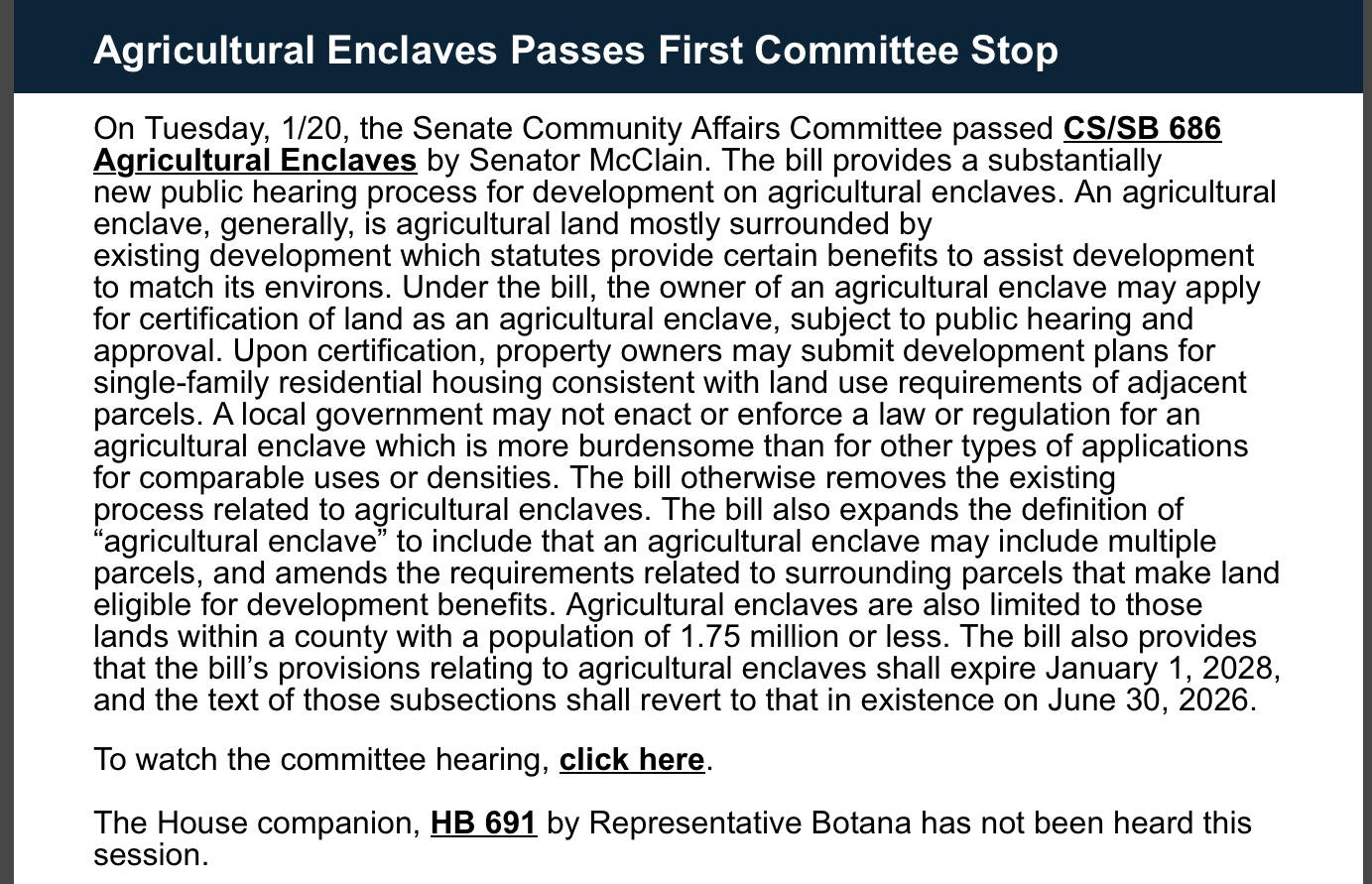
In the Florida Association of Counties FAC Legislative Bulletin: Week 2, dated January 23, 2026, they included a summary:

FAC Email Bulletin January 23, 2026

FAC legislative bulletins are distributed to county officials throughout Florida as part of the association’s legislative tracking.

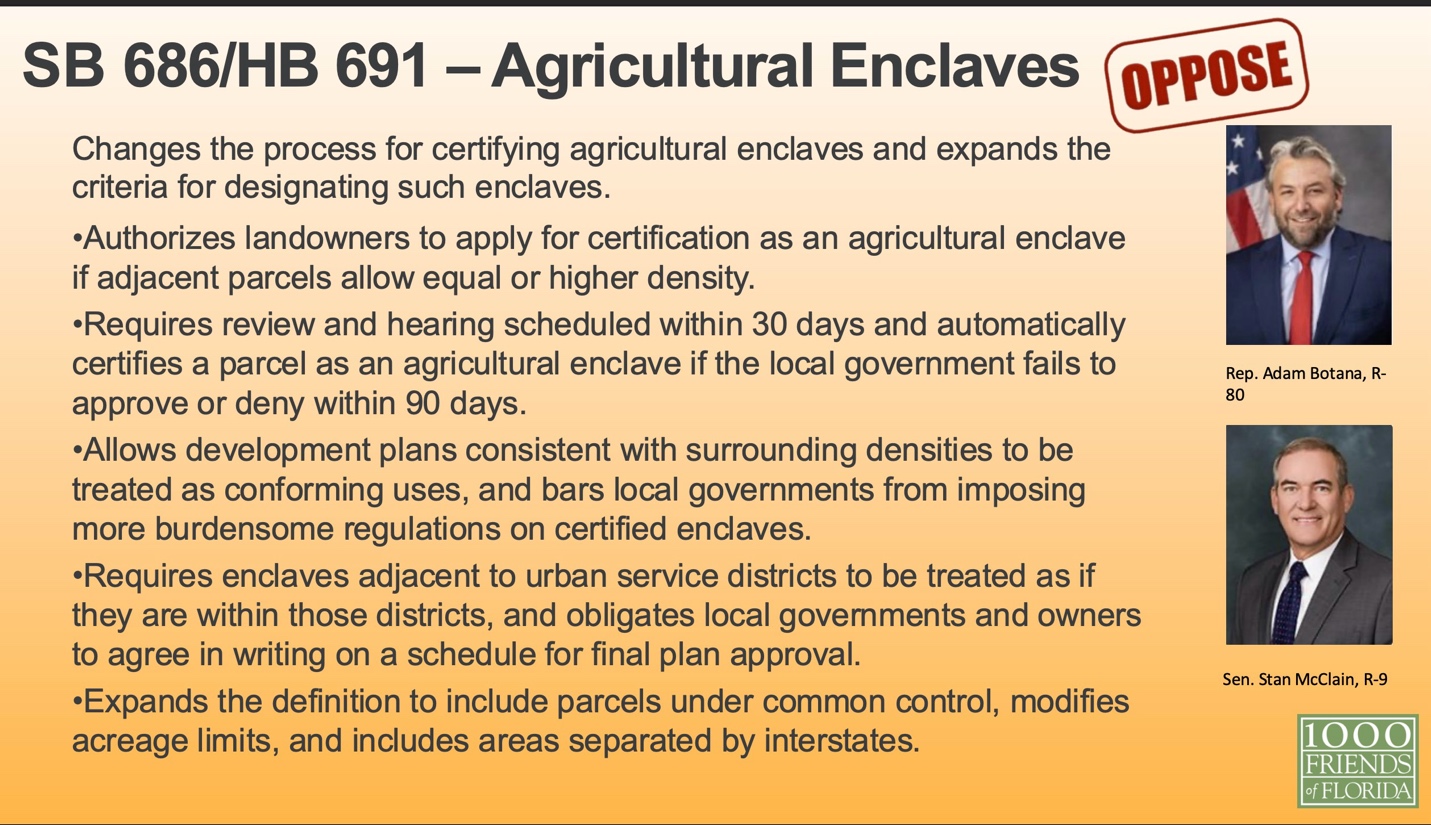
The 1000 Friends of Florida shared an update about the bill in their February 11 webinar and strongly opposed the bill

1000 Friends of Florida Webinar, February 11, 2026

Here is a link to the full history of the bill on the Senate website: SB 686 Senate Bill History

The related House Bill was HB 691 and filed on December 8, 2025 by Representative Adam Botana of District 80 (Bonita Springs, Leon and Collier Counties)

Link to the House Bill is here: Companion Bill HB 691

The bill was presented to the Governor on April 9 and signed April 20, becoming effective July 1, 2026.


SB 686 did not appear overnight. Whether someone agrees with SB 686 or opposes it, one thing is clear from the legislative record: this bill followed the normal legislative process over several months. It moved through Florida’s normal legislative process over several months, with committee hearings, legislative analyses, advocacy from supporters and opponents, and regular legislative updates distributed to county governments through the Florida Association of Counties.

The legislation also received support from members of the St. Johns County legislative delegation. Senator Leek voted Yes on February 26, and the bill was sent to the House where all 3 of our County Representatives voted Yes on March 11, 2026.

County commissioners are now responsible for administering a law that many local officials and planning advocates opposed.


Where are we now?

On July 1, the day the law became effective, 4 Ag Enclave certification requests were filed in St.Johns County. They were followed by 2 more on July 7.

Recent public comments have focused on whether county officials had advance warning that SB 686 was moving through the Legislature and whether the volume of applications could have been anticipated.

These are actually two very different issues.

One concerns the legislation itself.

The other concerns how quickly developers responded once the law became effective.

Those questions deserve to be evaluated separately.

Was the legislation itself foreseeable?

Could the volume of applications have been anticipated?

Regardless of where you stand on SB 686, one thing should now be clear.

By the time these six Ag Enclave applications reached the St. Johns County Commission, the fundamental policy decision had already been made in Tallahassee.

The discussion before the Commission is no longer Should Florida have adopted SB 686?

It is How should the County administer the law the Legislature has already enacted?

Those are two very different questions, and understanding that distinction is essential to understanding the months ahead.


Why this matters

The real lesson is broader.

SB 686 illustrates how profoundly state legislation can reshape local government authority.

Whether one supports or opposes the policy, understanding where decisions are made, and when citizens have the greatest opportunity to influence them, is essential.

By the time an Ag Enclave certification reaches the County Commission, many of the key policy decisions have already been made in Tallahassee.

Whether you support SB 686 or oppose it, understanding the legal framework helps all of us have a more informed discussion.


Over the past several days, I’ve reviewed four of the Ag Enclave certification applications filed in St. Johns County using a checklist developed directly from SB 686 and the supporting statutory requirements. In the coming days, I’ll be sharing those reviews separately. The purpose of those articles will be different from this one: not to explain the law itself, but to examine how the submitted applications compare to the requirements established by the Legislature.


If you are finding value in these updates, please subscribe to my blog so you get notifications when I publish an update. Feel free to share with others who may find value in the content.
Posted in BOCC, Politics, St Johns County Schools, St. Johns County

The Candidates Are Qualified: A Look at the 2026 St. Johns County Primary

The candidates are qualified!

And the Commissioner and School Board races have shifted with some surprises. The biggest shift this year is that the 2026 elections for Board of County Commissioners are Universal Open Primaries. What does that mean? Because all candidates who qualified for these races are members of the same political party and there are no write-in candidates, Florida election law requires these races to be conducted as Universal Open Primaries, allowing all registered voters to participate regardless of party affiliation.

For the first time in recent history, all registered voters, regardless of party affiliation, will be able to vote in the Primary for Commissioner. In the past, voters who had registered as NPA, Democrat, or one of the minor parties had no voice in the Commissioner votes.

That means this year more voters will have a direct voice in selecting County Commissioners than in past election cycles. Whether that translates into higher turnout remains to be seen, but it certainly creates an opportunity for broader participation in local government. Previously, many voters just stayed home as the Commissioner’s race was the most critical vote for the County in the Primary. This year, having more non-Republican registered voters show up at the polls could impact the down ballot votes for School Board and special districts, as well. This will be an exciting year for all St. Johns County voters!


As of the close of qualifying, here is what the ballot currently looks like for St. Johns County voters.

Commissioner Races:

Commissioner, District 2

As anticipated, incumbent Commissioner Sarah Arnold did not file to run. In a surprise move, a 4th candidate entered the race just 5 days before qualifying, and qualified.

Candidates for District 2 are:

Heather Brofford – FB page: Heather Brofford for St. Johns County Commissioner District 2 Website: HeatherBrofford.com

Tim Burres – FB Page Vote Tim Burres for SJC Commissioner Website: https://votetimburres.com/ (still not active)

Wilson McMullan – FB: Will McMullan for County Commissioner District 2 Website: wmcmullan.com

Martin Pyszczymuka – FB: VoteMartinForCountyCommissioner Website: https://www.votemartin2026.com

Commissioner, District 4

In a last minute surprise, Heather Neville withdrew from the race and threw her support behind Candidate Sam Williams.

Candidates for District 4 are:

James Galloway – FB: James Galloway Website: https://jamesgalloway.com

Krista Joseph – FB: KristaKeatingJoseph Website: VoteKrista.com

Sam Williams – FB: Williams for St. Johns County Commissioner Website: samforstjohns.com


School Board Races

District 1 – one candidate failed to qualify so it is a 2 person race between Kevin Allen and Bev Slough

Kevin Allen – FB page:  Kevin Allen FB Page Website Kevin Allen website

Beverly Slough – FB page: Bev Slough for School Board Website: vote4bev.wixsite.com

District 3Jennifer Collins was unopposed so by default she will retain her seat

District 4

Leif Jonassen III – FB: Leif Jonassen FB Page Website Leif Jonassen Website

Tammie McClafferty – FB: Tammie McClafferty for School Board District 4 Website: Tammie McClafferty website

Jillian Tozer – Website: Jillian Tozer Website


As you listen to candidates and learn about their platforms this year, I encourage you to hear from them directly. Attend a town hall. Ask questions. Visit their websites. Follow their social media pages.

Too often, voters learn about candidates through attack ads, social media rumors, or secondhand commentary. This year, let’s make an effort to evaluate candidates based on their own words, ideas, and vision for St. Johns County.

Let’s learn what a candidate stands FOR, not simply what they oppose.

Let’s learn how a candidate intends to move our county forward, not just how they plan to stop someone else.

Most importantly, let’s remember that public service requires courage. Every candidate on this ballot has stepped forward, completed the qualification process, and offered themselves for public scrutiny and voter consideration. Regardless of who earns your vote, that commitment deserves a measure of respect.

Behind every candidate are family members, friends, neighbors, and supporters who care deeply about them. Let’s have spirited debates, ask tough questions, and engage thoughtfully—but let’s also be kind to one another.


If you are finding value in these updates, please subscribe to my blog so you get notifications when I publish an update. Feel free to share with others who may find value in the content.

Posted in BOCC, Politics, St. Johns County

St. Johns County and the 2026 Election Year

Updated to correct a missing website link!

It’s an election year! And we already have some very heated races in St. Johns County!


Having lived here 23 years, I know that for those of us who work in Jacksonville or travel a lot for our work, we often don’t even have time to pay attention to local elections.

Many of us have no idea who our Commissioners are or what they do for the County. Not too long ago a local business person told me he was reaching out to Mayor Deegan for help on something. I asked him why, and he said because she’s the Mayor! I pointed out his business is in St. Johns County and he might want to reach out to our County Commissioners. He didn’t know who any of them are.

That’s not a reflection on this individual – it’s just an example of how in the northern part of the county so many of us work, shop and play in Jacksonville that we naturally know more about the Jacksonville scene than what is happening in St. Johns County.

Today I thought I would spend a little time sharing information about the 2026 Election process in St. Johns County so you can start educating yourself and be prepared to get out and vote in the Primary (August 18,2026) or General Election (November 3, 2026.)


Let’s start with, are you registered to vote? And is your voter registration current? Check out the Supervisor of Elections website and confirm your status. You can do that here: Check My Status

And if you are a newcomer to St. Johns County or Florida, you may not be familiar with our Closed Primary process. If there are qualified candidates from more than one Party, it will be a closed Primary. That means when you go to the polls you will be presented with a Ballot showing only the candidates in your registered party. As an example, if you are a registered Republican, you will only see the Republican candidates on your ballot. If you are a registered Democrat, you will only see the Democratic candidates on your ballot. And if you are not affiliated with any party (No Party Affiliation) you will only see candidates for Non Partisan positions.


Before a candidate appears on a ballot, they have to go through Qualifying. You can see the Qualifying dates for St. Johns County positions on this page: Qualifying Dates & Fees

Most of our County offices have a Qualifying date of June 12. That means that any candidates currently showing on the Candidate List have not yet qualified to be on the Primary Ballot in August.


Today I’ll share known info about 2 of our most visible elected positions, County Commissioners.

We have two County Commissioner seats up for election this year, District 2 and District 4. Those seats are currently held by Sarah Arnold, District 2 and Krista Keating Joseph, District 4.

Commissioner Joseph has filed and shared about her desire to return to the Board for another term. Commissioner Arnold has not filed and all indications are that she is not going to run for re-election.

For District 2, we have 3 Active Candidates. That means they have filed but have not yet qualified.

Timothy Ray Burres is a former SJSO Law Enforcement Officer and is actively running. He has a registered website that is not yet active: VoteTimBurres and has an active FaceBook (FB) page: Vote Tim Burres for SJC Commissioenr

Wilson Malcolm McMullan is a lifelong Floridian actively running. He has an active website: Save St. Johns County.com and FB page: Will McMullan for County Commissioner

Martin Valerian Pyszczymuka is a 4 year resident of St. Johns County. He has an active website and indicates that he has gathered enough petitions to qualify for the ballot. His website is here: VoteMartin2026.com and his FB page is here: VoteMartinForCountyCommissioner Interesting note on his website is that he is opposing Sarah Arnold who has not filed to run. His website also addresses questions regarding residency eligibility and states that he plans to relocate into District 2 prior to the election.


District 4 has 4 Active Candidates. Again, they have filed but not yet qualified.

James Austin Galloway – At the time of writing, I was unable to locate an active campaign website. Mr. Galloway appears to be using his personal FB page for his platform: James Galloway

Krista Keating Joseph – Sitting District 4 Commissioner. Thanks to the alert reader who pointed me Commissioner Joseph’s active website: Vote Krista She also appears to be using her personal FB page for her campaigning. KristaKeatingJoseph

Heather Lane Neville – Born and raised in Northeast Florida and resident of St. Johns County since 2007.  Has an active website: VoteHeatherLaneNeville and FB Page ElectHeatherLaneNeville

Samuel Paul Willaims – Also a former SJSO Law Enforcement Officer with an active website: samforstjohns.com and FB page: Williams for St. Johns County Commissioner


As you evaluate candidates this year, I encourage you to spend time learning what each candidate stands FOR — their priorities, leadership style, and vision for the future of St. Johns County.

Local government decisions shape our roads, growth, schools, public safety, and quality of life in very real ways. Thoughtful participation matters.

In a climate where political conversations can quickly become negative, perhaps we can focus more on ideas, solutions, and the future we want to build for our County together.


If you are finding value in these updates, please subscribe to my blog so you get notifications when I publish an update. Feel free to share with others who may find value in the content.