
Posted in BOCC, Growth & Development, St. Johns County

Highlights from the April 4 Board of County Commissioners Meeting

Great discussion and good information shared!

Opening Session:

The morning started with a moving tribute to John Patton, a resident of Orangedale, celebrating his 100th birthday! Mr. Patton served his country during World War II, earning 6 bronze stars.

Public Safety Update

During the Public Safety Update, Sheriff Hardwick shared that the increase in commercial businesses in the county has been accompanied by a 71% increase in thefts, largely in these commercial businesses. Sadly, the county has seen a 21% increase in overdoses with 156 non fatal and 30 fatal events events in the past year. The Sheriff urges people to take advantage of programs to help kick addiction. The SJSO publishes resources for people to find the help they need.

Interim Fire Rescue Chief Bullard shared information about how they are better tracking their non-emergency calls. Last month they ran 3238 total calls, 1505 of which were transports to the hospital.

Regular Agenda Items

An item of interest on the agenda was the First Reading of an Ordinance Relating to Pedestrian and Vehicle Safety within Public Road and Rights-of-Way. For background, in January, Commissioner Whitehurst raised a question about public safety in the County Rights of Ways. He referenced an ordinance that had recently been passed in Clay County and wondered if St. Johns County could do the same. The Board directed staff to prepare an ordinance for consideration in St. Johns County.

During the presentation it was noted that Florida has been rated as the second highest in the nation in terms of pedestrian deaths. Statistics for St. Johns County show 60 vehicle/pedestrian crashes in 2020 with 4 fatalities, 88 crashes in 2021 with 9 fatalities and in 2022, 86 crashes with 7 fatalities.

The focus of this ordinance is to address safety hazards with interaction between pedestrians and vehicles in medians and near travel lanes and in vehicle-to-vehicle interactions while in travel lanes.

This ordinance would apply to unincorporated St. Johns County. “Designated Roadways” are interstate/intrastate, arterials, collectors, and the first 440 feet of a local road intersecting with those road types. Includes the media and 4 feet outside the shoulder or curb.

The focus is conduct, not speech or people holding signs.

Specific prohibitions include:

“engaging in any physical interaction between a pedestrian and an occupant of a motor vehicle, including the transfer of any product, material or monies, while the motor vehicle is located on the traveled portion of the designated roadway and is not legally parked”

“Stopping, sitting, standing, or otherwise occupying or remaining in a median on a designated roadway by a person when that person is not in the process of lawfully crossing the road in accordance with applicable traffic and safety laws, regulations and ordinances.”

They county performed comparison with neighboring Jacksonville City and Clay County ordinances and did not include some of the items in those ordinances that could have potential challenges in enforcement.

Questions were asked and satisfactorily answered about the impact on campaigning on the median or roadways. Again, the focus is on public safety, not prohibiting free speech.

The detailed presentation can be found here: Agenda Item 4

Public Comment:

During public comment there were again a large number of residents from Marsh Landing raising concerns about the Storm Water Management System in their community and the on-going litigation. It is a difficult situation as the County is trying to assist residents but ultimately have little control over the Storm Water Management System as it is under the purview of the St. Johns River Water Management District.

Commissioners Reports

During Commissioners reports, Commissioner Whitehurst as for assistance from Jesse Dunn, Director for the Office of Management and Budget to address some mis-information that has been shared in the county recently. There have been statements made in public forums that the County has $130 Million in impact fees that could be spent on roads, and the county is not spending the money appropriately.

Commissioner Whitehurst asked Mr. Dunn to share information about how Impact Fees are collected and how budget reserves are managed.

Mr. Dunn explained that yes, there is about $135 Million in collective impact fees that have been collected. There are 11 categories for Impact Fees. Currently, there are about $40 Million that remain in reserves. $95 Million has been allocated to projects. Mr. Dunn described the procurement process that could take 25 months to spend the money on the projects as the county goes through the process of awarding the contracts and initiating construction.

Just as in corporate budgets, the county must place that money in reserves for those projects until such time as the contracts are awarded and the money is paid out over the life of the contract and construction.

The concern from the Commissioners is that the accrual of money in reserves is being misrepresented and that residents may be hearing information that is misleading.

For those who enjoy digging into the numbers for themselves, the County budget can be found at this link:

2023 County Budget

This is a lengthy document – the Impact Fees Summary begins on Page 285.

If you enjoy these updates on the County Meetings, please subscribe to my blog and you’ll get the updates as soon as they are published. Feel free to share with other St. Johns County Residents who are interested.
Posted in Affordable Housing, BOCC, Comprehensive Plan, Essential Worker Housing, PZA, St. Johns County

What’s Ahead in St. Johns County This Week

Summary of Key Agenda Items for the Board of County Commissioners and Planning and Zoning Agency meetings this week

Board of County Commissioners Meeting

The Board of County Commissioners Meeting is Tuesday, April 4, 9:00 in the County Auditorium at 500 San Sebastian Way.

Of particular interest during the BOCC meeting this week is Item 4 on the Agenda.

This will be the First Reading of Ordinance Relating to Pedestrian and Vehicle Safety within Public Road and Rights-of-Way

This is timely as in the past week I’ve seen complaints on social media about people standing in the medians asking for donations for various organizations or for themselves.

At a previous meeting, Commissioner Whitehurst had asked Staff to review neighboring Clay County’s ordinance that had been recently passed to see if there was something we could do in St. Johns County to reduce these potential safety issues.

Background information on this item is as follows:

“A recent study identified the State of Florida as the second-highest-ranked state in the country in pedestrian deaths, in both the total and as an average per person. Traffic crash data shows that St. Johns County has experienced a number of vehicle/pedestrian crashes, including crashes causing death. The risk of such incidents is increased by the unexpected presence of pedestrians near a motor vehicle or within the travel lanes, including within medians or when engaged in person-to-vehicle or vehicle-to-person interactions. The inherent danger of such situations is heightened for certain higher traffic volume and/or speed roadways, such as interstate/intrastate highways and arterials and collector roads, and their approaches. The State of Florida and the National Highway Traffic Safety Administration have both identified enhanced legislation, regulation, and enforcement as elements of a successful strategy for enhancing pedestrian safety. The attached proposed ordinance would prohibit dangerous use of certain designated public rights-of-way in a way that interferes with the safe and efficient movement of people and property. Prohibited uses include, specifically, physical interactions while a vehicle is in the travel lanes and stopping or remaining in a median longer than needed to safely cross, subject to certain exceptions. The ordinance would be enforced by the Sheriff after conducting a public education campaign for the first 30 days and issuing warnings, after which first violations would result in a civil citation and fine, and second and subsequent violations prosecuted in the same manner as misdemeanors.”

Detailed information on the proposed ordinance and data supporting the need for such an ordinance can be found at this link:

Agenda Item 4

Planning and Zoning Agency

The Planning and Zoning Agency (PZA) Meeting is scheduled for Thursday, April 6, at 1:30 in the County Auditorium.

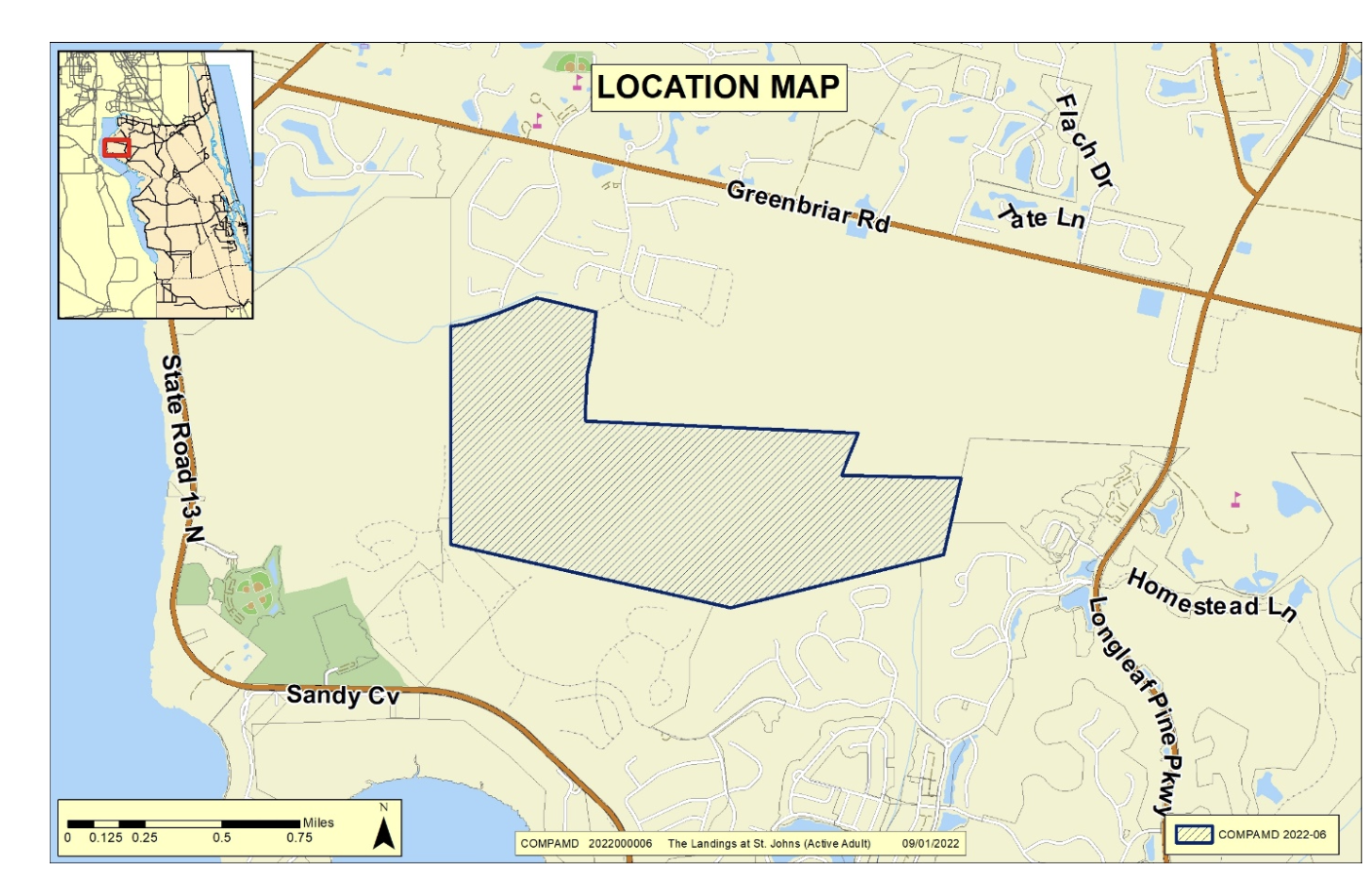
The first item on the agenda is one of great interest to residents of District 1. This is the Transmittal hearing with the PZA for The Landings at St. Johns. This development would be located south of Greenbriar Road and west of Longleaf Pine Parkway and is slated to be Res-B zoning (2 dwelling units per acre.)

 Background Information:

“COMPAMD 2022-06 The Landings at St. Johns (Transmittal), request for a Large-Scale Comprehensive Plan Amendment to change the Future Land Use Map designation of approximately 581 acres of land, located south of Greenbriar Road and west of Longleaf Pine Parkway, from Rural/Silviculture (R/S) to Residential-B (Res-B) with a site specific text amendment stating that in locations where the subject property is contiguous to The Landings at Greenbriar site, no Development Edges will be required.”

The full 512 page presentation can be found at this link:

PZA Agenda Item 1

Notes on the February 9 Community meeting, with the lists of attendees and proximate locations of the attendees begins on page 467.

Item 6 on the Agenda is the Adoption Hearing for the updates to the Workforce Housing Ordinance proposed by the Northeast Florida Builder’s Association (NEFBA) late last year.

Link to the Presentation on the Workforce Housing ordinance can be found here:

Workforce Housing Ordinance

Transparency – in my role as Chair of the St. Johns County Chamber of Commerce Public Policy Committee, I have presented the Chamber’s concerns with 2 points in the proposed ordinance change. Overall, the Chamber had agreed with 80% of the proposed changes.

What remains to be seen is how the newly signed “Live Local” bill designed to address the state-wide Affordable Housing issues will impact the St. Johns County Workforce Housing ordinance.

I’ll post updates on these meetings later in the week.

Posted in BOCC, Comprehensive Plan, St. Johns County

Update on the March 21 St. Johns County Board of County Commissioner’s Meeting

There were only 2 items on the Regular Agenda for March 21, but the meeting still ran about 4 hours. There was much discussion on Agenda Item 2, the Comprehensive Plan and a few lengthy topics during Public Comment.

Public Safety Update – included a report on a recent DUI Enforcement action that did result in a large number of DUI arrests. The hope is this will deter drunk driving in the county.

The Sheriff’s department has opened a Reentry Department with the goal of preventing folks from re-entering the system. They work with inmates to help them find jobs and housing when they leave the jail. One obstacle to gaining employment is having ID or a Driver’s License. They have set up a way, at the jail, to provide them a path to IDs and/or Driver’s Licenses.

The Clerk of Court’s report included assurances that they had been monitoring the 2 recent bank failures and inspecting the County’s banking relationships. They are closely watching to make sure the county’s tax dollars are protected.

The first item up for discussion on the Regular Agenda was the modification for the RiverTown DRI, continued from the March 7 meeting. One of the main items of concern was the continuation of the Veterans Parkway construction.

During the presentation it was confirmed the school mitigation was changed because of the modification to include 770 Age Restricted homes (55+) and that reduces the number of children in the school zones.

It was again confirmed that the Eagle’s Nest tree had been destroyed by fire and abandoned therefore they wish to modify the Eagle Protection Zone. It has been 5 years since there was an eagle in the nest.

The modifications were approved.

The second item on the agenda was discussion of the updates for the Comprehensive Plan.

Every 7 years the County or jurisdiction must decide if they are going to change the Comprehensive Plan. This presentation was to ask for direction from the Commissioners on how they want to proceed with the update.

During public comment concerns were raised about including affordable housing, preserving agricultural lands, and cultural preservation. There was a recommendation from the St. Johns County Civic Round Table (full transparency, I serve on the Board) to hire an independent consultant to facilitate the workshops.

Commissioner Dean made a recommendation to have the independent facilitator to lead the discussions, to have a 60-day comment period, and to have 5 Town Halls, one in each District.

Commissioner Whitehurst made note that with 300,000 residents, the Commissioners have to listen to all the input, and that input at times is in opposition to each other. All input will have to be weighed as they go through this process. He also noted that some of the suggestions could be considered moving against personal property rights. It will be a tough path forward through the updating of the Plan.

The motion was passed to proceed with Commissioner Dean’s recommendation with the initial step to be finding the independent facilitator.

During Public Comment, a representative from the Rock Springs Farms HOA in St. Augustine presented a concern to the Commissioners about an agreement that had been made between the developer and the County regarding maintenance of a Public Park.

When management of the HOA was turned over from the Developer to the HOA Owners in January of 2023, the HOA Board learned of this agreement that had been signed between the County and the Developer. This agreement requires the HOA to maintain the Public Park in perpetuity. This is unusual in that no other HOA is required to pay for a Public Park. The Park is owned by the County but is expected to be maintained by the residents of the HOA.

Further, the community learned that they are required to hold insurance on this park, even though they are not the owners. They cannot purchase insurance for a property they do not own.

Commissioner Alaimo is working with the community to address the concerns.

Once again there was representation from Marsh Landing residents wanting help with their drainage issues. It was again explained to the residents that the County does not have jurisdiction over the Storm Water Management System; that is in the purview of the St. Johns River Water Management District (SJRWMD.) The residents were urged to address their concerns with the SJRWMD Board.

During Commissioner Reports a motion was made and approved to match funds of $50,000 for a grant to reinstate a Mental Health Court in St. Johns County.

Posted in Affordable Housing, Comprehensive Plan, Florida Legislature, St. Johns County

Update on Florida Preemption Bills

Brief update on the Florida Preemption Bills I am tracking.

HB 1417/SB 1586 – Residential Tenancies

This bill preempts the regulation of residential tenancies and the landlord-tenant relationship to the state. What does that mean? Local communities cannot regulate any part of the “landlord-tenant relationship.” This includes setting caps on application fees and security deposits.

HB 1417 – Passed Civil Justice Subcommittee, Next Local Admin/Fed Affairs Judiciary

SB 1586 – On Judiciary Committee Agenda 3/29, Next Community Affairs, Rules

HB 1515/SB 170 – Local Ordinances

This bill empowers business owners to sue cities and counties for passing ordinances that case the financial losses. Businesses can sue over “arbitrary or unreasonable” ordinances for up to $50,000. While the lawsuit is proceeding, the local government must suspend enforcement of the ordinance in question. The bill also requires local government to produce and post on the local website a “business impact estimate” during the drafting phase of the ordinance.

SB 170 Passed the Senate – sent to the House

HB1515 – Ready for House Floor Vote

HB 627/SB 102 – Live Local

This bill is intended to incentivize developers and local governments to build or refurbish affordable housing units. This would waive zoning requirements that prevent affordable housing units from being built. It takes away requirements for a zoning change or comprehensive plan amendment for multi-family or mixed-use residential projects in commercial areas if the project sets aside 40% for affordable housing. Also included are incentives and tax exemptions for developers who provide affordable housing.

HB 627 – Laid on Table – Referred to SB 102

SB 102 – Passed the House and ready for the Governor’s signature

HB 359/SB 540 – Local Government Comprehensive Plans

Anyone challenging a local government for changing its comprehensive plan and then loses that challenge must pay the legal bills for the winner. This bill discourages small resident groups from challenging comprehensive plan changes

SB 540 – Passed Community Affairs, On Judiciary Committee 3/29

HB 359 – Ready for House Floor Vote

HB 1293/SB 1212 – Affordable Housing

Providing that a provision authorizing the board of county commissioners to approve certain development projects does not apply in a specified area of critical state concern; providing that a provision authorizing a municipality to approve certain development projects does not apply in a specified area of critical state concern; providing that certain provisions governing awards made pursuant to local housing assistance plans do not apply to counties and municipalities within areas of critical state concern meeting certain criteria, etc.

SB 1212 – Introduced 3/7

HB 1293 – Passed Local Administration, Federal Affairs & Special Districts Subcommittee, Next Agriculture, Conservation & Resiliency Committee

HB 235/SB 350 – Alternative Mobility Funding Systems

Revises requirements related to agreements to pay for or construct certain improvements; authorizes local governments to adopt alternative mobility planning & fee system; prohibits alternative system from imposing responsibility for funding existing transportation deficiency upon new development; revises requirements for calculation of impact fees; removes ability of local government, school district, or special district to increase impact fees in certain instances; provides requirements for mobility fees-based funding systems, mobility fees & fee increases; specifies criteria to be used in adopting mobility plan & mobility fee for transportation mitigation improvements; prohibits courts from using deferential standard for specified purpose; provides for specified mobility fee credits.

HB 235 Passed Local Administration, Federal Affairs & Special Districts Subcommittee, Next Ways & Means

SB 350 – Introduced

HB 833 – SB 714 – Vacation Rentals

Requiring advertising platforms to collect and remit specified taxes for certain vacation rental transactions; defining the term “advertising platform”; revising the regulated activities of public lodging establishments and public food service establishments preempted to the state to include licensing; requiring advertising platforms to require that persons placing advertisements for vacation rentals include certain information in the advertisements and attest to certain information; authorizing the division to revoke, refuse to issue or renew, or suspend vacation rental licenses under certain circumstances, etc.

SB 714 – Now in Appropriations Committee on Agriculture, Environment, and General Government, Fiscal Policy

HB 833 – On Agenda for Regulatory Reform, Next Ways & Means Committee

HB 439/SB 1604 – Land Use and Development Regulations

Revising the types of data that comprehensive plans and plan amendments must be based on; requiring local governments to determine if plan amendments are necessary to reflect a certain minimum planning period; requiring, rather than encouraging, a local government to comprehensively evaluate and update its comprehensive plan to reflect changes in local conditions; revising requirements for local land development regulations, etc.

HB 439 – now in Commerce Committee, Referred to State Affairs Committee

SB 1604 – Introduced

HB 41/SB 856 – Land Development Initiative and Referendum Processes

Revises restrictions on initiative and referendum processes. Another state preemption bill that prohibits local initiatives or referendums on land development regulations.

SB 856 – On Community Affairs Agenda, Next Judiciary; Rules

HB 41 – Ready for House Floor Vote

All bills can be found at the following links:

Florida House – Enter Bill number in search tool at the top of the page.

Florida Senate – Enter Bill number in search tool at the top of the page.

Posted in Affordable Housing, BOCC, Comprehensive Plan, Florida Legislature, Politics, St. Johns County

Preemption Bills in the Florida Legislature

Bills that could impact local government’s decision making powers

Here are a few of the Preemption Bills I am watching. Reminder that Preemption Bills are State level bills that limit how local governments can make decisions based on local needs and preferences.

HB 1417/SB 1586 – Residential Tenancies

This bill preempts the regulation of residential tenancies and the landlord-tenant relationship to the state. What does that mean? Local communities cannot regulate any part of the “landlord-tenant relationship.” This includes setting caps on application fees and security deposits.

HB 1417 – Added to Civil Justice Subcommittee Agenda

SB 1586 – Introduced

HB 1515/SB 170 – Local Ordinances

This bill empowers business owners to sue cities and counties for passing ordinances that case the financial losses. Businesses can sue over “arbitrary or unreasonable” ordinances for up to $50,000. While the lawsuit is proceeding, the local government must suspend enforcement of the ordinance in question. The bill also requires local government to produce and post on the local website a “business impact estimate” during the drafting phase of the ordinance.

SB 170 Passed the Senate – sent to the House

HB1515 – added to Civil Justice Subcommittee agenda

HB 627/SB 102 – Live Local

This bill is intended to incentivize developers and local governments to build or refurbish affordable housing units. This would waive zoning requirements that prevent affordable housing units from being built. It takes away requirements for a zoning change or comprehensive plan amendment for multi-family or mixed-use residential projects in commercial areas if the project sets aside 40% for affordable housing. Also included are incentives and tax exemptions for developers who provide affordable housing.

HB 627 – Added to Ways and Means Committee

SB 102 – Passed and moved to the House

HB 359/SB 540 – Local Government Comprehensive Plans

Anyone challenging a local government for changing its comprehensive plan and then loses that challenge must pay the legal bills for the winner. This bill discourages small resident groups from challenging comprehensive plan changes

SB 540 – on Community Affairs Agenda 3/22/23 – 11:00 AM

HB 359 – Now in State Affairs Committee

HB 1293/SB 1212 – Affordable Housing

Providing that a provision authorizing the board of county commissioners to approve certain development projects does not apply in a specified area of critical state concern; providing that a provision authorizing a municipality to approve certain development projects does not apply in a specified area of critical state concern; providing that certain provisions governing awards made pursuant to local housing assistance plans do not apply to counties and municipalities within areas of critical state concern meeting certain criteria, etc.

SB 1212 – Introduced 3/7

HB 1293 – Added to Local Administration, Federal Affairs & Special Districts Subcommittee agenda

HB 235/SB 350 – Alternative Mobility Funding Systems

Revises requirements related to agreements to pay for or construct certain improvements; authorizes local governments to adopt alternative mobility planning & fee system; prohibits alternative system from imposing responsibility for funding existing transportation deficiency upon new development; revises requirements for calculation of impact fees; removes ability of local government, school district, or special district to increase impact fees in certain instances; provides requirements for mobility fees-based funding systems, mobility fees & fee increases; specifies criteria to be used in adopting mobility plan & mobility fee for transportation mitigation improvements; prohibits courts from using deferential standard for specified purpose; provides for specified mobility fee credits.

HB 235 – Added to Local Administration, Federal Affairs & Special Districts Subcommittee agenda

SB 350 – Introduced

HB 833 – SB 714 – Vacation Rentals

Requiring advertising platforms to collect and remit specified taxes for certain vacation rental transactions; defining the term “advertising platform”; revising the regulated activities of public lodging establishments and public food service establishments preempted to the state to include licensing; requiring advertising platforms to require that persons placing advertisements for vacation rentals include certain information in the advertisements and attest to certain information; authorizing the division to revoke, refuse to issue or renew, or suspend vacation rental licenses under certain circumstances, etc.

SB 714 – Now in Appropriations Committee on Agriculture, Environment, and General Government

HB 833 – First Reading 3/7/23

HB 439/SB 1604 – Land Use and Development Regulations

Revising the types of data that comprehensive plans and plan amendments must be based on; requiring local governments to determine if plan amendments are necessary to reflect a certain minimum planning period; requiring, rather than encouraging, a local government to comprehensively evaluate and update its comprehensive plan to reflect changes in local conditions; revising requirements for local land development regulations, etc.

HB 439 – now in Commerce Committee, Referred to State Affairs Committee

SB 1604 – Introduced

HB 41/SB 856 – Land Development Initiative and Referendum Processes

Revises restrictions on initiative and referendum processes. Another state preemption bill that prohibits local initiatives or referendums on land development regulations.

SB 856 – Introduced 3/7/23

HB 41 – Now in State Affairs Committee

All bills can be found at the following links:

Florida House of Representatives – Enter Bill number in search tool at the top of the page.

Florida Senate – Enter Bill number in search tool at the top of the page.