Posted in BOCC, Florida Legislature, Growth & Development, St. Johns County

Florida Legislative Bills I Am Watching

House Bill 439 – Land Use and Development Regulations

Here’s a bill to watch in this Legislative Session if you are concerned about the future of development in St. Johns County.

House Bill 439, filed by Representative Stan McClain from District 27 (Ocala)

HB 439: Land Use and Development Regulations

GENERAL BILL by McClain

Land Use and Development Regulations; Revises effect of special magistrate’s recommendation; revises local governmental entity notification requirements; revises types of data that comprehensive plans & plan amendments must be based on; requires local government to submit affidavit for specified purposes; requires that EDR be sole publisher of specified estimates; revises elements that must be included in comprehensive plan; revises frequency at which local government must evaluate its comprehensive plan; prohibits local government from adopting plan amendments when it fails to meet certain requirements; revises exceptions to applicability of land development regulations relating to single-family or two-family dwelling building design elements; requires AG to audit county transportation trust fund.

Drilling into the bill, there are some important changes that would further impact how the local Board of County Commissioners would be able to approve or deny new development in the County.

According to the 1000 Friends of Florida this legislation:

  • Eliminates all state planning indicators for “urban sprawl,” instead defining urban sprawl as unplanned development that requires an extension of public facilities by a local government.
  • Expands the definition of an “agricultural enclave” from 1,000 residents to 1,000 residential units, in effect allowing major subdivisions in agricultural areas.
  • Prohibits the denial of a development order for failure to meet level-of-service standards, meaning that insufficient infrastructure (roads, schools, etc.) could not be the reason a local government denies a rezoning or subdivision plat approval.
  • Takes away local government discretion to reject a decision under Florida’s Land Use and Environmental Dispute Resolution Act, commonly referred to as “FLUEDRA.” 

Who should pay attention?

Residents who are opposed to rapid growth and development in St. Johns County often complain that the Commissioners aren’t denying applications. They can only deny based on legal grounds. They cannot deny based on the “clamor of the crowd.”

As posted in every St. John County Neighborhood Bill of Rights Notice:

NOTICE OF PUBLIC HEARING PROCEDURES: During the public hearing, all public comment is welcome, but please be aware that zoning decisions may not be merely based upon citizen “wishes” that are unsubstantiated by any competent facts, i.e. – the “clamor of the crowd” is not a sufficient reason upon which to base a decision, Board of County Commissioners of Brevard County v. Snyder, 627 So.2d 469 (Fla. 1993). However, the Florida courts have clearly held that “fact-based” lay testimony is admissible and may be relied upon as follows: “citizen testimony in a zoning matter is perfectly permissible and constitutes substantial competent evidence, so long as it is fact-based. Mere generalized statements of opposition are to be disregarded, but fact-based testimony is not.” Metropolitan Dade County v. Blumenthal, 675 So.2d 598 (Fla. 3d DCA 1995).”

House Bill 439 further erodes the legal justification for denying a new development by local governments. This is just one example of why it’s important to pay attention to what is happening in Tallahassee.

Current Status:

This bill has been referred to the following committees:

  • Local Administration, Federal Affairs & Special Districts Subcommittee
  • Commerce Committee
  • State Affairs Committee

It is now in the Local Administration, Federal Affairs & Special Districts Subcommittee

Local Administration Subcommittee

Posted in Florida Legislature, Politics, St. Johns County

Home Rule, Again?

The 2023 Version of Local Preemption Bills

Here We Go Again

In 2022, Senate Bill 620 was the big bear looming over local governments as it took away the ability of local municipalities to pass ordinances in the best interests of ALL local residents. This bill cast a blanket view that all counties and local governments in the State of Florida have the same needs.

Governor DeSantis vetoed this bill in June of 2022 because of its “broad and ambiguous” nature; something raised by many opponents as it made its way through the Legislature last year.

Governor DeSantis SB 620 Veto Letter

The Governor did suggest that if the bill were fine-tuned and included targeted preemption, when local governments undermined State policy or the rights of Floridians, he would be in favor

And that brings us to the 2023 Legislative session and Senate Bill 170,

Local Ordinances; Authorizing courts to assess and award
reasonable attorney fees and costs and damages in certain civil actions filed
against local governments; requiring a board of county commissioners to prepare or cause to be prepared a business impact estimate before the enactment of a proposed ordinance; requiring a county to suspend enforcement of an ordinance that is the subject of a certain legal action if certain conditions are met; requiring a governing body of a municipality to prepare or cause to be prepared a business impact estimate before the enactment of a proposed ordinance, etc.

 Residents of Florida should be paying attention to this bill and what it will cost local governments. The bill mandates a business impact statement to be filed before any ordinance can be adopted by a county or city.

Here in St. Johns County, that means the City of St. Augustine, City of St. Augustine Beach, and the County would need staff to review and prepare that business impact statement before every ordinance they consider. Our local governments are already stretched to meet current needs. This bill would add labor costs that then flow back to taxpayers as the budget would need to be increased to accommodate the additional workload. Even the Legislative Analysis says the financial impact is “indeterminate.”

What’s good for the goose is good for the gander

A full cost analysis and business impact analysis should be performed on this bill before it is passed!

Cause and Effect

If SB 170 is passed, one individual or business plaintiff could object to a local ordinance and then sue the local municipality, thus stopping the ordinance completely. If the plaintiff prevails, the attorney fees,
costs and damages would be borne by the local government; that means us taxpayers would foot the bill.

How might that play out? Let’s consider a local ordinance now being reviewed by St. Johns County. This local ordinance would raise the minimum cost of Affordable Workforce Housing from $240,000 to $260,000. What if a local business owner decided that was negatively impacting his business and ability to hire workers? He could sue the county and stop the ordinance in its tracks while it makes its way through the courts.

St. Johns County is not like Hillsborough County or Broward County or even Duval County. Local governments need to be able to pass local ordinances that are suited to local resident’s needs.

The next stop for this bill is the Senate Rules Committee. I expect it will sail through there just as SB 620 did in 2022. And this year, with the revisions based on feedback from Governor DeSantis in 2022, it is more likely to be signed.

If you are concerned about this local preemption bill, you can:

Read more about it here:

Florida Bill 170

Contact our St. Johns County Legislators Here:

Contact the Rules Committee at the email addresses in this link:

Rules Committee


Posted in BOCC, St. Johns County

February 7 St. Johns County Board of County Commissioners Meeting

What’s up next?

The February 7 Board of County Commissioners (BCC) Meeting looks to have a light agenda and that means possibly a much shorter meeting!

With only 4 items on the Regular Agenda, the morning should go quickly. It will be interesting to see how the new process for General Public Comment at a time certain goes. For Tuesday’s meeting it is at 11:30 Time Certain or at the meeting end, whichever occurs first.

Thus far, the “time certain” approach appears to be disruptive and has resulted in more than a few disgruntled residents as they didn’t make it to the podium before the 30 minutes ended and that meant they still had to wait until the end of the meeting. Will we start seeing a race to the line at 11:30?

 Consent Agenda

There are 37 items on the consent agenda Tuesday. The Consent Agenda is approved as one item and public comment is allowed on the Consent Agenda. Most items on the Consent Agenda are routine in nature. They include approval of final plats, easements, or bill of sales.

Tuesday’s Consent Agenda does include authorization for a notice about a March 7 Hearing for the Vacation of a Right of Way on Bishop Estates Road and a purchase of 3 new ambulances for the St Johns County Fire Rescue Department.

Another item of interest on the Consent Agenda is the Establishment of Civil Penalties for the violation of the Land Development Code governing Short Term Vacation Rentals.

And certainly, of interest to all St. Johns County residents are the Consent Agenda items intended to address Coastal Storm Risk Management.

Regular Agenda Items

First on the agenda is a request from the Sheriff’s Office to add a Fleet Maintenance Building on the site of the current SJSO Training Facility near SR 16 and I-95.

Second on the Agenda is the 2nd reading of an amendment to the Land Development Code, updating the Office and Professional Services Use code to include Veterinary Offices and Animal Hospitals.

Following this item, the Board of County Commissioners will adjourn the meeting and reconvene as the St Johns County Community Redevelopment Agency. This is a technical requirement so they can shift focus to the next item on the agenda. This item is a request from the Flagler Estates CRA Steering Committee to use funds from the Flagler Estates Trust Fund to purchase 2 parcels of land to increase the size of the Flagler Estates Park.

After hearing and voting on this item, the Board will adjourn the meeting of the St Johns County Community Redevelopment Agency and reconvene as the Board of County Commissioners.

The last item on the agenda is the consideration of the appointment of a BCC member to the Value Adjustment Board. Just what is the Value Adjustment Board?

From the Florida Department of Revenue:

“The purpose of the value adjustment board (VAB) is to hear appeals regarding property value assessments, denied exemptions or classifications, ad valorem tax deferrals, portability decisions, and change of ownership or control. Taxpayers or their representatives file petitions with the VAB clerk in the county where the property is located. See the taxpayer guide on Petitions to the Value Adjustment Board for more information.”

The Board of County Commissioners Meeting takes place in the County Auditorium at 500 San Sebastian View, St. Augustine, FL. It can also be watched live, on-line at this link GTV Live

Or on Comcast Cable in Southern St. Johns – Channel 3, Northern St. Johns – Channel 29 or 26, in Jacksonville on Channel 26

Posted in Affordable Housing, Essential Worker Housing, PZA, St. Johns County

St. Johns County Planning and Zoning Agency February 2 Meeting Summary

The February 2 St. Johns County Planning and Zoning Agency (PZA) was largely unremarkable.

During initial public comments, only one resident shared comments to essentially remind the PZA members that the Board of County Commissioners had voted down industrial development in an area zoned residential at their most recent meeting. This was interesting as there was no such request on the PZA agenda for the February 2 meeting.

Discussion on the Smith Borrow Pit was minimal, considering the previous presentation of this item in November. One comment of note was that while there would be noise and disruption for a period of time while the borrow pit was in use, the longer term implications of the borrow pit are a pond and no further infill development of residential or industrial. Perhaps something to consider when future requests for a borrow pit come forward.

The modifications to the River Town DRI and PUD turned out to not be as concerning as some residents had thought. The Abandoned Eagle’s nest referenced in the application turned out to be a nest that had been in a tree that had burned during a wildfire, so the protected designation was no longer needed. There was positive impact on schools as 770 residents to be built will be Deed Restricted for active adults thus lessening the impact on the local school crowding situation. There was little debate on approving this item.

The last two items of the day covered the request from the Northeast Florida Builders Association (NEFBA) to modify the County’s Workforce Housing Ordinance. This was originally presented to the Board of County Commissioners on October 18. The original request was to modify density requirements and to adjust the maximum initial sales price of Workforce Housing up to $270,000 while also reducing the % of Workforce Housing units to be constructed down to 20%. Commissioner Dean proposed a compromise at that meeting to raise the maximum initial sales price to $260,000 and lower the % of units to be constructed to 30%.

NEFBA presented their request for the ordinance change and two comments in favor of the change were presented. As the Chair of the St. Johns County Chamber of Commerce Public Policy Committee, I presented a statement on behalf of the Chamber supporting the changes in density and expressing concern with decreasing the percentage of homes dedicated to Essential Worker Housing in St. Johns County.

The Ordinance change was approved to go forward to the Board of County Commissioners.

Video of the meeting can be found at this link: Feb 2 PZA Meeting

Posted in Affordable Housing, PZA, St. Johns County

St. Johns County Planning and Zoning Agency

Agenda for February 2, What You Should Know!

The February 2 St. Johns County Planning and Zoning Agency (PZA) is scheduled for 1:30 PM in the County Auditorium at 500 San Sebastian View in St. Augustine. If you aren’t able to attend in person, you can watch it live here:

Watch PZA Live

The meeting has an interesting mix of projects for review. Some are more routine, such as the approval for a Manufactured/Mobile home to be used as a residence in an area zoned for RS-3 Residential or a change in set-backs for a yard.

Others are more impactful, and the public may want to be aware of the impacts. This update will focus on the more impactful items.

The first item on the Agenda Thursday is a continuation of an item from November 15. This is the Smith Borrow Pit application, requesting a Special Use Permit to allow a Borrow Pit area within Open Rural Zoning and to allow for a residential dwelling unit on the same property. At the previous hearing there were several concerns raised about the project. The continuance was granted to allow time for neighbors to provide input and for the applicant to present additional evidence in response to the many questions raised by PZA members.

An item of concern to residents is Agenda Items 9 and 10. These items are modifications to the River Town DRI and PUD. The requests include revising the school mitigation requirements, addressing the abandonment of the Eagle nest, the proposed Greenway Map and the Wildlife/Plant Resources Map, adding a date certain for the provision of a library site and a fire station site, clarifying the residential development rights include age restricted units, and reducing the proposed roundabout locations on SR 13.

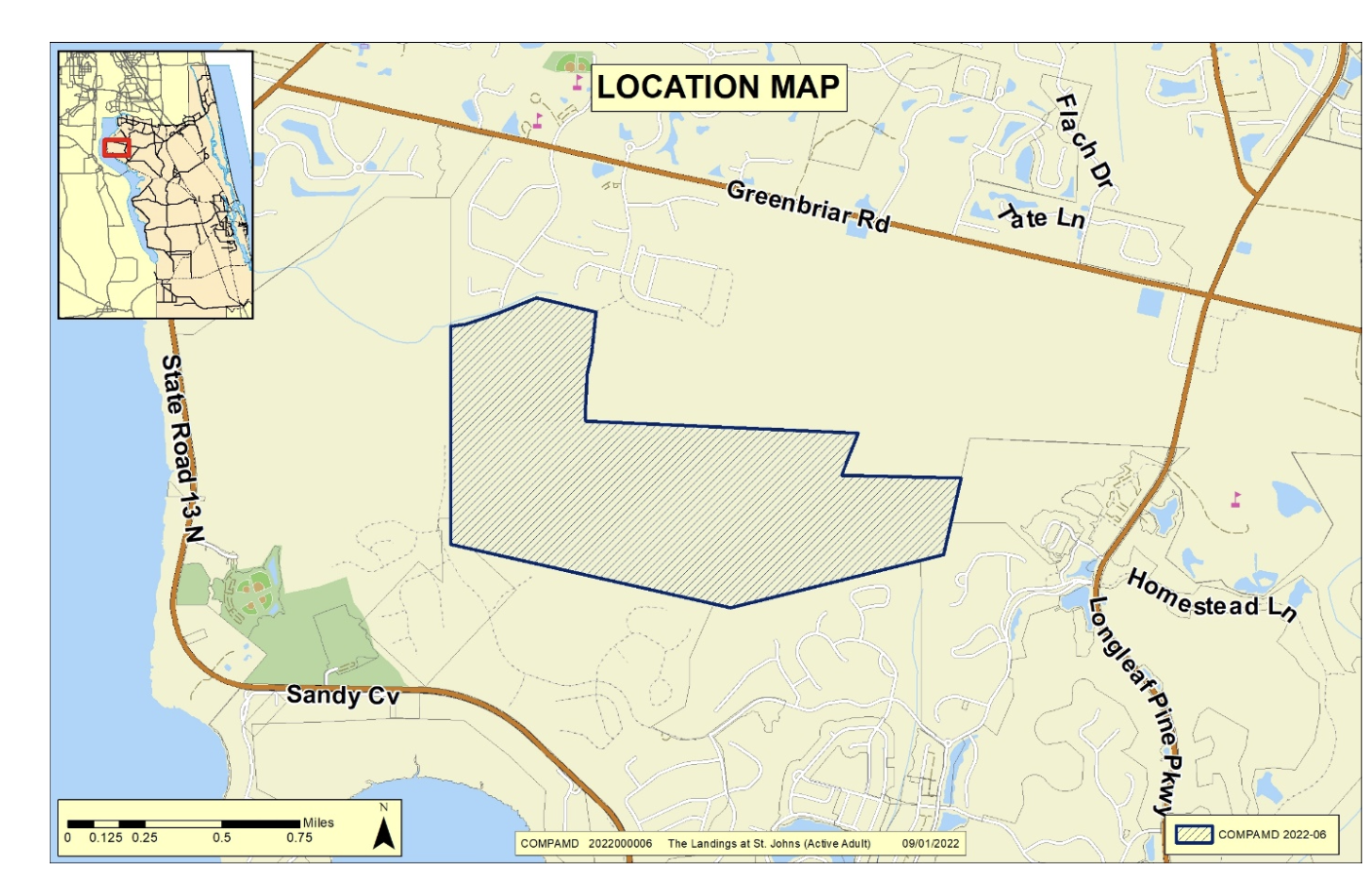
For those not familiar with RiverTown, it is located along SR 13 North, south of Greenbriar Road, with Longleaf Pine Parkway being located to the east.

The last two items of the day are related to a request from the Northeast Florida Builders Association to modify the County’s Workforce Housing Ordinance. This was originally presented to the Board of County Commissioners on October 18. The original request was to modify density requirements and to adjust the maximum initial sales price of Workforce Housing up to $270,000 (from $240,000) while also reducing the percentage of Workforce Housing units to be constructed from 40% down to 20%. Commissioner Dean proposed a compromise at that meeting to raise the maximum initial sales price to $260,000 and lower the percentage of units to be constructed to 30%.

Concerns have been raised in the community by Affordable Housing advocates and the business community that this change in the ordinance does not address the need for more affordable housing in the county. Of particular concern to business owners is the need for Essential Workforce Housing in the county.

If you can’t attend or watch the PZA meeting, check back here for an update next week.