
Posted in Affordable Housing, BOCC, Essential Worker Housing, St. Johns County

St. Johns County April 18 Board of County Commissioner’s Meeting

What’s on the Agenda for the April 18 St. Johns County Board of County Commissioner’s Meeting?

A key theme for Tuesday’s meeting is addressing Affordable Housing in St. Johns County. That term can have a negative connotation to some of our residents. Considering the median price of a home in St. Johns County last month was $555,000, and the median income in St. Johns County is $110,000; it really means providing housing for people who can’t afford the median priced home but provide many of our daily services that contribute to our quality of life in St. Johns County.


After the usual opening activities, the Commissioners will approve the Consent Agenda.

The Consent Agenda for Tuesday includes an important item for Affordable Housing in St. Johns County. One of the impediments for building affordable housing in the County is the high Impact Fees charged to builders. A request had been made to utilize State Housing Initiative (SHIP) grant funds to assist in lowering the cost of the Impact fees non-profit developers who are building homes for the low and very-low income population. This would affect ONLY homes under $260,000.

Read more about the proposed amendment here: Consent Agenda Item 20

Moving on to the Regular Agenda, Public Comment will be heard at Time Certain of 11:30.


Regular Agenda:

Puerta Del Sol

On the Regular Agenda Tuesday is a Public Hearing for Puerta Del Sol in District 3 on State Road 206 near US 1. This could be a lengthy presentation and discussion based on the presentation at the Planning and Zoning Agency March 2. The PZA decision was a “technical denial” as it was tied, 3-3.

Anticipate this topic will take up the morning session, up to Public Comment and a lunch recess.

There are two requests for Puerta Del Sol. The first is for a Comprehensive Plan Amendment to change the Land Use change from Residential B to Residential C and the second is the creation of a Planned Unit Development (PUD). The PUD would include a single-family home, 137 townhome units, and 25,000 square feet of commercial use.

At the PZA presentation, there was much public comment from nearby residents who do not want more development in their area. Some were ok with more development if it wasn’t townhomes because they don’t want lower income homes nearby. Other residents were in favor because of the need for diverse housing options such as townhomes. Another recommendation in favor was the concern if housing does not get built in this space, commercial will one day fill the space and housing is preferable to adding commercial to 206.

Read more about the PUD here: Puerta Del Sol PUD

Live Local Act

Continuing the theme of Affordable Housing, Item 5 on the Agenda is a workshop discussion to be led by one of the County Attorneys, Christine Valliere and Assistant Administrator Joy Andrews.

Senate Bill 102, The Live Local Act, was recently passed by the Florida Legislature and quickly signed into law by Governor DeSantis. This legislation is intended to incentivize developers and builders to provide more affordable housing across the State of Florida and in many instances preempts local jurisdictions local ordinances.

Some important elements include:

  • Preempts local authorization of multi-family and mixed-use residential rental developments in any area zoned commercial, industrial, or mixed use with an affordable housing component.
  • 40% of the units must be affordable for at least 30 years; 65% of the total square footage must be residential in mixed-use projects.
  • Density and height restrictions are based on maximum limits of jurisdiction and nearby developments.
  • Local government cannot require a development authorized under this preemption to obtain a land use/zoning change, special use approval or variance for use, density, or height. No public hearing process allowed.

Read more about Tuesday’s presentation here: Live Local Act – Workshop


The full agenda for Tuesday can be found here: BOCC Agenda

I’ll provide a summary of the meeting later in the week.


If you are finding value in these updates, please subscribe to my blog so you get notifications when I publish an update. Feel free to share with others who may find value in the content.
Posted in Affordable Housing, BOCC, Comprehensive Plan, Essential Worker Housing, PZA, St. Johns County

What’s Ahead in St. Johns County This Week

Summary of Key Agenda Items for the Board of County Commissioners and Planning and Zoning Agency meetings this week

Board of County Commissioners Meeting

The Board of County Commissioners Meeting is Tuesday, April 4, 9:00 in the County Auditorium at 500 San Sebastian Way.

Of particular interest during the BOCC meeting this week is Item 4 on the Agenda.

This will be the First Reading of Ordinance Relating to Pedestrian and Vehicle Safety within Public Road and Rights-of-Way

This is timely as in the past week I’ve seen complaints on social media about people standing in the medians asking for donations for various organizations or for themselves.

At a previous meeting, Commissioner Whitehurst had asked Staff to review neighboring Clay County’s ordinance that had been recently passed to see if there was something we could do in St. Johns County to reduce these potential safety issues.

Background information on this item is as follows:

“A recent study identified the State of Florida as the second-highest-ranked state in the country in pedestrian deaths, in both the total and as an average per person. Traffic crash data shows that St. Johns County has experienced a number of vehicle/pedestrian crashes, including crashes causing death. The risk of such incidents is increased by the unexpected presence of pedestrians near a motor vehicle or within the travel lanes, including within medians or when engaged in person-to-vehicle or vehicle-to-person interactions. The inherent danger of such situations is heightened for certain higher traffic volume and/or speed roadways, such as interstate/intrastate highways and arterials and collector roads, and their approaches. The State of Florida and the National Highway Traffic Safety Administration have both identified enhanced legislation, regulation, and enforcement as elements of a successful strategy for enhancing pedestrian safety. The attached proposed ordinance would prohibit dangerous use of certain designated public rights-of-way in a way that interferes with the safe and efficient movement of people and property. Prohibited uses include, specifically, physical interactions while a vehicle is in the travel lanes and stopping or remaining in a median longer than needed to safely cross, subject to certain exceptions. The ordinance would be enforced by the Sheriff after conducting a public education campaign for the first 30 days and issuing warnings, after which first violations would result in a civil citation and fine, and second and subsequent violations prosecuted in the same manner as misdemeanors.”

Detailed information on the proposed ordinance and data supporting the need for such an ordinance can be found at this link:

Agenda Item 4

Planning and Zoning Agency

The Planning and Zoning Agency (PZA) Meeting is scheduled for Thursday, April 6, at 1:30 in the County Auditorium.

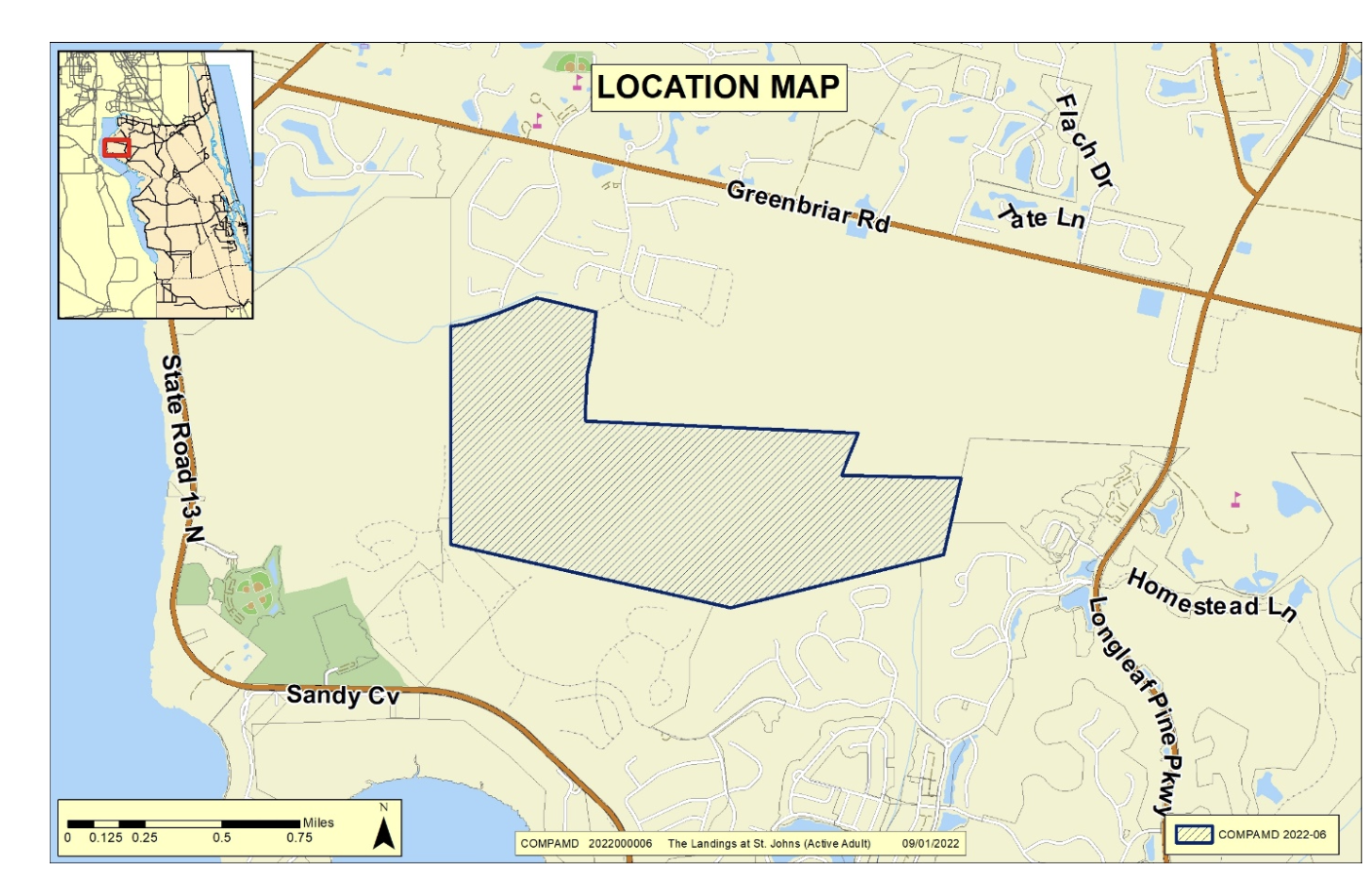
The first item on the agenda is one of great interest to residents of District 1. This is the Transmittal hearing with the PZA for The Landings at St. Johns. This development would be located south of Greenbriar Road and west of Longleaf Pine Parkway and is slated to be Res-B zoning (2 dwelling units per acre.)

 Background Information:

“COMPAMD 2022-06 The Landings at St. Johns (Transmittal), request for a Large-Scale Comprehensive Plan Amendment to change the Future Land Use Map designation of approximately 581 acres of land, located south of Greenbriar Road and west of Longleaf Pine Parkway, from Rural/Silviculture (R/S) to Residential-B (Res-B) with a site specific text amendment stating that in locations where the subject property is contiguous to The Landings at Greenbriar site, no Development Edges will be required.”

The full 512 page presentation can be found at this link:

PZA Agenda Item 1

Notes on the February 9 Community meeting, with the lists of attendees and proximate locations of the attendees begins on page 467.

Item 6 on the Agenda is the Adoption Hearing for the updates to the Workforce Housing Ordinance proposed by the Northeast Florida Builder’s Association (NEFBA) late last year.

Link to the Presentation on the Workforce Housing ordinance can be found here:

Workforce Housing Ordinance

Transparency – in my role as Chair of the St. Johns County Chamber of Commerce Public Policy Committee, I have presented the Chamber’s concerns with 2 points in the proposed ordinance change. Overall, the Chamber had agreed with 80% of the proposed changes.

What remains to be seen is how the newly signed “Live Local” bill designed to address the state-wide Affordable Housing issues will impact the St. Johns County Workforce Housing ordinance.

I’ll post updates on these meetings later in the week.

Posted in Affordable Housing, Comprehensive Plan, Florida Legislature, St. Johns County

Update on Florida Preemption Bills

Brief update on the Florida Preemption Bills I am tracking.

HB 1417/SB 1586 – Residential Tenancies

This bill preempts the regulation of residential tenancies and the landlord-tenant relationship to the state. What does that mean? Local communities cannot regulate any part of the “landlord-tenant relationship.” This includes setting caps on application fees and security deposits.

HB 1417 – Passed Civil Justice Subcommittee, Next Local Admin/Fed Affairs Judiciary

SB 1586 – On Judiciary Committee Agenda 3/29, Next Community Affairs, Rules

HB 1515/SB 170 – Local Ordinances

This bill empowers business owners to sue cities and counties for passing ordinances that case the financial losses. Businesses can sue over “arbitrary or unreasonable” ordinances for up to $50,000. While the lawsuit is proceeding, the local government must suspend enforcement of the ordinance in question. The bill also requires local government to produce and post on the local website a “business impact estimate” during the drafting phase of the ordinance.

SB 170 Passed the Senate – sent to the House

HB1515 – Ready for House Floor Vote

HB 627/SB 102 – Live Local

This bill is intended to incentivize developers and local governments to build or refurbish affordable housing units. This would waive zoning requirements that prevent affordable housing units from being built. It takes away requirements for a zoning change or comprehensive plan amendment for multi-family or mixed-use residential projects in commercial areas if the project sets aside 40% for affordable housing. Also included are incentives and tax exemptions for developers who provide affordable housing.

HB 627 – Laid on Table – Referred to SB 102

SB 102 – Passed the House and ready for the Governor’s signature

HB 359/SB 540 – Local Government Comprehensive Plans

Anyone challenging a local government for changing its comprehensive plan and then loses that challenge must pay the legal bills for the winner. This bill discourages small resident groups from challenging comprehensive plan changes

SB 540 – Passed Community Affairs, On Judiciary Committee 3/29

HB 359 – Ready for House Floor Vote

HB 1293/SB 1212 – Affordable Housing

Providing that a provision authorizing the board of county commissioners to approve certain development projects does not apply in a specified area of critical state concern; providing that a provision authorizing a municipality to approve certain development projects does not apply in a specified area of critical state concern; providing that certain provisions governing awards made pursuant to local housing assistance plans do not apply to counties and municipalities within areas of critical state concern meeting certain criteria, etc.

SB 1212 – Introduced 3/7

HB 1293 – Passed Local Administration, Federal Affairs & Special Districts Subcommittee, Next Agriculture, Conservation & Resiliency Committee

HB 235/SB 350 – Alternative Mobility Funding Systems

Revises requirements related to agreements to pay for or construct certain improvements; authorizes local governments to adopt alternative mobility planning & fee system; prohibits alternative system from imposing responsibility for funding existing transportation deficiency upon new development; revises requirements for calculation of impact fees; removes ability of local government, school district, or special district to increase impact fees in certain instances; provides requirements for mobility fees-based funding systems, mobility fees & fee increases; specifies criteria to be used in adopting mobility plan & mobility fee for transportation mitigation improvements; prohibits courts from using deferential standard for specified purpose; provides for specified mobility fee credits.

HB 235 Passed Local Administration, Federal Affairs & Special Districts Subcommittee, Next Ways & Means

SB 350 – Introduced

HB 833 – SB 714 – Vacation Rentals

Requiring advertising platforms to collect and remit specified taxes for certain vacation rental transactions; defining the term “advertising platform”; revising the regulated activities of public lodging establishments and public food service establishments preempted to the state to include licensing; requiring advertising platforms to require that persons placing advertisements for vacation rentals include certain information in the advertisements and attest to certain information; authorizing the division to revoke, refuse to issue or renew, or suspend vacation rental licenses under certain circumstances, etc.

SB 714 – Now in Appropriations Committee on Agriculture, Environment, and General Government, Fiscal Policy

HB 833 – On Agenda for Regulatory Reform, Next Ways & Means Committee

HB 439/SB 1604 – Land Use and Development Regulations

Revising the types of data that comprehensive plans and plan amendments must be based on; requiring local governments to determine if plan amendments are necessary to reflect a certain minimum planning period; requiring, rather than encouraging, a local government to comprehensively evaluate and update its comprehensive plan to reflect changes in local conditions; revising requirements for local land development regulations, etc.

HB 439 – now in Commerce Committee, Referred to State Affairs Committee

SB 1604 – Introduced

HB 41/SB 856 – Land Development Initiative and Referendum Processes

Revises restrictions on initiative and referendum processes. Another state preemption bill that prohibits local initiatives or referendums on land development regulations.

SB 856 – On Community Affairs Agenda, Next Judiciary; Rules

HB 41 – Ready for House Floor Vote

All bills can be found at the following links:

Florida House – Enter Bill number in search tool at the top of the page.

Florida Senate – Enter Bill number in search tool at the top of the page.

Posted in Affordable Housing, BOCC, Comprehensive Plan, Florida Legislature, Politics, St. Johns County

Preemption Bills in the Florida Legislature

Bills that could impact local government’s decision making powers

Here are a few of the Preemption Bills I am watching. Reminder that Preemption Bills are State level bills that limit how local governments can make decisions based on local needs and preferences.

HB 1417/SB 1586 – Residential Tenancies

This bill preempts the regulation of residential tenancies and the landlord-tenant relationship to the state. What does that mean? Local communities cannot regulate any part of the “landlord-tenant relationship.” This includes setting caps on application fees and security deposits.

HB 1417 – Added to Civil Justice Subcommittee Agenda

SB 1586 – Introduced

HB 1515/SB 170 – Local Ordinances

This bill empowers business owners to sue cities and counties for passing ordinances that case the financial losses. Businesses can sue over “arbitrary or unreasonable” ordinances for up to $50,000. While the lawsuit is proceeding, the local government must suspend enforcement of the ordinance in question. The bill also requires local government to produce and post on the local website a “business impact estimate” during the drafting phase of the ordinance.

SB 170 Passed the Senate – sent to the House

HB1515 – added to Civil Justice Subcommittee agenda

HB 627/SB 102 – Live Local

This bill is intended to incentivize developers and local governments to build or refurbish affordable housing units. This would waive zoning requirements that prevent affordable housing units from being built. It takes away requirements for a zoning change or comprehensive plan amendment for multi-family or mixed-use residential projects in commercial areas if the project sets aside 40% for affordable housing. Also included are incentives and tax exemptions for developers who provide affordable housing.

HB 627 – Added to Ways and Means Committee

SB 102 – Passed and moved to the House

HB 359/SB 540 – Local Government Comprehensive Plans

Anyone challenging a local government for changing its comprehensive plan and then loses that challenge must pay the legal bills for the winner. This bill discourages small resident groups from challenging comprehensive plan changes

SB 540 – on Community Affairs Agenda 3/22/23 – 11:00 AM

HB 359 – Now in State Affairs Committee

HB 1293/SB 1212 – Affordable Housing

Providing that a provision authorizing the board of county commissioners to approve certain development projects does not apply in a specified area of critical state concern; providing that a provision authorizing a municipality to approve certain development projects does not apply in a specified area of critical state concern; providing that certain provisions governing awards made pursuant to local housing assistance plans do not apply to counties and municipalities within areas of critical state concern meeting certain criteria, etc.

SB 1212 – Introduced 3/7

HB 1293 – Added to Local Administration, Federal Affairs & Special Districts Subcommittee agenda

HB 235/SB 350 – Alternative Mobility Funding Systems

Revises requirements related to agreements to pay for or construct certain improvements; authorizes local governments to adopt alternative mobility planning & fee system; prohibits alternative system from imposing responsibility for funding existing transportation deficiency upon new development; revises requirements for calculation of impact fees; removes ability of local government, school district, or special district to increase impact fees in certain instances; provides requirements for mobility fees-based funding systems, mobility fees & fee increases; specifies criteria to be used in adopting mobility plan & mobility fee for transportation mitigation improvements; prohibits courts from using deferential standard for specified purpose; provides for specified mobility fee credits.

HB 235 – Added to Local Administration, Federal Affairs & Special Districts Subcommittee agenda

SB 350 – Introduced

HB 833 – SB 714 – Vacation Rentals

Requiring advertising platforms to collect and remit specified taxes for certain vacation rental transactions; defining the term “advertising platform”; revising the regulated activities of public lodging establishments and public food service establishments preempted to the state to include licensing; requiring advertising platforms to require that persons placing advertisements for vacation rentals include certain information in the advertisements and attest to certain information; authorizing the division to revoke, refuse to issue or renew, or suspend vacation rental licenses under certain circumstances, etc.

SB 714 – Now in Appropriations Committee on Agriculture, Environment, and General Government

HB 833 – First Reading 3/7/23

HB 439/SB 1604 – Land Use and Development Regulations

Revising the types of data that comprehensive plans and plan amendments must be based on; requiring local governments to determine if plan amendments are necessary to reflect a certain minimum planning period; requiring, rather than encouraging, a local government to comprehensively evaluate and update its comprehensive plan to reflect changes in local conditions; revising requirements for local land development regulations, etc.

HB 439 – now in Commerce Committee, Referred to State Affairs Committee

SB 1604 – Introduced

HB 41/SB 856 – Land Development Initiative and Referendum Processes

Revises restrictions on initiative and referendum processes. Another state preemption bill that prohibits local initiatives or referendums on land development regulations.

SB 856 – Introduced 3/7/23

HB 41 – Now in State Affairs Committee

All bills can be found at the following links:

Florida House of Representatives – Enter Bill number in search tool at the top of the page.

Florida Senate – Enter Bill number in search tool at the top of the page.

Posted in Affordable Housing, Essential Worker Housing, PZA, St. Johns County

St. Johns County Planning and Zoning Agency February 2 Meeting Summary

The February 2 St. Johns County Planning and Zoning Agency (PZA) was largely unremarkable.

During initial public comments, only one resident shared comments to essentially remind the PZA members that the Board of County Commissioners had voted down industrial development in an area zoned residential at their most recent meeting. This was interesting as there was no such request on the PZA agenda for the February 2 meeting.

Discussion on the Smith Borrow Pit was minimal, considering the previous presentation of this item in November. One comment of note was that while there would be noise and disruption for a period of time while the borrow pit was in use, the longer term implications of the borrow pit are a pond and no further infill development of residential or industrial. Perhaps something to consider when future requests for a borrow pit come forward.

The modifications to the River Town DRI and PUD turned out to not be as concerning as some residents had thought. The Abandoned Eagle’s nest referenced in the application turned out to be a nest that had been in a tree that had burned during a wildfire, so the protected designation was no longer needed. There was positive impact on schools as 770 residents to be built will be Deed Restricted for active adults thus lessening the impact on the local school crowding situation. There was little debate on approving this item.

The last two items of the day covered the request from the Northeast Florida Builders Association (NEFBA) to modify the County’s Workforce Housing Ordinance. This was originally presented to the Board of County Commissioners on October 18. The original request was to modify density requirements and to adjust the maximum initial sales price of Workforce Housing up to $270,000 while also reducing the % of Workforce Housing units to be constructed down to 20%. Commissioner Dean proposed a compromise at that meeting to raise the maximum initial sales price to $260,000 and lower the % of units to be constructed to 30%.

NEFBA presented their request for the ordinance change and two comments in favor of the change were presented. As the Chair of the St. Johns County Chamber of Commerce Public Policy Committee, I presented a statement on behalf of the Chamber supporting the changes in density and expressing concern with decreasing the percentage of homes dedicated to Essential Worker Housing in St. Johns County.

The Ordinance change was approved to go forward to the Board of County Commissioners.

Video of the meeting can be found at this link: Feb 2 PZA Meeting