
Keeping the focus on the important Ag Enclave activities in St. Johns County, let’s catch up with what has happened in September.
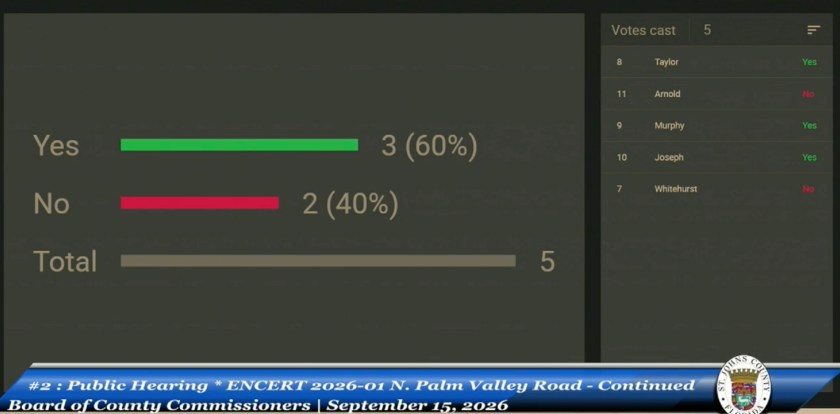
On September 15, the BOCC formally denied certification of the 4,462-acre N. Palm Valley Agricultural enclave by a 3-2 vote, with Whitehurst and Arnold casting the no votes. Just a few moments later they approved the 310-acre AFI Enclave, also by a 3-2 vote, with Taylor and Joseph casting the no votes.
What was important in that meeting was that with the denial of the N. Palm Valley Enclave, the county has the test case for the courts to decide if a local government can deny an application that county staff has determined meets the criteria for the Agricultural Enclave certification.
What was evident in discussion during the meeting was the chosen strategy – litigate in St. Johns County rather than Leon County. County Attorney Rich Komando relayed outside counsel’s recommendation that the best path was to deny the application, creating the opportunity for the applicant to challenge that denial.
This creates an interesting scenario. The Commissioners deliberately chose to deny the application in order to create the court challenge. Commissioner Murphy had stated previously there was “no legal reason to deny” the application. Now, he has reversed course and the implication from the dais was that the denial was done specifically to enable the county to challenge SB 686 in the courts.
There were a few public comments that challenging the law in court would allow insurance to cover the cost of the litigation. It will be interesting to see if the county’s insurance does cover litigation in a case that was intentionally created by the Commissioners to challenge this law. It is on record, in multiple meetings, that is the intent of the denial.
There were a few points in the meeting that you may want to hear for yourself how the discussion went. The first was in Public Comment when Commissioner Whitehurst encouraged anyone there to speak on the N. Palm Valley Enclave agenda item to speak up during General Public Comment. He was seeking clarification that the public comment portion for that agenda item was closed and the Commission was just continuing deliberations on Tuesday.
Hear the discussion here: Commentary on Public Comments for the Hearing
What was the stated reason for denial?
The stated criterion for denial presents an interesting question for the courts. And it could indeed set a precedent for Agricultural Enclaves across the state. The statute requires portions of an agricultural enclave perimeter to be surrounded by land designated and developed for industrial, commercial or residential purposes. The question being raised is, what qualifies as “existing industrial, commercial or residential development.”
The applicant’s argument is that surrounding properties in Nocatee and Roscoe Boulevard have been platted and therefore meet the statutory definition of development. The applicant’s attorney pointed out seawalls, drainage improvements, constructed homes and other physical evidence of development. County staff had independently reviewed the perimeter and concluded the application met the statutory threshold.
An attorney hired by anonymous residents, Brad Russell, argued that the law distinguishes the act of developing land from the resulting condition of “existing” residential, commercial or industrial development. His interpretation is that dividing property into parcels does not automatically turn every vacant lot, common tract or conservation area into existing residential development.
This could be pivotal for enclave certification across the state.
How did Mr. Russell become involved in the dispute?
Commissioner Joseph had reached out to Mr. Russell when the Ag Enclaves first came to her attention in July. He was known to Commissioner Joseph and the other Commissioners as he had represented Commissioner Joseph in her federal lawsuit against the county in 2024.
At the September 15 hearing, Mr. Russell stated he had been retained by a group of St. Johns County residents who wished to remain anonymous. In her comments, Commissioner Joseph praised his arguments against the certification and asked him back to the podium, highlighted his credentials and then asked if he had previously been successful litigating against a county.
This does not invalidate Mr. Russell’s arguments. It does raise a question about the disclosure of outside information and the impact on Commissioner votes.
Hear Mr. Russell’s comments here: Attorney Russell’s comments
During public comment, attorney Ellen Avery-Smith objected to the county holding what she characterized as a third public hearing on the application. She argued that SB 686 contemplates one staff report followed by one public hearing, that the hearing had been closed on September 1, and that the county should not continue accepting new evidence after that hearing concluded.
Hear Ms.Avery Smith’s recital here: Ellen Avery Smith objection to 3 Public Hearings
Here is a link to the hearing on September 15. I think it’s important to hear what was actually said as the Commissioners debated their votes: N. Palm Valley Public Hearing #3
Chair Murphy’s changing Votes
Commissioner Murphy had said repeatedly from the dais that he opposed the new law but saw no legal reason to deny N. Palm Valley. In the September 15 meeting he again talked about his opposition to the law and its impact on Home Rule in the county. He talked about carrying petitions to Tallahassee to seek repeal of the law. And then voted to deny. It was not clear from the dais what his reasons for denial were.
Since that meeting, Chair Murphy has appeared in news media carrying the banner for fighting back against SB 686.
What’s important to remember is that when this gets to court, the judge will not be deciding whether commissioners or residents dislike the law and want it repealed. The judge will examine the law, the evidence and the findings supporting the denial.
Staff and their Review
Growth Management staff have become the scapegoat in public debate. The criticism is confusing an unpopular statute with the staff members required to administer it.
Staff did not write or enact the statute. They are tasked with reviewing the applications against the Legislature’s criteria. There has been evidence that staff has challenged and disputed some of the criteria. This resulted in some applications being withdrawn and it appears the applicants were addressing the weaknesses before resubmitting.
There is clear evidence of staff’s independent review. There is no evidence that the staff blindly accepted developers’ claims as is speculated in social media.
Commissioners may reject a staff recommendation when the record supports a different finding. They should specify the contrary evidence behind their differing conclusion. There were questions asked and points debated, but no clear explanation from the dais connecting the differing evidence to the statutory criteria.
It’s unfair to treat the professional staff, our neighbors and fellow residents, as suspect because their analysis produces an answer we don’t like. That weakens our local governance that we are trying to protect from Tallahassee.
Insurance does not make litigation free
Several speakers and Commissioner Joseph suggested the county’s insurance would bear the cost of litigation, rather than taxpayers directly. We pay for that insurance. It is part of the county budget funded by taxpayers. Depending on the policy, the county may also be responsible for deductibles, staff time, outside experts, consultants, uncovered claims or costs exceeding policy limits. Just like our auto and homeowners insurance policies, claims history can affect future premiums and coverage terms. There may even be limits to when and how they will cover litigation.
Before treating litigation as costless, we need to understand the applicable deductibles, whether the carrier accepts the defense, and what categories of expense remain the county’s responsibility.
The final order will matter
It was clear that the applicant’s attorney was prepared for this denial. She offered a clear rebuttal for Mr. Russell’s interpretation, defense of the evidence in the record and preserved an objection to the procedure after Commissioner Joseph made her motion before all Commissioners had finished identifying whether new information affected the decision. Why is that important? The applicant may argue that the timing of the motion indicates Commissioner Joseph had decided how she intended to vote before all the evidence and commissioners’ discussion were complete. This is evidence of an experienced land-use attorney anticipating litigation that the commissioners had openly discussed.
The County has now assumed the burden of defending a denial that its professional staff did not recommend. The final written order will have to identify the findings of fact and legal conclusions supporting the denial. That means the county must clearly explain which evidence the Board accepted, which statutory requirement it concluded was not met, and how it reached a conclusion different from its professional staff.
Another surprise twist
During Commissioner reports on the 15th, another surprising twist happened. Commissioner Whitehurst recommended that two previously approved Enclaves, Heritage East and Heritage West, be brought back before the Board for consideration. As one of the Commissioners who had voted to approve these previously, he had the right to call for this reconsideration. The vote to bring those back was 4-1, with Commissioner Murphy voting no.
Hear Commissioner Whitehurst’s request and the following discussion here: Commissioner Whitehurst request for Reconsideration
There is a Special Meeting scheduled for September 28 to rehear those applications.
More Legal Happenings
It was no surprise that the PARC Group, represented by Attorney Ellen Avery-Smith, has indicated they are filing an appeal of the N. Palm Valley denial. That would most likely be filed in the St. Johns County Circuit Court. The challenge must be filed within 30 days after the county issues its final written decision.
In the case of the Heritage East and West applications being brought back to the Board on Monday, 9/28, the owner, Chris Shee, filed an emergency petition on September 23, to block the special hearing on Monday, September 28.
The argument from the developer is that there was no duly noticed meeting and agenda and also SB686 does not give the county the leeway to reconsider an application they already approved.
As of September 27, we have not seen the court’s response to that petition.
If you are finding value in these updates, please subscribe to my blog so you get notifications when I publish an update. Feel free to share with others who may find value in the content.


