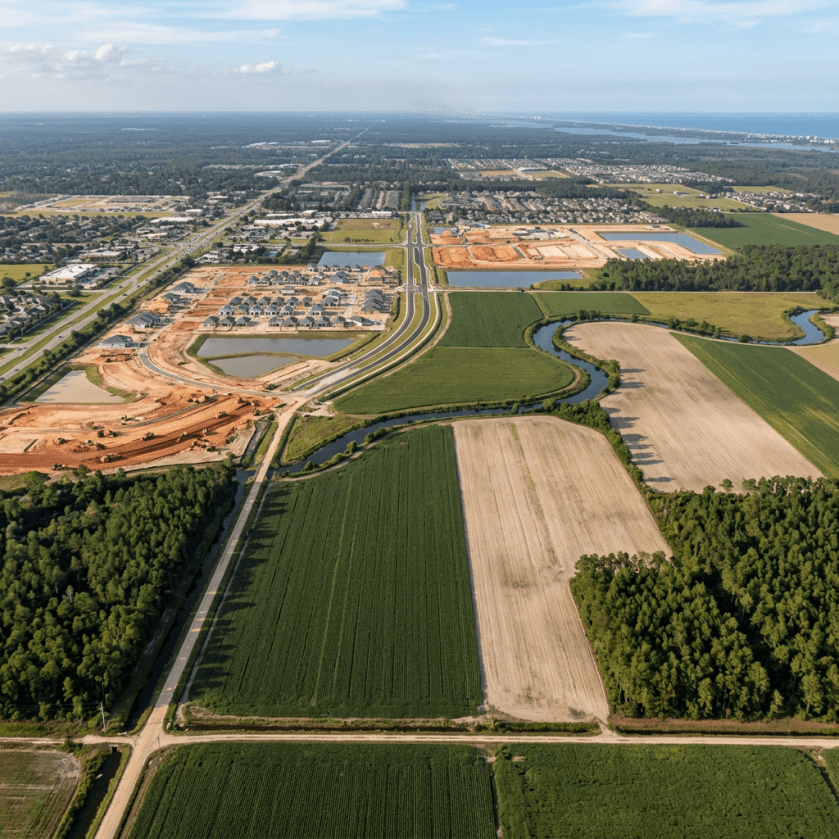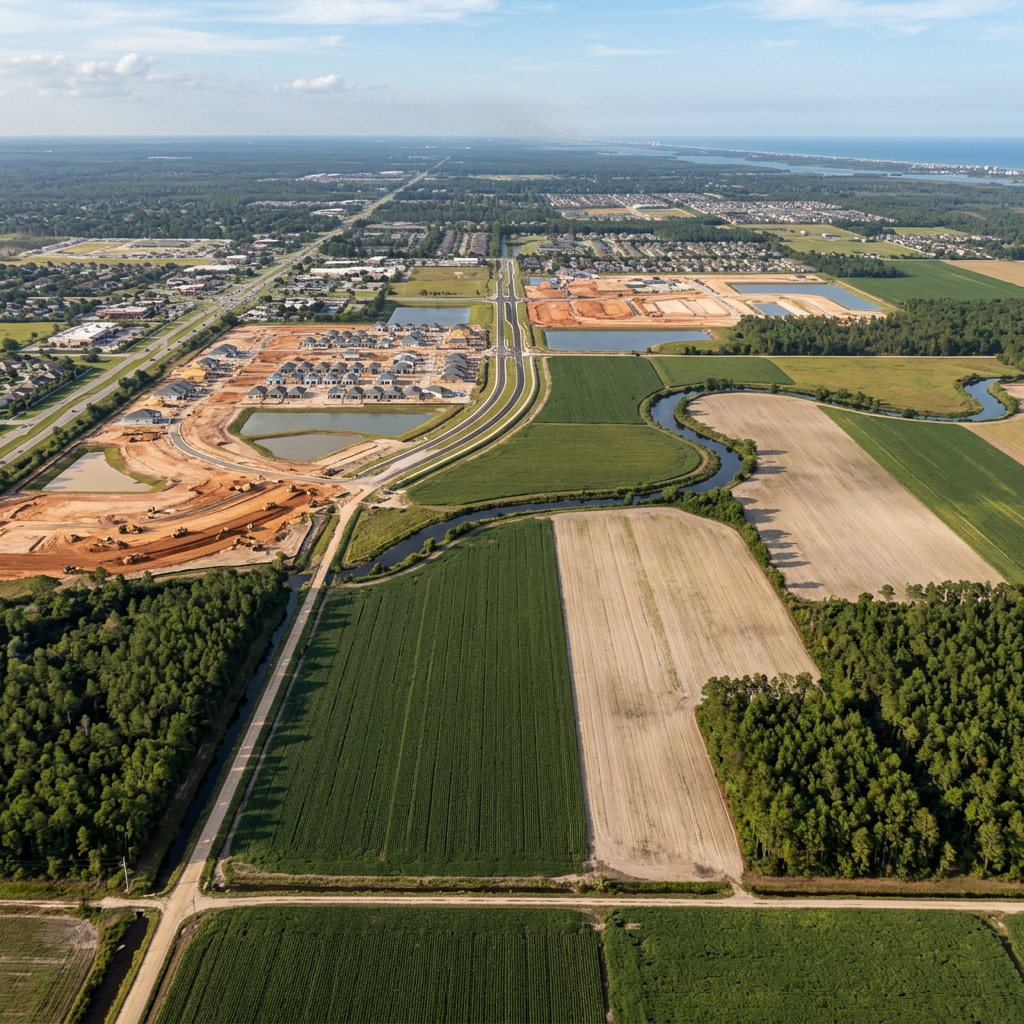
What really happened at the Ag Enclave Certification Meeting on Wednesday, August 19.
Spoiler: Thousands of homes were NOT approved
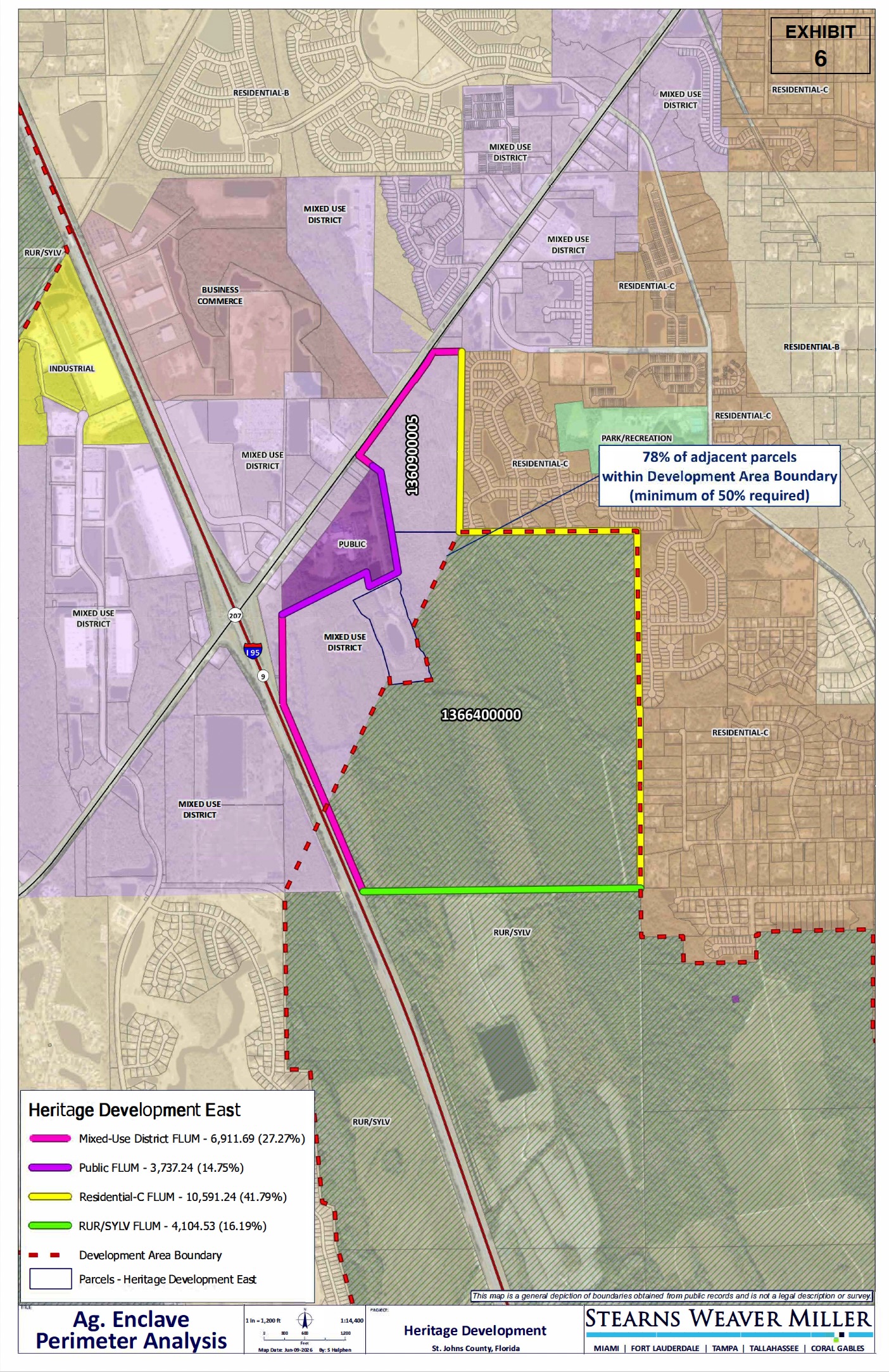
At its August 19 meeting, the St. Johns County Board of County Commissioners considered three applications for agricultural-enclave certification: Heritage Development East, Heritage Development West and N. Palm Valley Road.
The nearly four-hour hearing revealed substantial confusion about what certification does—and does not—approve.
What is most important was the clarification from Deputy County Attorney Kealey West about the Board’s task on Wednesday. It was a very narrow, quasi-judicial lane. Did each application meet the criteria established in SB 686 for an agricultural enclave? It was not a policy vote on whether the Commissioners liked the potential development. The commissioners had to base their decisions on the statutory criteria and the competent, substantial evidence in the record—including the application materials, staff’s review and evidence presented during the hearing.
Watch Ms. West’s explanation here: Commissioner Requirements for Today’s Agenda
At a high level, here was the meeting outcome:
| Application | Acreage | Applicant’s density position | Result |
| Heritage Development East | Approximately 615 acres | Statutory maximum discussed as 13 units per acre; no development plan presented | Certified 3–2 |
| Heritage Development West | Approximately 551 acres | Statutory maximum discussed as 13 units per acre; no development plan presented | Certified 3–2 |
| N. Palm Valley Road | Approximately 4,462 acres | Applicant requested 1 unit per acre | Continued to September 1 |
The two Heritage certifications passed 3-2, with Commissioners Joseph and Taylor voting no.
A motion to deny N. Palm Valley failed 2–3 with Commissioners Whitehurst, Murphy, and Arnold voting against denial.
Before a motion to approve was made, Chairman Murphy requested a continuance to allow staff to reexamine the boundary calculations, particularly the northern boundary. The continuance passed, 4–1 with Arnold being the no vote.
1. Heritage Development East
The applicant argued that the two parcels met every statutory criterion:
- Approximately 615 acres, within unincorporated St. Johns County.
- Owned or controlled by one entity.
- Undeveloped as of January 1, 2025.
- Used for timber production and classified as agricultural for at least ten years.
- Surrounded by qualifying future land-use designations along more than the required percentage of the perimeter.
- Within the County’s development area boundary.
- Under the statutory acreage cap.
- Located in a county with fewer than 1.75 million residents.
- The applicant agreed to enter into a binding agreement to provide or pay for required public services.
The applicant said the certification could permit densities up to 13 units per acre based on surrounding land uses. However, counsel acknowledged that 13 single-family homes per acre was probably not a realistic product and said the actual density and development layout would not be known until a development plan was submitted.
Note the important statement there – until a development plan was submitted. A development plan must still be submitted even though the property was certified as an agricultural enclave.
Staff concluded that the application satisfied the agricultural-enclave definition.
Questions from commissioners
Commissioner Whitehurst focused on the distinction between the statutory maximum and actual development. He asked whether a single-family product could realistically achieve 13 units per acre. The applicant said he was unaware of such a product and that setbacks, wetlands and other land-development regulations would affect the final yield.
Commissioner Joseph questioned whether the property had previously been denied, what activity had occurred on the timber property during the previous five years, and whether people, trucks and logging operations were regularly present. The applicant could identify it as a timber operation but could not provide the date of the last harvest or replanting from the podium.
The statute requires the property to have been in continuous bona fide agricultural use for at least five years before the application. The applicant submitted historical aerial imagery showing continued timber use, and County staff independently verified that the property had received an agricultural classification and assessment from 2015 through 2025. Staff concluded that the application demonstrated compliance with the agricultural-use requirement.
Public comment
I normally do not include public comment in my reports. I’m sharing here the highlights because it is important to understand where there is confusion about the certification hearing and what comes next in the process.
Public comment focused primarily on infrastructure, maximum potential density, wetlands and the argument that the County Comprehensive Plan remained controlling. A second line of argument questioned whether agricultural classification and tax-parcel boundaries were sufficient evidence under the statute.
Applicant rebuttal and legal clarification
County Attorney West directly rejected the central Comprehensive Plan argument. She explained that the new law begins with “notwithstanding any other law” and creates a limited statutory preemption. For certification, the Board had to apply the agricultural-enclave criteria rather than the County Comprehensive Plan.
Watch her explanation here
The applicant also responded that:
- Certification was only the first step.
- Wetlands, environmental permitting, setbacks and other development regulations would still apply.
- A future development plan would still be reviewed by County staff.
- Public-services agreements were specifically allowed by the statute.
- No public speaker had produced competent evidence contradicting the application’s acreage, ownership, perimeter calculations or agricultural classification.
Board discussion and vote
Commissioner Taylor moved to deny, citing unanswered questions about bona fide agricultural use. Commissioner Joseph seconded.
Commissioner Whitehurst asked what competent evidence had been presented showing that the property was not a bona fide timber operation. He noted that timber production does not require daily activity and questioned whether the proposed denial could be legally defended.
Commissioners Taylor and Joseph voted to deny despite staff findings of compliance and did not identify contrary evidence sufficient to persuade the majority.
The denial failed 2–3. A subsequent motion to certify passed 3–2.
2. Heritage Development West
The second Heritage presentation was largely parallel to the first because it involved the same owner and statutory framework.
The applicant represented that:
- The application covered three parcels totaling approximately 551 acres.
- The parcels were undeveloped and under single ownership or control.
- The land had been used for timber production and classified as agricultural.
- More than 75% of the perimeter qualified under the applicable surrounding-development test.
- The applicant offered to enter into agreements for required public services.
- The property met the acreage and county-population limits.
- County staff found that the application met the statutory definition.
As with Heritage East, the presentation discussed a maximum potential density of 13 units per acre calculated from surrounding land uses under the statute, but no development plan or actual unit count was presented.
Public comment
Public comment expanded during the West hearing.
Similar arguments were repeated during the Heritage West hearing, despite County counsel’s earlier explanation that SB 686 creates a limited preemption for the certification decision. Other comments addressed schools, agricultural documentation, parcel boundaries, traffic, wetlands and wildlife.
The agricultural-use evidence was substantially the same as for Heritage East: historical aerial imagery, a reported timber operation dating to 1956, and agricultural classification and assessment from 2015 through 2025. County staff independently reviewed the records and found that the application satisfied the statutory requirement.
Applicant rebuttal and staff response
The applicant emphasized that the property appraiser classifies agricultural and nonagricultural land annually under Section 193.461. Therefore, the classification was not a one-time designation from many years earlier.
Counsel also explained that:
- The statutory definition of “parcel of land” does not prohibit using a property-appraiser parcel.
- Agricultural classification was supported by the property appraiser’s annual review.
- The offer to provide or pay for required services was the alternative expressly authorized by the statute.
County staff confirmed that it had consulted with Property Appraiser Eddie Creamer and his staff, reviewed their agricultural-classification methodology, and was comfortable with the determinations.
Board discussion and vote
Chairman Murphy gave one of the clearest summaries of the Board’s dilemma. He said St. Johns County was suffering from growth fatigue and that he disliked the state preemption, but his personal view of growth was not the legal standard. He said he could not identify a legally supportable reason to deny an application that staff concluded met the law.
Commissioners Taylor and Joseph again voted to deny despite staff findings of compliance and did not identify contrary evidence sufficient to persuade the majority.
Heritage West was certified 3–2.
3. N. Palm Valley Road
This hearing was substantially longer and produced more focused statutory challenges than the Heritage hearings.
The applicant emphasized that the application contained more than 500 pages of supporting material, including:
- A signed and sealed legal description and survey.
- Deeds and ownership records.
- Property-appraiser records.
- A timber-management plan.
- Timber-sales information.
- Sworn affidavits.
- Perimeter and surrounding-development calculations.
- Letters concerning utilities, schools and other public services.
The applicant repeatedly corrected the claim that it was seeking six units per acre:
The request was one single-family residential unit per acre—approximately 4,462 units—not 26,772 units.
County staff had calculated that the statute could support a maximum of six units per acre based on surrounding land uses, but that was not what the applicant requested. Later in the hearing, County staff said the one-unit-per-acre commitment would be incorporated into a future development agreement, and applicant’s counsel stated on the record that there would be no more than 4,462 units.
The applicant argued that the property met the applicable 75%/50% perimeter test:
- Approximately 84% of its perimeter was adjacent to qualifying residential, commercial or industrial designations.
- Approximately 50.88% qualified as existing development.
- The calculations were based on a signed and sealed survey.
- Land across the Intracoastal Waterway, in Nocatee and in Duval County was used in the analysis.
- The statute expressly requires looking across rights-of-way, bodies of water and canals.
- Nothing in the statute prohibits considering land in an adjacent jurisdiction.
The applicant also explained that certification did not eliminate:
- Wetlands and environmental permitting.
- Transportation analysis.
- School concurrency.
- Proportionate-share requirements.
- Utility permitting.
- Construction-plan review.
- County land-development regulations.
Commissioner questions before public comment
Commissioner Joseph questioned:
- The Davis family’s ownership of adjoining land in Duval County.
- Why the owner did not proceed through the ordinary public development process.
- Whether the one-unit-per-acre commitment could later be increased.
- Where traffic would go.
- Whether an independent forester should inspect the property.
- When timber had last been planted or harvested.
The applicant responded that the property had a timber-management plan, timber-sales information, a full-time property manager and agricultural records. Counsel declined to agree that an additional inspection was necessary.
Commissioner Taylor asked how the one-unit-per-acre representation could be guaranteed. Staff responded that the statute establishes potential density from surrounding land, but the applicant’s one-unit commitment would be written into the future development agreement.
Chairman Murphy asked whether the owner could later use this certification to qualify adjoining land to the north. Counsel cited language prohibiting an applicant from using the perimeter of one certified enclave to qualify another.
Public comment: the stronger statutory challenges
Some of the N. Palm Valley comments were much more closely connected to the actual certification criteria than comments made during the Heritage hearings.
- Whether the 50% test should measure the percentage of the surrounding parcels that is developed rather than the percentage of the enclave perimeter touching development.
- Whether the qualifying acreage existed as a legally defined configuration as of January 1, 2025.
- Whether the application relied on a boundary drawn in 2026 rather than the parcels existing in 2025.
- Whether the approximately 50.88% result depended on an impermissible calculation.
- Whether the one-unit-per-acre representation was legally binding.
- Whether staff independently verified continuous commercial agricultural use.
- Use of Duval County land in the calculation.
- The meaning of “the local government” in the statute.
- Whether the 50% test was being applied to perimeter length rather than the area or condition of the surrounding parcels.
- Whether the Board should continue the hearing to obtain a written legal analysis.
- Whether land in another county could be considered at all. This was an interesting statutory question, although the applicant argued that the law requires examination of surrounding lands and contains no same-county restriction.
Those were the portions of public comment most directly relevant to the Board’s certification decision.
Public comment: development-impact arguments
A large portion of the remaining public comment concerned:
- Traffic on Palm Valley Road, Roscoe Boulevard, A1A and Nocatee Parkway.
- School construction and taxpayer debt.
- Water pressure and potable-water supply.
- Wetlands, wildlife, tree removal and climate impacts.
- The lack of a transportation plan.
- Residents’ loss of public input over the eventual development plan.
- General opposition to rapid growth.
- Requests that the Board “fight” the statute in court.
These are legitimate development concerns. However, they generally did not rebut the applicant’s evidence on the statutory certification criteria. The development plan for the property is not part of the certification process.
Several speakers explicitly acknowledged that they did not understand the legal process or were not attempting to make a statutory argument. Their comments were largely appeals to deny or delay development based on its anticipated impacts.
Applicant rebuttal
The applicant responded point by point:
- The application boundary was supported by a signed and sealed legal description and survey.
- The alternative map displayed by a public speaker was not the map in the application.
- The statutory definition permits an owner or developer to designate a describable parcel of land.
- The long parcel along the Intracoastal was included in the timber-management plan and sworn agricultural-use testimony.
- The 50.88% calculation came from surveyed boundary dimensions.
- “Development” under Chapter 380 can include subdivision of land, shoreline alteration and other improvements; a parcel need not contain a completed house to constitute existing development.
- The statute does not prohibit considering adjoining land in Duval County.
- JEA had provided a letter stating that it could serve the property.
- The project would still undergo concurrency and development-plan review.
- The applicant committed on the record to no more than 4,462 units.
The applicant submitted a Property Appraiser letter, property records, aerial imagery, a timber-management plan, timber-sales information and sworn testimony concerning the property’s agricultural use. Staff reviewed the documentation and independently concluded that the property had been in continuous bona fide agricultural use for the required five-year period.
Board discussion and continuance
Commissioner Taylor moved to deny based on insufficient proof of agricultural use and inadequate infrastructure under the Community Planning Act. Commissioner Joseph seconded. The motion failed 2–3 with Commissioners Whitehurst, Murphy and Arnold voting against denial.
Before an approval motion was made, Chairman Murphy asked for a continuance. He said public comment had raised questions about the boundary calculations that he wanted staff to examine more fully.
The Board voted 4-1 to continue the hearing until September 1 and directed staff to recheck the boundary, particularly in the northern portion, using GIS. Commissioner Joseph also requested an independent forestry review and renewed Community Planning Act analysis, but the Board did not reach consensus on those requests.
Commissioner Whitehurst cautioned against imposing a more demanding evidentiary standard on N. Palm Valley than the Board had applied to the two Heritage applications.
What the hearing clarified—and what it did not approve
The most persistent confusion throughout the hearing was the belief that certification approved thousands of homes for immediate development.
It did not.
No development plan was before the Board for any of the three applications. Certification determines whether property meets the definition of an agricultural enclave established by state law. It does not eliminate the later requirements for environmental permitting, concurrency, transportation analysis, utility review, construction plans or compliance with applicable land-development regulations.
Maximum density is not a development plan
The Heritage properties were discussed using a statutory maximum of 13 units per acre. Those maximums were repeatedly converted into claims that approximately 8,000 homes had been approved on Heritage East and 7,000 on Heritage West.
No such development plans were presented or approved.
The applicant acknowledged that it was not aware of a single-family housing product that could realistically achieve 13 units per acre. Wetlands, setbacks, infrastructure requirements and other development regulations will affect the ultimate number and location of homes.
The same confusion surrounded N. Palm Valley. The statute could support a maximum of six units per acre based on surrounding land uses, but the applicant requested one unit per acre from the beginning—approximately 4,462 units, not 26,772. During the hearing, the applicant committed on the record to that limit, and County staff stated that it would be incorporated into the development agreement.
Infrastructure concerns did not automatically defeat certification
Many comments focused on roads, schools, utilities and other infrastructure. Those concerns will matter as development plans are prepared and reviewed, but existing infrastructure deficiencies were not an automatic basis for denying certification.
SB 686 expressly allows an applicant either to demonstrate that required public services exist or to agree to provide, fund, construct or dedicate land for those services.
The argument that the County Comprehensive Plan nevertheless allowed commissioners to deny certification was also addressed directly by County Attorney Kealey West. She explained that SB 686 creates a limited preemption for the certification process. The Board was required to apply the agricultural-enclave criteria established by state law—not the County’s ordinary discretionary standards for a Comprehensive Plan amendment.
Questions are not evidence of noncompliance
Commissioners Taylor and Joseph questioned whether the properties had been in bona fide agricultural use and supported motions to deny. However, County staff had reviewed the applications, consulted with the Property Appraiser’s Office and found that the agricultural-use requirements were satisfied.
Commissioner Whitehurst repeatedly asked what competent, substantial evidence had been introduced to contradict those findings. Questions about when timber was last harvested, whether workers were present every day or whether additional inspections might provide greater comfort did not, by themselves, establish that the statutory requirement had not been met.
The majority ultimately concluded that the Heritage applicants had demonstrated compliance and that the record did not support denial.
Why N. Palm Valley was continued
N. Palm Valley produced a different result because some questions were tied more directly to the statutory certification test.
Those questions concerned the application boundary and the calculations used to determine whether the property met the required surrounding-development percentages. Chairman Murphy requested additional time for staff to recheck the boundary, particularly along the northern portion of the property.
The hearing was continued to September 1. The application was neither approved nor denied.
The real divide at the hearing
The commissioners were not deciding whether additional growth was good for St. Johns County. They were deciding whether each property met a definition created by the Florida Legislature.
That distinction was uncomfortable but controlling.
Commissioners could dislike the law, oppose state preemption and share residents’ concerns about infrastructure. What they could not responsibly do in a quasi-judicial hearing was deny an application solely because they opposed the development that might eventually follow.
Heritage East and Heritage West were certified because the majority concluded that the applications met the statutory requirements. N. Palm Valley was continued because the majority wanted one certification issue—the boundary calculation—examined more closely.
Thousands of homes were not approved on August 19. Two properties were certified as agricultural enclaves, and one certification hearing remains open.
If you are finding value in these updates, please subscribe to my blog so you get notifications when I publish an update. Feel free to share with others who may find value in the content.