
Posted in BOCC, Comprehensive Plan, Florida Legislature

Why Can’t St. Johns County Simply Vote “No” on Ag Enclave Applications?

Understanding how SB 686 changed the County Commission’s role.

If you’ve been following the recent discussion about Ag Enclave applications in St. Johns County, you’ve probably heard one question repeated over and over:

Why can’t the County Commission simply vote “no”?

There has been a lot of discussion in Northeast Florida over the past week about SB 686, the Ag Enclave bill. With our first applications filed, I thought it would be helpful to give some background on this bill and how we got here. Then we can talk about what the county can, or cannot, do.

Residents want to know why the County Commission can’t simply deny these six Ag Enclave applications the same way it could deny a Comprehensive Plan Amendment.

The answer is that these applications are not processed like Comprehensive Plan Amendments or rezonings. SB 686 created an entirely different process under state law, and understanding that process explains why the Commission’s role is very different than many people realize.

This may feel like another rezoning request.

It isn’t.

SB 686 created an entirely different legal process.

This article isn’t about whether SB 686 is good or bad policy. It’s about understanding what the law requires and how we arrived here.


Two Different Questions Are Being Asked

There are really two separate questions being debated.

The first is whether SB 686 was good public policy. Reasonable people can disagree on that.

The second is what authority the County Commission has now that SB 686 is law. That is the question this article addresses.

Before writing this article, I reviewed SB 686, the House and Senate bill analyses, legislative history, Florida Association of Counties updates, and four Ag Enclave certification applications filed in St. Johns County.

Before SB 686, counties had broad discretion in zoning changes. Comprehensive Plan Amendments and rezonings were legislative decisions. County Commissioners could make decisions, within the law, on local impacts of a Comprehensive Plan Amendment or zoning waiver

After SB 686, the Legislature created the Ag Enclave Certification process. Certification is essentially the county determining whether an application meets the criteria established in state law. It is not the same thing as deciding whether the county likes the project. Once certified, local decisions still occur but under a much narrower legal framework established by the legislature.

Certification is not the same as approval. There are specific steps that are very different from the usual Comprehensive Plan Amendment.

The process essentially is:

1. Developer submits certification application.

2. County reviews statutory eligibility. (Staff performs the analysis and presents to Commissioners.)

3. County issues certification if criteria are met.

4. Development application follows.

5. County still reviews engineering, infrastructure, concurrency, stormwater, utilities, etc.

6. But the County’s discretion is very different than under a traditional Comprehensive Plan Amendment.

SB 686 enacted

        ↓

Certification Application

        ↓

County determines statutory eligibility

        ↓

Certification issued (if requirements met)

        ↓

Development Review

        ↓

Construction approvals

Why can’t commissioners simply vote no?

Their discretion in the certification process is governed by state law rather than local judgment.

If the application meets the certification criteria, they must vote “yes” to certify. If the Commission denies certification even though the statutory requirements are met, the applicant may seek review in circuit court through a writ of certiorari. In other words, the court reviews whether the county followed the law, not whether the judges agree with the project.


So how did St. Johns County end up operating under this entirely new process?

The answer doesn’t begin with the six applications filed this month. It begins in Tallahassee, where SB 686 moved through the normal legislative process over several months before becoming law on July 1, 2026.

The Legislative Record

On December 1, 2025, Senator Stan McLain of District 9 (Central Florida District) filed the Ag Enclave bill, SB 686.

“Agricultural Enclaves; Authorizing certain persons to apply to the governing body of the local government for certification of certain parcels as agricultural enclaves; requiring the local government to hold a public hearing within a specified timeframe to approve or deny such certification; authorizing certain persons to submit certain development plans; authorizing the development of certain parcels for commercial, industrial, or single-family residential purposes under certain circumstances, etc.”

It then moved through committee hearings over the next several months before passing both chambers and being signed by the Governor on April 20, 2026, with an effective date of July 1.

The Florida Association of Counties exists in part to keep county governments informed about legislation that affects local government.

In the Florida Association of Counties FAC Legislative Bulletin: Week 2, dated January 23, 2026, they included a summary:
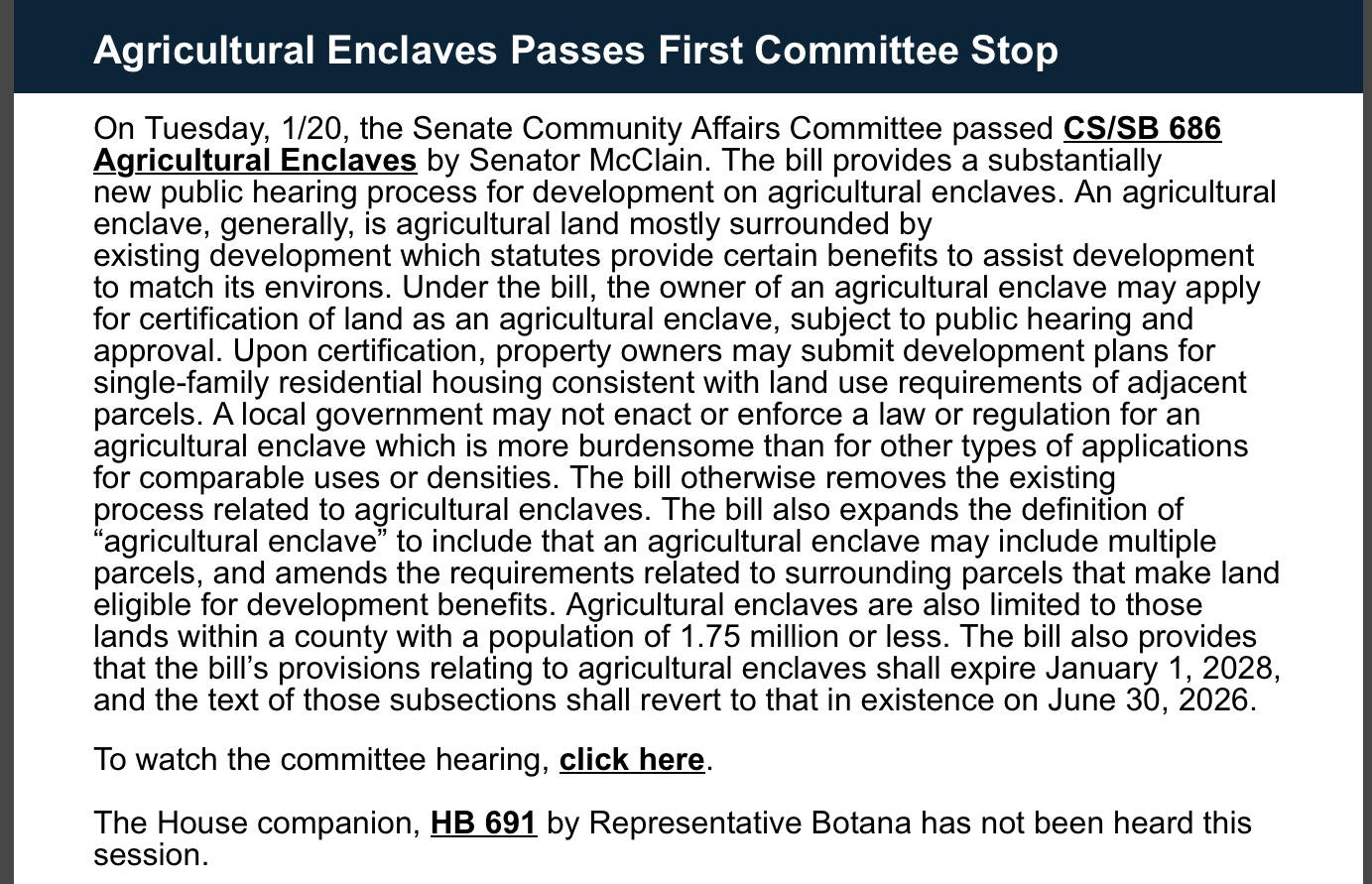
FAC Email Bulletin January 23, 2026

FAC legislative bulletins are distributed to county officials throughout Florida as part of the association’s legislative tracking.

The 1000 Friends of Florida shared an update about the bill in their February 11 webinar and strongly opposed the bill
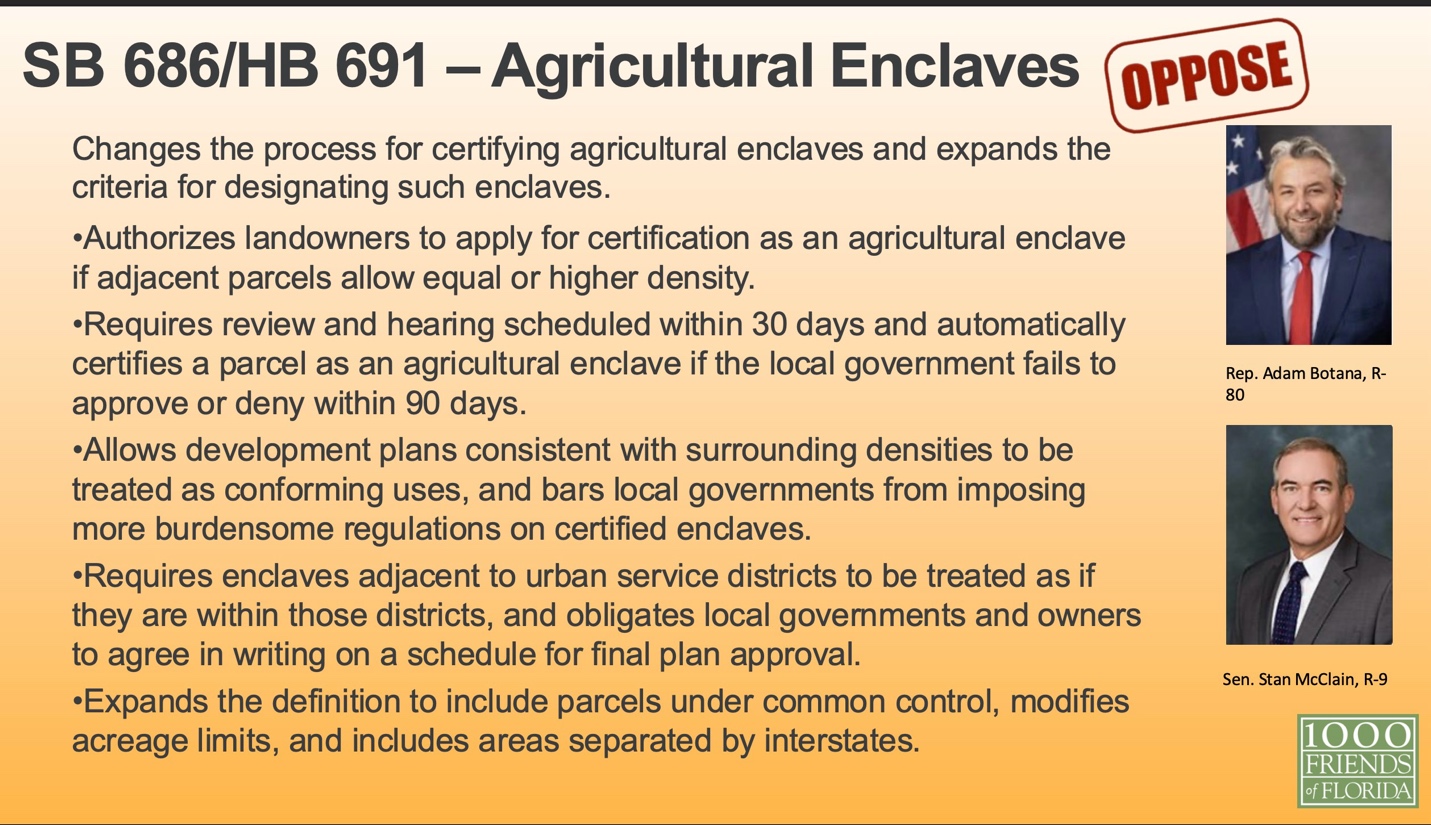
1000 Friends of Florida Webinar, February 11, 2026

Here is a link to the full history of the bill on the Senate website: SB 686 Senate Bill History

The related House Bill was HB 691 and filed on December 8, 2025 by Representative Adam Botana of District 80 (Bonita Springs, Leon and Collier Counties)

Link to the House Bill is here: Companion Bill HB 691

The bill was presented to the Governor on April 9 and signed April 20, becoming effective July 1, 2026.


SB 686 did not appear overnight. Whether someone agrees with SB 686 or opposes it, one thing is clear from the legislative record: this bill followed the normal legislative process over several months. It moved through Florida’s normal legislative process over several months, with committee hearings, legislative analyses, advocacy from supporters and opponents, and regular legislative updates distributed to county governments through the Florida Association of Counties.

The legislation also received support from members of the St. Johns County legislative delegation. Senator Leek voted Yes on February 26, and the bill was sent to the House where all 3 of our County Representatives voted Yes on March 11, 2026.

County commissioners are now responsible for administering a law that many local officials and planning advocates opposed.


Where are we now?

On July 1, the day the law became effective, 4 Ag Enclave certification requests were filed in St.Johns County. They were followed by 2 more on July 7.

Recent public comments have focused on whether county officials had advance warning that SB 686 was moving through the Legislature and whether the volume of applications could have been anticipated.

These are actually two very different issues.

One concerns the legislation itself.

The other concerns how quickly developers responded once the law became effective.

Those questions deserve to be evaluated separately.

Was the legislation itself foreseeable?

Could the volume of applications have been anticipated?

Regardless of where you stand on SB 686, one thing should now be clear.

By the time these six Ag Enclave applications reached the St. Johns County Commission, the fundamental policy decision had already been made in Tallahassee.

The discussion before the Commission is no longer Should Florida have adopted SB 686?

It is How should the County administer the law the Legislature has already enacted?

Those are two very different questions, and understanding that distinction is essential to understanding the months ahead.


Why this matters

The real lesson is broader.

SB 686 illustrates how profoundly state legislation can reshape local government authority.

Whether one supports or opposes the policy, understanding where decisions are made, and when citizens have the greatest opportunity to influence them, is essential.

By the time an Ag Enclave certification reaches the County Commission, many of the key policy decisions have already been made in Tallahassee.

Whether you support SB 686 or oppose it, understanding the legal framework helps all of us have a more informed discussion.


Over the past several days, I’ve reviewed four of the Ag Enclave certification applications filed in St. Johns County using a checklist developed directly from SB 686 and the supporting statutory requirements. In the coming days, I’ll be sharing those reviews separately. The purpose of those articles will be different from this one: not to explain the law itself, but to examine how the submitted applications compare to the requirements established by the Legislature.


If you are finding value in these updates, please subscribe to my blog so you get notifications when I publish an update. Feel free to share with others who may find value in the content.

Posted in BOCC, Politics, St Johns County Schools, St. Johns County

The Candidates Are Qualified: A Look at the 2026 St. Johns County Primary

The candidates are qualified!

And the Commissioner and School Board races have shifted with some surprises. The biggest shift this year is that the 2026 elections for Board of County Commissioners are Universal Open Primaries. What does that mean? Because all candidates who qualified for these races are members of the same political party and there are no write-in candidates, Florida election law requires these races to be conducted as Universal Open Primaries, allowing all registered voters to participate regardless of party affiliation.

For the first time in recent history, all registered voters, regardless of party affiliation, will be able to vote in the Primary for Commissioner. In the past, voters who had registered as NPA, Democrat, or one of the minor parties had no voice in the Commissioner votes.

That means this year more voters will have a direct voice in selecting County Commissioners than in past election cycles. Whether that translates into higher turnout remains to be seen, but it certainly creates an opportunity for broader participation in local government. Previously, many voters just stayed home as the Commissioner’s race was the most critical vote for the County in the Primary. This year, having more non-Republican registered voters show up at the polls could impact the down ballot votes for School Board and special districts, as well. This will be an exciting year for all St. Johns County voters!


As of the close of qualifying, here is what the ballot currently looks like for St. Johns County voters.

Commissioner Races:

Commissioner, District 2

As anticipated, incumbent Commissioner Sarah Arnold did not file to run. In a surprise move, a 4th candidate entered the race just 5 days before qualifying, and qualified.

Candidates for District 2 are:

Heather Brofford – FB page: Heather Brofford for St. Johns County Commissioner District 2 Website: HeatherBrofford.com

Tim Burres – FB Page Vote Tim Burres for SJC Commissioner Website: https://votetimburres.com/ (still not active)

Wilson McMullan – FB: Will McMullan for County Commissioner District 2 Website: wmcmullan.com

Martin Pyszczymuka – FB: VoteMartinForCountyCommissioner Website: https://www.votemartin2026.com

Commissioner, District 4

In a last minute surprise, Heather Neville withdrew from the race and threw her support behind Candidate Sam Williams.

Candidates for District 4 are:

James Galloway – FB: James Galloway Website: https://jamesgalloway.com

Krista Joseph – FB: KristaKeatingJoseph Website: VoteKrista.com

Sam Williams – FB: Williams for St. Johns County Commissioner Website: samforstjohns.com


School Board Races

District 1 – one candidate failed to qualify so it is a 2 person race between Kevin Allen and Bev Slough

Kevin Allen – FB page:  Kevin Allen FB Page Website Kevin Allen website

Beverly Slough – FB page: Bev Slough for School Board Website: vote4bev.wixsite.com

District 3 – Jennifer Collins was unopposed so by default she will retain her seat

District 4

Leif Jonassen III – FB: Leif Jonassen FB Page Website Leif Jonassen Website

Tammie McClafferty – FB: Tammie McClafferty for School Board District 4 Website: Tammie McClafferty website

Jillian Tozer – Website: Jillian Tozer Website


As you listen to candidates and learn about their platforms this year, I encourage you to hear from them directly. Attend a town hall. Ask questions. Visit their websites. Follow their social media pages.

Too often, voters learn about candidates through attack ads, social media rumors, or secondhand commentary. This year, let’s make an effort to evaluate candidates based on their own words, ideas, and vision for St. Johns County.

Let’s learn what a candidate stands FOR, not simply what they oppose.

Let’s learn how a candidate intends to move our county forward, not just how they plan to stop someone else.

Most importantly, let’s remember that public service requires courage. Every candidate on this ballot has stepped forward, completed the qualification process, and offered themselves for public scrutiny and voter consideration. Regardless of who earns your vote, that commitment deserves a measure of respect.

Behind every candidate are family members, friends, neighbors, and supporters who care deeply about them. Let’s have spirited debates, ask tough questions, and engage thoughtfully—but let’s also be kind to one another.


If you are finding value in these updates, please subscribe to my blog so you get notifications when I publish an update. Feel free to share with others who may find value in the content.
Posted in BOCC, St. Johns County

May 17 St. Johns County BOCC Meeting

Highlights: Triathlon Impact & Agenda Items

The May 17 BOCC meeting was a long one so focus today is on items from the Regular Agenda and the additional Agenda item that was raised by Commissioner Krista Joseph.

The weekend prior to the meeting, there was an Ironman triathlon event in Jacksonville. Part of the course came through St. Johns County. This was the inaugural Ironman in Jacksonville and there were many lessons to be learned from the event!

While there were many St. Johns County residents participating in the event, The  event had been publicized on the news and the St. Johns County Sheriff’s FB page indicating there may be traffic impacts on Saturday; however the word did not get out to many residents along the route and there were upset residents, in both St. Johns County and Duval County, who were surprised and unhappy about the traffic impacts.

Commissioner Joseph had posted on her FB page about the impacts and that the County was not aware of the event and that it would be impacting St. Johns County. She brought the concerns to the Board for discussion at the May 17 meeting.

Administrator Andrews shared that the impact on roads and residents was far greater than had been conveyed to the County by the City of Jacksonville.  She pointed out the course had changed over time and had much more impact on the NE part of the county than originally anticipated.

Watch the discussion here: IronMan Discussion


Regular Agenda Items

Agenda Items 1 & 2 were heard together. This was an appeal of a decision by the Planning and Zoning Agency to approve a Special Use Permit to allow for on-site sale and consumption of Alcoholic Beverages in conjunction with a restaurant. The Appeals came from God’s Way Baptist Church of Hastings and the First Baptist Church of Hastings. After close to 2 hours of discussion, the Appeal was upheld with a 5:0 vote.

“Request to appeal the Planning and Zoning Agency (PZA) approval of a Special Use Permit (SUPMAJ 2025-27) to allow for the on-site sale and consumption of Alcoholic Beverages in conjunction with a restaurant located in Commercial General (CG) zoning. This request is being made on behalf of Jeb S. Smith, representing God’s Way Baptist Church of Hastings. This item was heard at the Planning and Zoning Agency’s regularly scheduled February 29, 2019, meeting. Motion to approve was made by Mr. Matovina was seconded by Mr. Olson, and passed with a vote of 4 to 3. Dissenting votes by Mrs. Spiegel, Dr. Hilsenbeck, and Mr. Labanowski.”

Background materials are here: Agenda Item 1 and Agenda Item 2

“Request to appeal the Planning and Zoning Agency (PZA) approval of ZVAR 2025-32 and SUPMAJ 2025-27 to allow for the on-site sale and consumption of Alcoholic Beverages in conjunction with a restaurant located in Commercial General (CG) zoning within 1,000 feet of an existing Church. This request is being made on behalf of Benjamin Rodda, representing First Baptist Church of Hastings. This item was heard at the Planning and Zoning Agency’s regularly scheduled February 29, 2019, meeting. Motion to approve was made by Mr. Matovina, seconded by Mr. Olson, and passed with a vote of 4 to 3. Dissenting votes by Mrs. Spiegel, Dr. Hilsenbeck, and Mr. Labanowski.”

Watch the discussion/presentation here: Discussion on Agenda Items 1 & 2


Agenda Item 3 – “Request to rezone approximately 3.08 acres of land from Open Rural (OR) to Planned Unit Development (PUD) to allow for a maximum 11,500 square feet Automobile Repair Facility with a maximum of ten (10) active service bays and accessory Outdoor Storage located at 10150 Cartwheel Bay Avenue.”

Background materials here: Agenda item 3

With commitments to address concerns about vehicle parking and keeping the location neat and orderly, the request was approved 5:0

You can watch this discussion here:

Discussion on Agenda Item 3


Agenda Item 4 – Anchor Faith Mall – Request to rezone approximately 9.56 acres of land from Commercial General (CG) to Commercial Intensive (CI), located specifically at 2121 US Highway 1 S. The Planning and Zoning Agency (PZA) heard this request at their regularly scheduled public hearing on April 2, 2026, and was recommended for approval with a vote of 7-0.

After adding 2 conditions, no Data Center and nothing built under the Live Local Act, the request was approved unanimously.

Materials are here: Agenda Item 4

The application states, “This rezoning merely seeks to rezone the middle two parcels that are buffered from any adjoining properties by their own CG parcels that they also own, which creates a built-in buffer and planning step down in intensity. The parcel rezoning is limited their two inner parcels that will allow some temporary outside use of the parking area deemed necessary for some current use. The property is in the middle of the MIXED USE DISTRICT on the arterial federal highway and is bordered by a car dealership, restaurants, and their own properties. This request is both reasonable and compatible to the area and current uses thereon and in the area.”


Agenda Item 5 – 4060 County Road 13S. – This was a simple request to change the Future Land Use Map desgination from Agricultural Intensive to Residential A to allow the construction of 1 single family dwelling unit on the property. It was approved 5:0.


Agenda Item 6 – Rivers Edge CDD (Rivertown)

This petition proposes to remove approximately 298.07 acres from the 983.88 acres of land currently comprising the district, leaving approximately 685.81 acres within the amended CDD boundary.

The petition was approved 5:0


Agenda Item 7 – Landscaping Service Accessory Use – This is a follow up to an item that came up at the February 17 BOCC Meeting requesting a change to the Land Development Code to allow Landscaping Service businesses as an accessory use to Commercial Plant Nurseries.

The Board of County Commissioners requested changes to Land Development Code (LDC) regulations regarding Landscaping Service businesses as an accessory use to Commercial Plant Nurseries as a Special Use at their regularly scheduled public hearing on Tuesday, February 17, 2026.

This was heard in conjunction with Agenda Item 8, “This amendment amends Land Development Code Article II (Zoning Districts and Special Uses), Article III (Special Districts) and Article XII (Definitions) to codify changes to State Statute that went into effect on July 1, 2021 with the enactment of House Bill 403. The bill added Florida Statute 559.955, which stipulates the policies local governments may implement to regulate home-based businesses. This amendment brings the Land Development Code into compliance with F.S. 559.955 by adding the allowed specified criteria to Home-Based Business as permitted in zoning districts allowing residential use. The amendment also removes outdated language no longer in statute.”

This was a First Reading of both ordinance changes so no vote was required.


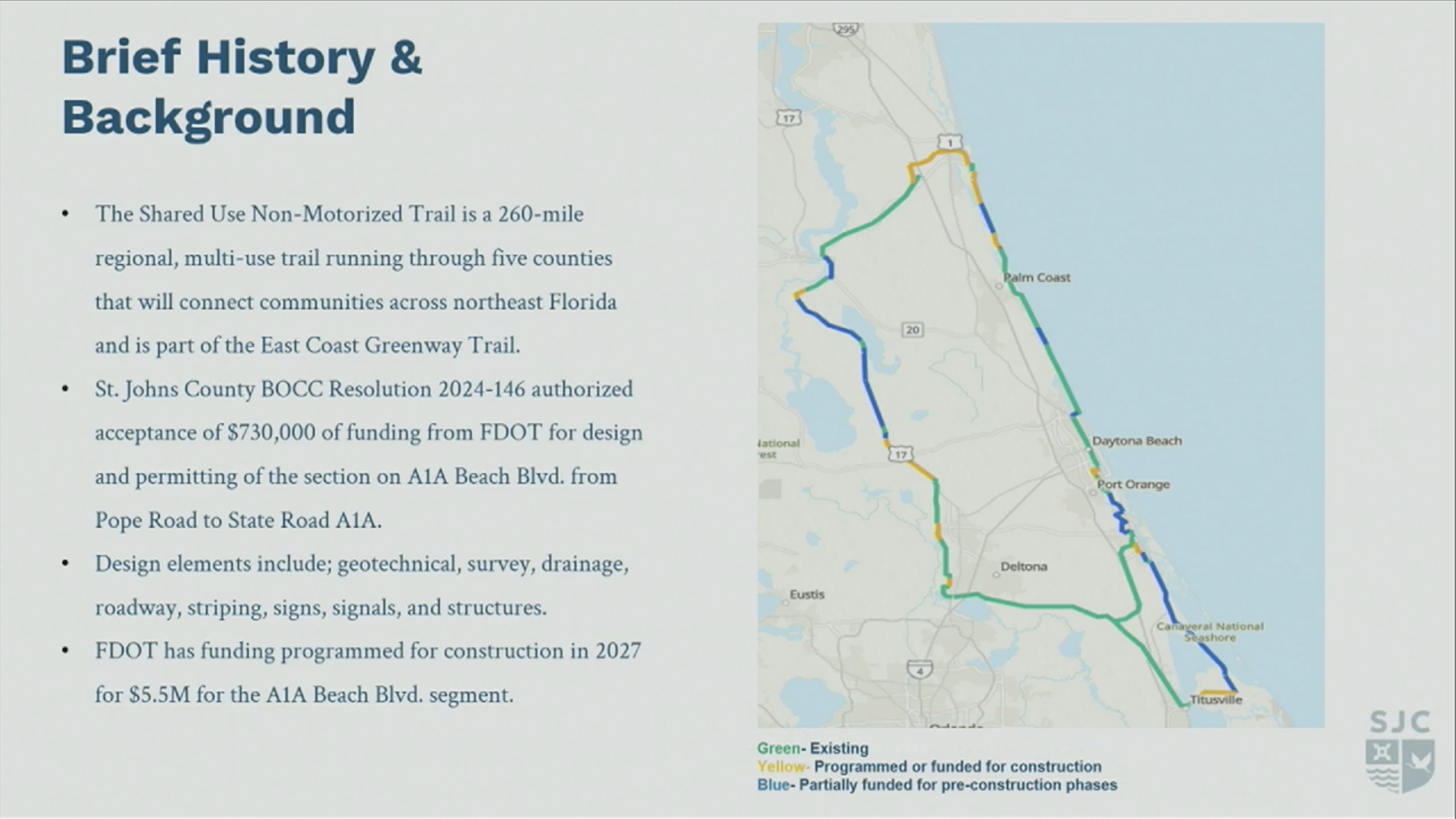
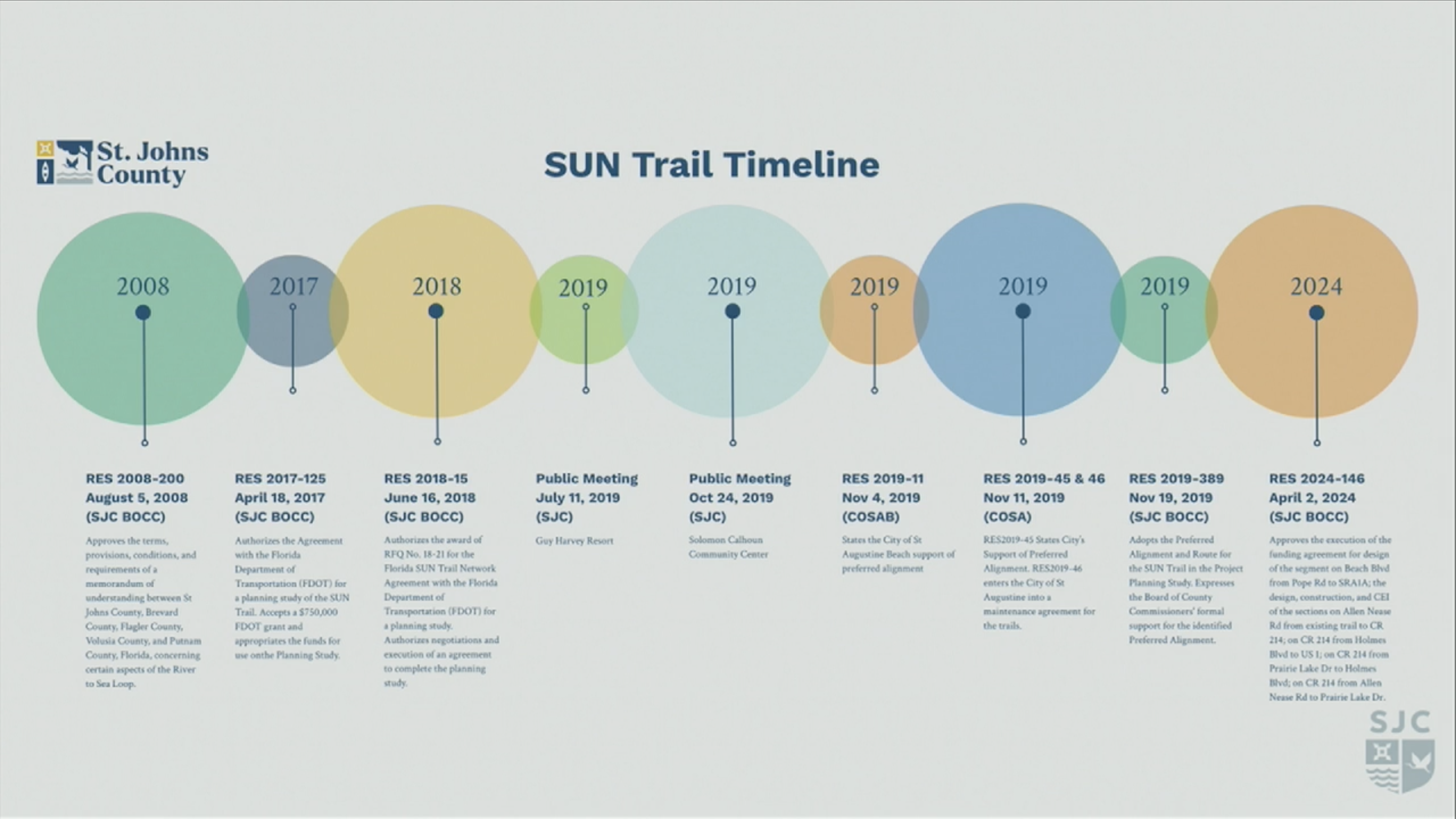
Agenda Item 9 – SUN Trail Network Presentation This was a presentation to help the current Board understand how we got to the current work on the SUN Trail. Important to note this project has beeh moving forward since 2008.

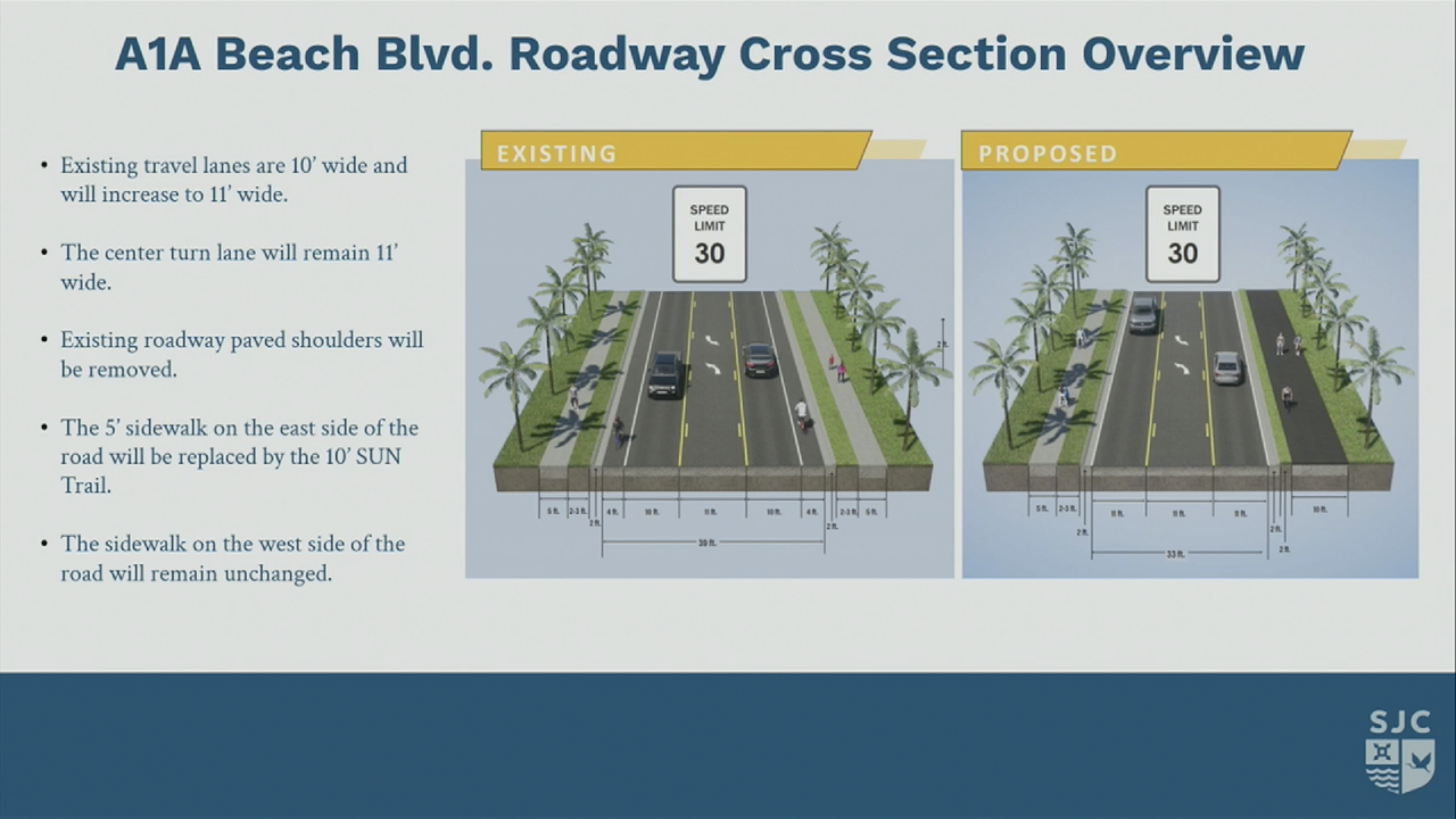
“Presentation to the Board concerning the SUN Trail, the Northeastern Florida regional loop trail represents a coordinated, multi-jurisdictional effort to create what is anticipated to be the longest multi-use loop trail in the Southeast, totaling approximately 260 miles upon completion. Within this broader system, nearly 40 miles will be in St. Johns County, including segments within the City of St. Augustine and the City of St. Augustine Beach, positioning the County as a critical link in the regional network. The loop integrates with major statewide and national trail systems, including the East Coast Greenway and the Coast to Coast Trail, enhancing both interstate and cross-state connectivity. This presentation will focus on the segment along Beach Blvd. from Pope Road to A1A, within the City of St. Augustine Beach.”

Watch the presentation here: SUN Trail Discussion


Commissioner Reports

During Commission Reports Commissioner Whitehurst reminded residents about the Memorial Day event at the St. Augustine National Cemetery. He also shared information about a presentation he and Commission Taylor attended a presentation on Data Centers and wanted to share that new data centers being built today are not using water for cooling, but a synthetic coolant.

Commission Taylor followed up with her appreciation for that presentation and the concern that data centers do require a tremendous amount of electricity.

Commissioner Murphy wanted to bring back a project that had been presented to the BOCC 2 weeks ago, and now that he has additional information would like to bring it back to the Board for consideration. After discussion and public comment, the project will be brought back before the board for action. This was approved 3-2 with Taylor and Joseph being the no votes.


If you are finding value in these updates, please subscribe to my blog so you get notifications when I publish an update. Feel free to share with others who may find value in the content.
Posted in BOCC, Politics, St. Johns County

St. Johns County and the 2026 Election Year

Updated to correct a missing website link!

It’s an election year! And we already have some very heated races in St. Johns County!


Having lived here 23 years, I know that for those of us who work in Jacksonville or travel a lot for our work, we often don’t even have time to pay attention to local elections.

Many of us have no idea who our Commissioners are or what they do for the County. Not too long ago a local business person told me he was reaching out to Mayor Deegan for help on something. I asked him why, and he said because she’s the Mayor! I pointed out his business is in St. Johns County and he might want to reach out to our County Commissioners. He didn’t know who any of them are.

That’s not a reflection on this individual – it’s just an example of how in the northern part of the county so many of us work, shop and play in Jacksonville that we naturally know more about the Jacksonville scene than what is happening in St. Johns County.

Today I thought I would spend a little time sharing information about the 2026 Election process in St. Johns County so you can start educating yourself and be prepared to get out and vote in the Primary (August 18,2026) or General Election (November 3, 2026.)


Let’s start with, are you registered to vote? And is your voter registration current? Check out the Supervisor of Elections website and confirm your status. You can do that here: Check My Status

And if you are a newcomer to St. Johns County or Florida, you may not be familiar with our Closed Primary process. If there are qualified candidates from more than one Party, it will be a closed Primary. That means when you go to the polls you will be presented with a Ballot showing only the candidates in your registered party. As an example, if you are a registered Republican, you will only see the Republican candidates on your ballot. If you are a registered Democrat, you will only see the Democratic candidates on your ballot. And if you are not affiliated with any party (No Party Affiliation) you will only see candidates for Non Partisan positions.


Before a candidate appears on a ballot, they have to go through Qualifying. You can see the Qualifying dates for St. Johns County positions on this page: Qualifying Dates & Fees

Most of our County offices have a Qualifying date of June 12. That means that any candidates currently showing on the Candidate List have not yet qualified to be on the Primary Ballot in August.


Today I’ll share known info about 2 of our most visible elected positions, County Commissioners.

We have two County Commissioner seats up for election this year, District 2 and District 4. Those seats are currently held by Sarah Arnold, District 2 and Krista Keating Joseph, District 4.

Commissioner Joseph has filed and shared about her desire to return to the Board for another term. Commissioner Arnold has not filed and all indications are that she is not going to run for re-election.

For District 2, we have 3 Active Candidates. That means they have filed but have not yet qualified.

Timothy Ray Burres is a former SJSO Law Enforcement Officer and is actively running. He has a registered website that is not yet active: VoteTimBurres and has an active FaceBook (FB) page: Vote Tim Burres for SJC Commissioenr

Wilson Malcolm McMullan is a lifelong Floridian actively running. He has an active website: Save St. Johns County.com and FB page: Will McMullan for County Commissioner

Martin Valerian Pyszczymuka is a 4 year resident of St. Johns County. He has an active website and indicates that he has gathered enough petitions to qualify for the ballot. His website is here: VoteMartin2026.com and his FB page is here: VoteMartinForCountyCommissioner Interesting note on his website is that he is opposing Sarah Arnold who has not filed to run. His website also addresses questions regarding residency eligibility and states that he plans to relocate into District 2 prior to the election.


District 4 has 4 Active Candidates. Again, they have filed but not yet qualified.

James Austin Galloway – At the time of writing, I was unable to locate an active campaign website. Mr. Galloway appears to be using his personal FB page for his platform: James Galloway

Krista Keating Joseph – Sitting District 4 Commissioner. Thanks to the alert reader who pointed me Commissioner Joseph’s active website: Vote Krista She also appears to be using her personal FB page for her campaigning. KristaKeatingJoseph

Heather Lane Neville – Born and raised in Northeast Florida and resident of St. Johns County since 2007.  Has an active website: VoteHeatherLaneNeville and FB Page ElectHeatherLaneNeville

Samuel Paul Willaims – Also a former SJSO Law Enforcement Officer with an active website: samforstjohns.com and FB page: Williams for St. Johns County Commissioner


As you evaluate candidates this year, I encourage you to spend time learning what each candidate stands FOR — their priorities, leadership style, and vision for the future of St. Johns County.

Local government decisions shape our roads, growth, schools, public safety, and quality of life in very real ways. Thoughtful participation matters.

In a climate where political conversations can quickly become negative, perhaps we can focus more on ideas, solutions, and the future we want to build for our County together.


If you are finding value in these updates, please subscribe to my blog so you get notifications when I publish an update. Feel free to share with others who may find value in the content.
Posted in BOCC, St. Johns County

Recap of Key Items from the May 5 St. Johns County Board of County Commissioner’s Meeting

I’ve been away for a break but back to providing updates on the St. Johns County Board of County Commissioner’s Meetings.

The County Public Relations staff has been doing an excellent job of publicizing the Commissioner’s Meetings and making them available not only through the County GTV but also broadcasting on social media.

It is so important, especially this year, an election year, to get your information about what is discussed directly from the meetings. I strive to always share with you the direct links to the information so you can watch and hear for yourself what was said. No filter, no bias. I’ll continue to do that throughout 2026.


The May 5 meeting opened with several Proclamations:

  • Recognizing George Ceccanese and William West for reaching their 100th birthdays!
  • National Correctional Officers and Employees Week 2026
  • 41 Years of Hope through St. Gerard Campus
  • Juror Appreciation Month
  • Foster Parent Appreciation Month

Watch the heartwarming recognitions here: Proclamations


Regular Agenda Items

Agenda Item #1 – Outpost at Old Moultrie Administrative Interpretation Appeal

This item has been trending high on social media for St. Augustine and the southern part of the County for a few weeks.

This is an “Appeal of Administrative Interpretation Letter ADMI 2026-01 regarding whether the subject parcel constitutes a lawfully developed or previously developed commercial site, whether mobile food vendors qualify as a permitted accessory use, and whether any specific provision of the Land Development Code requires a previously developed commercial site to undergo full redevelopment or site plan approval as a prerequisite.”

In short, the owner of the property had been operating a location with food trucks and current interpretation of the Land Development Code had caused the location to be shut down. A special magistrate was appointed to review the decision and ruled the county was correct to shut the location down. This morning’s hearing was to appeal the ruling.

Background Materials are here: Agenda Item 1

This was a complicated situation and emotions around the decision have been running high. While all the Commissioners expressed a desire to get the business back in operations, there were differences in how to best accomplish that goal.

Rather than rely on soundbites or social media interpretations of what happened at the meeting, I encourage you to listen to the discussion among the Commissioners before their vote at this link: Commissioner Discussion on Agenda Item 1

The Appeal was upheld and the ruling overturned by a 3:2 vote (Murphy, Joseph voting no)

Commissioner Whitehurst followed up with a motion for staff to work to update the LDC to not require paved parking spots for food trucks, not just at this parcel, but for any other similar uses. Commissioner Taylor asked if something could be added for temporary usage. Growth Management Director Roberson shared that there IS a provision for temporary usage that can be applied.

The motion was clarified that the staff is being asked to come up with wording that recognizes Food Trucks are separate from other Commercial structures.

That motion passed 5:0.

You can watch the entire presentation and discussion here:

Full Agenda Item 1 presentation and discussion


Regular Agenda Item 2 – Golfway Center PUD – this was a “Request for a Major Modification to the Golfway Centre PUD (Ordinance 1997-67, as amended) to revise the MDP Map and MDP Text to allow the remaining development to occur on the property as either Commercial Retail and Commercial Office uses; revise the phasing schedule to a single 10- year phase; add Church and Large Places of Assembly as allowable uses; allow details of future buildings and associated development to be shown on Incremental MDP Maps; and eliminate the requirement to preserve the isolated wetland on site.The Planning and Zoning Agency (PZA) heard this request at their regularly scheduled public hearing on April 2, 2026. The Agency recommended approval with a vote of 7-0. During the hearing, there were discussions regarding the traffic impacts to International Golf Parkway and impacts to the remaining wetlands located onsite.”

They requested 5 updates:

  • 221,032 sq ft of already approved Commercial Retail and Office uses to be located anywhere within the PUD.
  • Remove development acreage
  • Eliminate the requirement ot presereve the isolated wetland on site
  • Add Church and large Places of Assembly as allowable uses
  • Single 10 year Phase

After presentation and discussion at the Board, a motion was made to deny the request. That was approved 3-2, Whitehurst and Arnold voting no.


Regular Agenda Item 3 – Enclave at World Golf – “On August 5, 2025, the Board denied John Troy and Buffie Marie Hilberts’ request to rezone approximately 18.5 acres of land from Planned Unit Development (PUD) to Workforce Housing (WH). The property is located at 3740 Pacetti Road. The Hilberts filed a request for relief from the denial under the Florida Land Use and Environmental Dispute Resolution Act (“FLUEDRA”). FLUEDRA provides a means to potentially resolve disputes pre-suit through a special magistrate mediation and hearing process. The FLUEDRA special magistrate mediation occurred on October 29, 2025. During the mediation, the Hilberts presented a plan to reduce the number of units in their proposed development. The parties agreed that, contingent on Board approval, the Hilberts could proceed to a public hearing on their revised proposal. If the Board does not approve scheduling a new rezoning hearing, the parties will proceed to a public FLUEDRA special magistrate hearing regarding the August 2025 rezoning denial.”

The presentation and vote can be found here: Agenda Item 2

This was not a rezoning request but a consideration of whether to schedule it for a rezoning hearing or allow it to continue to a FLUEDRA hearing. No action was taken by the Board so it will continue to a public FLUEDRA hearing.


Regular Agenda Item 4 – Appointment the Affordable Housing Advisory Committee (AHAC) – Tom Turner was appointed to the AHAC with a unanimous vote


Commissioner’s Reports

Commissioner Arnold brought forth complaints being raised aboutstreet parking in Silverleaf and impacton school bus drop-offs. She requested and received consensus for staff to meet with SJSO and the School District to come up with solutions.

Commissioner Joseph recognized the loss of a long time employee at the Ponte Vedra Inn & Lodge, Sidey Austin. He was a part of the community and his loss is felt. She also brought up concerns about Home Rule. She referenced comments from Commissioner Whitehurst at a previous meeting and asked to form a task force to push back on home rule. As part of establishing the task force, she suggested firing the Lobbying firm, The Florida Group, because she felt they have not done enough to bring these type of bills to the attention of the Commissioners. She indicated that the lobbying group not providing information is probably a breach of contract. She also feels that there is a conflict of interest because the lobbying firm also represents clients who support items that the Commission is opposed to. After discussion, Administrator Andrews indicated that staff can and will look at the contract and advise if there are any items that would be considered a breach of contract.

You can watch Commissioner Joseph’s comments and the following discussion here: Commissioner Joseph Concerns about Lobbying Firm

Commissioner Whitehurst had no Report

Commissioner Taylor brought forward concerns about Data centers and the amount of water and electricity they can take. She asked that staff draft an ordinance to eliminate Data Centers from businesses that could qualify for economic incentives, tax exemptions or abatements. And additionally, she would like to have the LDC amended to limit zoning categories where these could be located. Commissioners Whitehurst and Murphy indicated they would like more information before such a vote. Commissioner Whitehurst asked for consensus for a presentation from staff on pros and cons of data centers. Consensus was achieved.

Commissioner Murphy had no report.


Administrator Report – Administrator Andrews shared information about the upcoming budget sessions beginning May 11. You can watch the Budget sessions on-line here: https://www.sjcfl.us/watch-govtv-live/


Attorney’s Report

Only item was to discuss who will be on the Canvassing Board this year. That will be Commissioners Murphy and Whitehurst.


If you are finding value in these updates, please subscribe to my blog so you get notifications when I publish an update. Feel free to share with others who may find value in the content.