This is the first in a series explaining Amendment 3 – it is not advocating for or against the Amendment – just explaining the various components in the Amendment and what they would mean for St. Johns County.
Let’s dive in.
During Florida’s 2026 regular legislative session, lawmakers considered seven different proposals to reduce or eliminate portions of property taxes. None reached the ballot during the regular session.
On May 27, Governor Ron DeSantis announced a new “Save Our Homes” proposal and called the Legislature into a special session. The proposed constitutional amendment was filed June 1, revised during the legislative process and approved by both chambers June 2.
The original proposal applied the expanded exemption to school taxes as well as non-school taxes and created a path for the exemption eventually to reach a home’s full assessed value. During the Senate committee process, lawmakers removed school district taxes from the expanded exemption. The final ballot version applies the new $150,000 and $250,000 exemptions only to non-school property taxes. School taxes would remain subject to the existing $25,000 homestead exemption.
The final version of the Amendment does NOT match the savings calculator published on the Save our Homes website Save Our Homes FL
This is important. You and I may have been some of the many residents who went to that website to see what our savings would be. And it generates a higher number than we would see under the final version of Amendment 3
Why?
The State of Florida’s Save Our Homes calculator does not calculate savings solely under the final version of Amendment 3. Its own disclaimer says that it estimates what homeowners would have saved if the broader Save Our Homes proposal had applied to their 2025 tax bills. Because the original proposal included school taxes and the final amendment does not, the calculator may show greater savings than a homeowner would receive under the version appearing on the ballot.
What’s in the Amendment
For many voters, the first numbers they see may be the only ones they remember: a $150,000 exemption in 2027 and a $250,000 exemption in 2028. Who wouldn’t want a larger property tax exemption?
But those numbers are only the beginning of Amendment 3. The proposal also changes how local tax dollars may be used, gives the Legislature a much larger role in defining local government responsibilities, and creates a process for potentially expanding the exemption even further. Those provisions may be less eye-catching, but their long-term effects could be much more significant.
That is why this series will examine Amendment 3 in smaller pieces: what it would do to an individual tax bill, what it could mean for county services and nonprofit organizations, and how it would shift authority over local budgets from local elected officials to Tallahassee.
Here’s the language of the Amendment that will appear on your ballot:
INCREASED HOMESTEAD EXEMPTION; LOWER CAP ON INCREASES IN NONHOMESTEAD PROPERTY ASSESSMENTS
This amendment increases the homestead exemption, for all non-school taxes, to $150,000 in 2027 and $250,000 in 2028, and adjusts for inflation thereafter. It requires the Legislature to prescribe a uniform procedure for counties and municipalities, for their respective levies, to increase the homestead exemption up to full assessed value, and allows special districts, subject to referendum approval, to do the same. Persons who are not Florida residents on December 31, 2026, will receive the existing homestead exemption upon qualifying for a homestead exemption, with the increased homestead exemption beginning with the fifth year of exemption, to the extent permitted by the U.S. Constitution.
This amendment reduces the annual cap on assessment increases for non-homestead properties from 10% to 5%. This amendment requires counties and municipalities to use property taxes solely for public safety, education and schools, infrastructure, natural resources, bond debt service, retirement benefits for employees, and operations and administration. Other expenditures may be approved by county officers or county or municipal governing bodies unless prohibited by general law, notwithstanding Article VII, Section 9(a) of the Florida Constitution, which allows counties and municipalities to levy property taxes for their respective purposes. This amendment takes effect January 1, 2027.
St. Johns County has created a webpage explaining the proposed Property Tax Amendment 3 that will appear on Florida’s November 3 ballot. Check that out here: St. Johns County Amendment 3 Info
They held a Town Hall on Tuesday, September 29. If you missed it, check out the video here: SJC Town Hall – Amendment 3
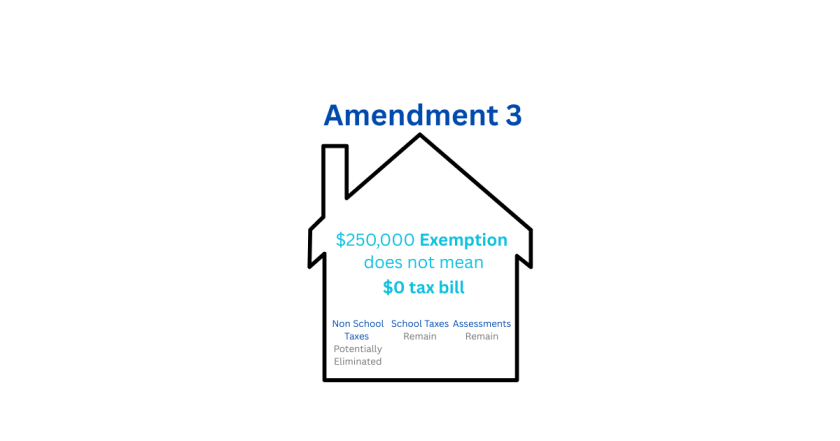
One of the easiest misunderstandings is that a home assessed below $250,000 would no longer have a property tax bill if the amendment passes.
That is not correct.
What the Amendment Would Change
If approved by at least 60% of voters statewide, Amendment 3 would increase the homestead exemption applied to non-school property taxes:
- Up to $150,000 beginning January 1, 2027
- Up to $250,000 beginning January 1, 2028
- Annual inflation adjustments beginning in 2029
The expanded exemption would not apply to school district property taxes. The standard homestead exemption for school taxes would remain $25,000.
The amendment would also reduce the annual assessment increase allowed on most non-homestead property from 10% to 5%. It would require people establishing Florida residency on or after January 1, 2027, to wait until their 5th year of residency before receiving the expanded homestead exemption.
What a $200,000 Property Bill Could Look Like
Consider a hypothetical homesteaded property with an assessed value of $200,000. After the $250,000 non-school exemption is fully implemented, that property could have no remaining taxable value for the affected non-school taxes.
But $175,000 would still be subject to school taxes after the standard $25,000 school exemption. Using 2025 St. Johns County millage rates only as an illustration, the school taxes would be approximately $1,098.
Non-ad valorem assessments would also remain. These are charges placed on the tax bill but not calculated from taxable value. They may include solid-waste charges, community development district assessments and other property-specific assessments.
Using actual charges from one St. Johns County tax bill as an illustration, the remaining non-ad valorem assessments include solid-waste disposal, collection and recycling charges, along with a CDD assessment.
| Illustrative 2028 Bill on a $200,000 Assessed Value | Amount |
| Non-school property taxes | $0 |
| School property taxes | $1,098 |
| Illustrative solid-waste assessments | $334 |
| Total without a CDD assessment | $1,432 |
| Illustrative CDD assessment, if applicable | $1,486 |
| Total with the illustrative CDD assessment | $2,918 |
The CDD amount would vary by CDD entity, and many properties in the county have no CDD assessment. The point is that even when the affected non-school property tax falls to zero, the total bill does not.
“The first $250,000 is exempt” means exempt from certain non-school property taxes. It does not mean a zero-property tax bill.
In the next article, we will look at who receives the tax benefit and who does not.
If you are finding value in these updates, please subscribe to my blog so you get notifications when I publish an update. Feel free to share with others who may find value in the content.